
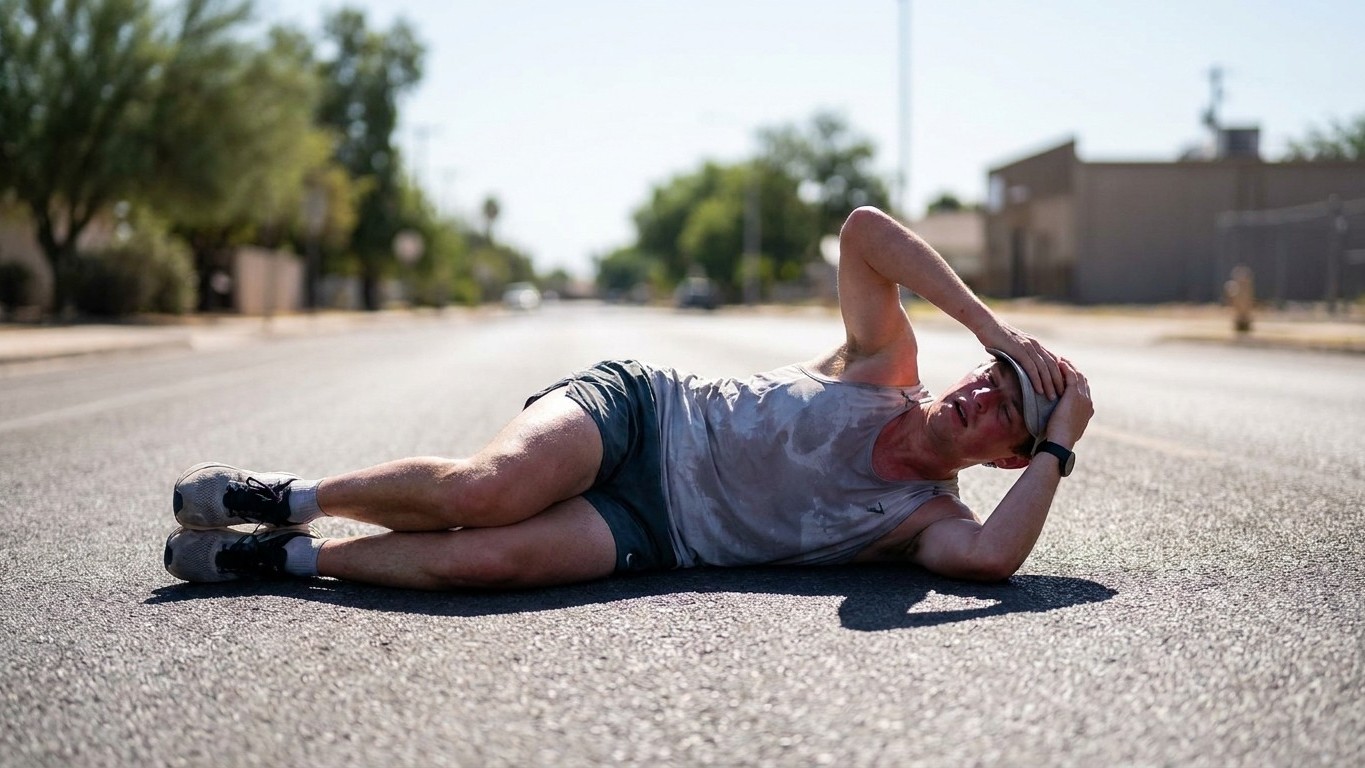
The body gives fair warning. Long before you collapse, it sends dizziness, a racing pulse, a headache that creeps in at the temples, and sweat that eventually, and dangerously, stops. Most of us, in the grip of a training mentality that equates discomfort with progress, interpret these signals as proof we’re pushing hard enough. That logic works indoors, on a treadmill, in air conditioning. Outside at noon in July, it can send you to the ground.
This is the story of what actually happens when your body overheats during exercise, and what the science says you should do instead, starting today.
Key takeaways
- The body sends clear warning signals hours before collapse—but athletes mistake them for signs of progress
- Midday sun can add 20+ degrees to actual air temperature, creating a ‘thermal attack from two directions’
- Simple scheduling changes and gradual heat acclimatation can prevent heat exhaustion entirely
What Your Body Is Fighting Against at Noon
Across most of the United States, the hottest period of the day typically falls between 10 a.m. and 6 p.m. During these hours, the body absorbs heat from the surrounding air. Also, from direct sunlight. That dual exposure is the part most people underestimate. You’re not just dealing with a hot day, you’re dealing with a thermal attack from two directions at once.
“That midday sun can add as much as 20 degrees or more to the actual air temperature,” notes one sports science expert. “You really have to be careful about that.” Add your own metabolic heat production from running or cycling, and the numbers start to become alarming very quickly.
During high-intensity exercise in extreme temperatures, “the ambient heat is added to the large amount of metabolic heat already produced by the muscles.” To prevent a dangerous rise in body temperature, the body activates heat-dissipation mechanisms: sweating, followed by evaporation, and increased blood flow to the skin. The problem? When conditions are extremely demanding, high ambient temperatures, humidity, or prolonged exertion, these mechanisms may become insufficient. The internal temperature then rises above safe levels, a condition known as hyperthermia, which compromises the central nervous system.
Humidity compounds this exponentially. Humidity plays a large role: in high humidity, your body can’t use sweat to cool itself, robbing it of one of the most important ways of getting rid of extra heat. That explains why a 90°F day in Atlanta feels catastrophically different from the same temperature in Phoenix.
The Symptoms That Come Before the Fall
Here’s the counter-intuitive part, the one that took me too long to understand: heat exhaustion doesn’t announce itself dramatically. It doesn’t always hit like a wave. Often, it builds gradually, making it easy to ignore until your body can no longer cope. That’s precisely what makes noon training so deceptive, you feel fine, then you feel a little off, then you’re on the pavement.
Symptoms include heavy sweating, headache, dizziness, nausea, and fast heart rate. The classic warning sequence goes like this: you start sweating heavily, then you notice muscle cramps, then the dizziness arrives. Heat cramps are often the first sign of heat illness, presenting as painful muscle cramps or spasms in the arms, legs, or stomach, accompanied by extreme sweating. Most people push through the cramps. That’s the mistake.
When you have heat exhaustion, your body has trouble cooling itself down. Your core body temperature typically rises, but it’s generally below 104°F, unlike in heat stroke, where your temperature spikes higher. That threshold matters enormously. Ignoring warning symptoms can lead to heatstroke, which is far more dangerous and can result in organ failure or death. The gap between “I feel dizzy” and “I need emergency care” is shorter than most athletes believe.
“You’ll see young kids, super healthy, running on dark tracks, getting really hot, not drinking, collapsing,” notes one emergency medicine expert. “Then, you have a second problem, where the ground gets so hot you can actually get burns to your skin just from lying on that pavement for a very short period of time.” Fitness level offers no real protection. Youth offers no real protection. The physiology is indifferent to your PR.
What the Science Actually Recommends
Everyone who exercises, even high-level athletes in prime condition, should have a plan to prevent heat-related illness. “Your body is built to cool itself while you exercise. But when you exercise in warmer temperatures, your body has to work harder to do that,” says Sarah Eby, MD, PhD, a sports medicine specialist at Mass General Brigham.
The single most effective fix is also the simplest: change when you go out. Avoid outdoor exercise between the hours of 11 a.m. and 3 p.m., which is considered the hottest part of the day. Limit high-intensity workouts to early morning or early evening hours when the sun’s radiation is minimal, as activity during the hottest parts of the day will increase heat gain through the skin from the sun and decrease heat loss through the skin.
Second, if you want to eventually train in heat, say, you’re preparing for a summer race or an event in a hot city — the process has a name, and it requires patience. Healthcare providers call this acclimatizing. It means you slowly work up to more intense physical activity in the heat over a period of at least a couple of weeks, starting with short sessions and gradually increasing the duration and intensity. With heat acclimation comes an increase in total blood volume, so blood flow to your muscles and skin is improved, making it easier for the body to cool itself and resulting in lower heart rate and body temperatures at any given exertion.
Hydration, obviously. But the specifics matter more than the general advice. The American College of Sports Medicine recommends drinking plenty of fluids, wearing the right clothes, and exercising at the right time of day. You need to drink water, sports drinks, or fruit juices before, during, and after exercise, generally drinking according to your thirst, no more and no less. Because salt depletion can play a role in heat-related illness, consider an electrolyte-rich sports drink when it’s very hot and humid.
If It Happens Anyway
Knowing what to do in the moment can be the difference between recovery and catastrophe. The priority is fast cooling, not rest. Get to a cooler environment as soon as you can, shed excess layers, and sip water slowly unless nauseous, then stop drinking. If you have extra water, putting some on your skin can help you cool down faster. Cold compresses to the neck, armpits, and groin, areas with high blood flow, accelerate the process considerably.
The instinct is to tough it out and keep moving. Resist it. “When you’re planning to exercise, especially when outdoor temperatures start to warm up, you need to start low, start slow, and ease into activity. Keep an eye on your body and how it’s doing, and don’t push it too much.”
One detail that doesn’t get enough attention: sunburn itself makes everything worse. Getting burned increases your risk for heat illness. Damaged skin is less efficient at regulating temperature, meaning that skipping sunscreen before a noon run is actively compounding the danger, not just a cosmetic oversight. Spending 30 minutes in the sun at 1 p.m. can be far more damaging than two hours at 5 p.m., because UV intensity is much higher during peak hours. Two risks stacking on each other, quietly, while you think you’re just getting a good workout in.
Sources : ncbi.nlm.nih.gov | news.northeastern.edu