
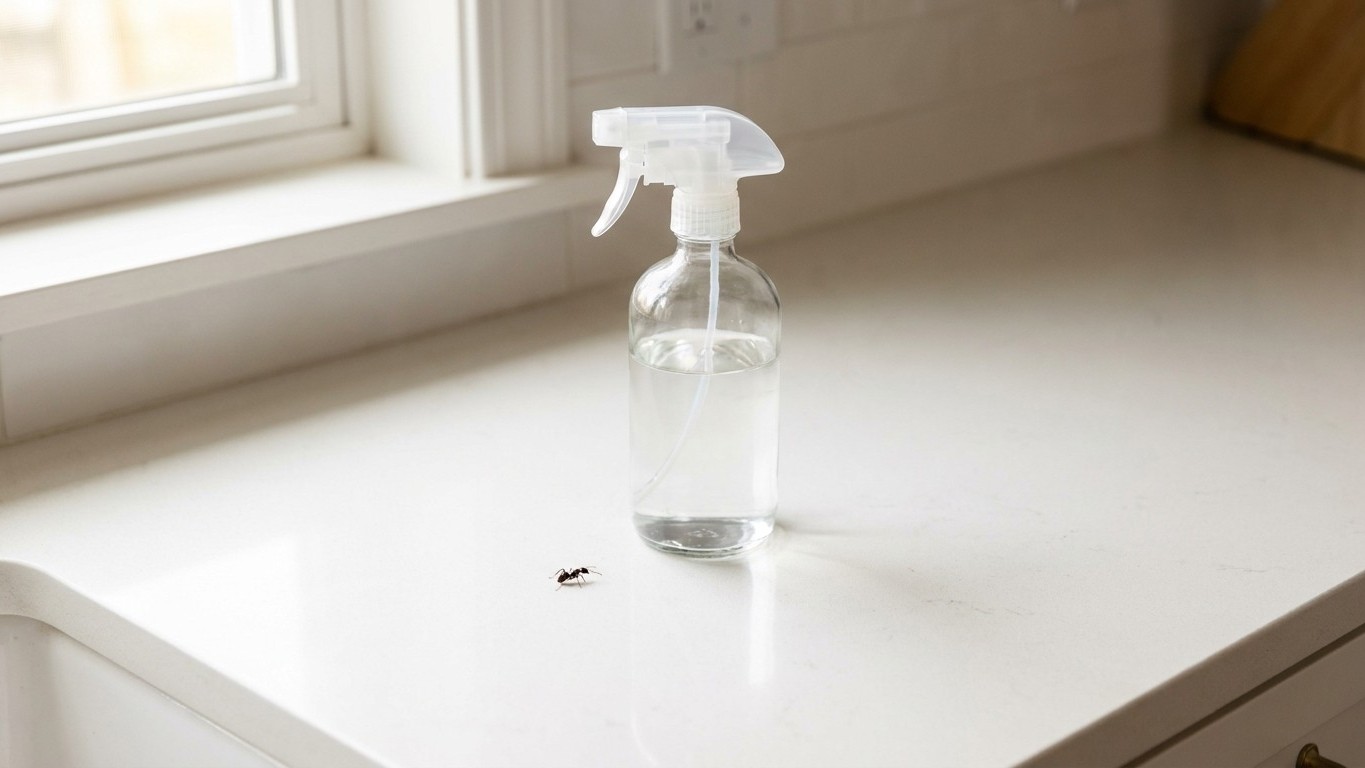
That line of ants marching across the counter didn’t vanish because vinegar poisoned them. It disappeared because a simple 1:1 mix of white vinegar and water erased the chemical map they were following. When sprayed along ant trails, the acetic acid destroys the pheromone markers ants leave behind to guide other colony members, leaving them disoriented and unable to navigate efficiently. No poison, no pest-control spray with a skull on the label. Just an ingredient already sitting in the pantry.
Franchement, this is one of those cleaning hacks that sounds too simple to be real, and yet the mechanism behind it is genuinely elegant once you understand how ants actually communicate.
Key takeaways
- Ants navigate using invisible pheromone trails, and vinegar doesn’t just mask them—it structurally destroys these chemical markers
- The silence after vinegar treatment might be temporary: colonies can re-establish broken trails within 24 hours by finding new routes
- Vinegar disrupts scout paths but doesn’t kill the queen or solve the root infestation—it’s a surface-level solution with real limits
The invisible roadmap you just wiped away
Ants don’t scout randomly. When an ant finds food, it lays a scent trail on its return to the colony, which guides other ants to the food source. That trail is invisible to us but perfectly legible to every ant that crosses it, a kind of chemical breadcrumb path built from pheromones. Wipe that path with vinegar, and the message gets scrambled instantly.
The intense smell of the vinegar solution effectively neutralizes or masks the pheromone trails, Destroying the ants’ navigational system and leaving worker ants disoriented, unable to follow the established route. It’s not that they’re being chased away by fear of the smell alone (though they do dislike it). It’s that the very language they use to talk to each other gets deleted mid-sentence.
There’s a second layer to this too, and it’s the part most people miss. This mild acid is the perfect weapon against ant trails: acid breaks down and dissolves the lipid-based pheromones completely, so vinegar does not just mask the scent, it structurally destroys the chemical markers the ants left behind. That’s the difference between covering up a smell and actually breaking down the molecule responsible for it. Which explains why a plain wipe-down, something you were doing anyway to clean the counter, ended up solving a problem you weren’t even trying to fix.
Here’s the catch nobody tells you in the comment section
Now for the contrarian part, the bit that tends to get left out of every triumphant “vinegar cured my ant problem” story online. Vinegar is remarkably good at disrupting a trail. It is not, on its own, a colony killer.
Vinegar is most useful as a trail-disruption and cleaning tool, not as a colony-killing treatment, and killing the ants you see does not solve the infestation, since most ants inside a home are foragers. The queen, tucked away in a nest somewhere in a wall cavity or under a slab outside, never touches your countertop. She doesn’t care that the scouts lost their way for an afternoon.
And here’s the nuance that really upends the tidy narrative: the silence might not last. Pheromone trail disruption is temporary in a frustrating, precise way, since the colony can re-establish a broken trail within 24 hours as the queen sends out fresh scouts, who simply find a new route around the treated area, which is exactly why so many people see ants “move” rather than disappear after vinegar treatment. So if the line vanished overnight and hasn’t returned, that’s either a small, disorganized scouting party that gave up entirely, or you got lucky with timing. Either way, don’t be shocked if a fresh trail shows up a few inches to the left three weeks from now.
There’s also a scent detail worth knowing before you reach for whatever bottle is under the sink. When people say vinegar for ants, they mean white vinegar, not apple cider vinegar, because apple cider vinegar will work to clear chemical trails but it’s not as effective or harsh-smelling, and may actually attract ants due to its slightly sweet nature. That sweetness is a dealbreaker. You’re essentially advertising a snack bar to the very insects you’re trying to evict.
Making the erasure stick
The technique itself barely qualifies as a technique. The most common and effective solution for general use is a simple 1:1 mixture of white vinegar and water, a dilution strong enough to mask pheromones while remaining safe for use on most surfaces, poured into a spray bottle for easy and targeted application. The trick isn’t the ratio, it’s the follow-through: don’t just mist and walk away.
When addressing a known ant trail, spray the entire length of the path and the entry point thoroughly to ensure the pheromone trail is completely neutralized, then the area can be wiped clean, removing both the ants’ chemical signals and any food residue that might have attracted them. That last part matters as much as the vinegar itself. A crumb of jam or a sticky ring from a coffee cup is its own invitation, no pheromone required.
For anyone tempted to get creative with the formula, resist the urge to “boost” it with baking soda. Mixing an acid and a base produces sodium acetate, water, and carbon dioxide gas, the acid is completely neutralized, and you’re left with salt water that has zero pesticidal or repellent effect. Pure kitchen mythology, that one. And under absolutely no circumstance combine vinegar with bleach: this combination produces chlorine gas, a toxic, potentially lethal compound.
If the trail keeps reappearing week after week despite regular wiping, that’s less a vinegar failure and more a signal. For best results, vinegar works as part of a larger ant-control plan that also includes sanitation, sealing entry points, and removing food and moisture sources. The nest is still there. The counter was just where it happened to show up first.
Sources : pestsource.com | pestagent.ca