
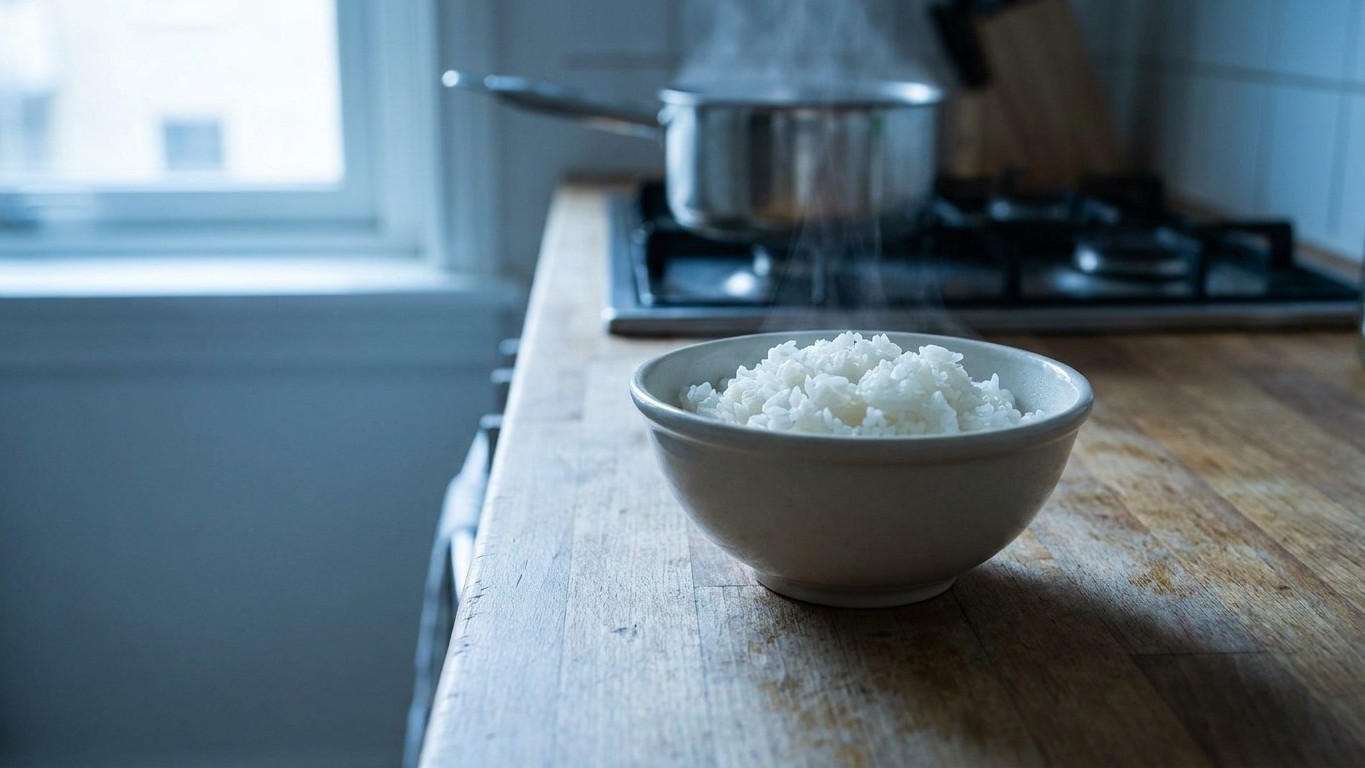
That bowl of rice sitting on the counter after dinner isn’t just cooling down. It’s often becoming a breeding ground for a bacterium that produces a toxin no amount of stir-frying, microwaving, or boiling will ever undo.
The culprit has a name most home cooks have never heard: Bacillus cereus. It lives in soil, on grains, practically everywhere, and it survives the very process meant to kill it. Bacillus cereus is a spore-forming bacterium found naturally in soil and on the surface of grains including rice, and when you cook rice, the heat kills the active bacteria, but the spores survive boiling. They’re built like tiny survival capsules, dormant, waiting. And once the rice starts cooling on the stove or the counter, those capsules wake up.
Key takeaways
- A common bacterium in rice produces a toxin that survives temperatures your stove can’t reach
- Reheating rice—even in a smoking wok—does absolutely nothing to neutralize what’s already formed
- Most cases are mild, but rare complications have caused acute liver failure and hospitalization
The bacterium that laughs at your stovetop
Once the rice cools to room temperature, those spores germinate back into active bacteria and begin multiplying rapidly. As they multiply, they don’t just sit there quietly. As B. cereus multiplies in warm cooked rice, it produces two types of toxins. One causes diarrhea. The other, cereulide, causes violent vomiting, and it’s the one that should really worry you.
Here’s the part that surprises almost everyone: cereulide doesn’t degrade with heat the way normal food toxins do. The emetic toxin cereulide is heat stable up to 250°F (121°C). A CDC report on a 1994 fried rice outbreak put it plainly, describing a toxin that is highly stable and survives high temperatures and exposure to trypsin, pepsin, and pH extremes. Your stomach acid won’t touch it either.
Compare that to the diarrheal toxin, which is comparatively fragile. Enterotoxin is heat-labile and can be inactivated by heating at 55 °C for 5 min. Cereulide plays by different rules entirely. Frying leftover rice at scorching wok temperatures, the classic move behind what’s nicknamed “fried rice syndrome”, does nothing to neutralize it. Leftover fried rice is a primary culprit because after the rice is cooked, it is often left at room temperature for more than two hours to cool before frying it with other ingredients, and cooling the rice ensures that the finished fried rice won’t get clumpy, but reheating it doesn’t get rid of the toxins the bacteria have already produced.
When “it’s just an upset stomach” turns into something worse
Most cases really are mild. The CDC reports that B. cereus accounts for approximately 63,000 cases of foodborne illness in the United States each year, though many cases go unreported because symptoms are often mild. Vomiting usually kicks in fast, symptoms of emetic reheated rice syndrome typically begin within 30 minutes to 6 hours, and it tends to resolve within a day.
But not always. The cases that make headlines involve something far more serious than a rough afternoon. A 2019 report described how a college student died after reportedly eating spaghetti he’d cooked, left out of the fridge for five days, then reheated and ate. Researchers documenting fried rice ball poisonings found something similarly alarming: severe intoxications with the emetic Bacillus cereus toxin cereulide, which is resistant to heat and acid during cooking, can cause acute liver failure and encephalopathy. Five otherwise healthy adults in that case series ended up hospitalized, one with kidney damage. Rare, yes. But rare isn’t the same as impossible, and that’s exactly why this deserves more attention than it gets.
The one-hour window nobody respects
The fix isn’t complicated, but it does require breaking a habit most kitchens have had for decades: letting the pot sit “just until it stops steaming.” That window is precisely where the trouble starts. The core of the rice remains in the danger zone (15°C to 50°C) for several hours, providing the perfect incubator for Bacillus cereus to produce the emetic toxin.
Food safety specialists generally point to a narrow margin for action. The 2-hour rule says to cool cooked rice to below 4°C within 2 hours of cooking, though the FDA Food Code recommends this as the outer limit while many food safety specialists suggest aiming for 1 hour to be conservative. Skip straight from stovetop to fridge, but skip the giant pot too. Break a big portion up into smaller storage containers before refrigerating, don’t put a hot, covered pot of rice in the fridge that will trap heat and take a long time to cool, and after storing rice in smaller containers, put it right in the fridge; you don’t need to wait for it to cool down first. That last point contradicts what most of us were taught by our mothers, who insisted on letting things cool “naturally” before refrigerating. Turns out that instinct, however well-meaning, is exactly backwards.
Reheating still matters, just not the way people assume. It won’t erase a toxin that’s already formed, but it does stop things from getting worse. While reheating cannot destroy the emetic toxin, it will kill the vegetative cells, and all starch products should be reheated to a core temperature of at least 75°C. Some food safety guides go further, suggesting rice should really only make one trip back to the microwave. The “one-time” rule holds that cooked rice or pasta should only ever be reheated once, with any leftovers after the second heating discarded to prevent cumulative toxin buildup.
Rice isn’t the lone offender, either. Cooked rice is a good home for Bacillus cereus, especially when left out to be refried in another dish, but the bacteria can grow on many kinds of foods, including other starches like pasta and potatoes. And it isn’t even the most common repeat offender at your holiday table. Clostridium perfringens grows on gravy and meats, produces toxins resistant to cooking and reheating, and is responsible for about 15 times the number of foodborne illnesses as Bacillus cereus, especially around the holidays.
One detail that rarely makes it into the warnings: dry, uncooked rice sitting in your pantry isn’t the problem at all. White rice stored properly in a sealed container is essentially shelf-stable for four to five years and doesn’t go bad in any meaningful food safety sense, though quality does slowly decline as the grain dries further. The danger has nothing to do with the grain itself and Everything to do with what happens in that first hour after it leaves the pot, sitting on the counter, looking perfectly, deceptively fine.
Sources : ncbi.nlm.nih.gov | academic.oup.com