
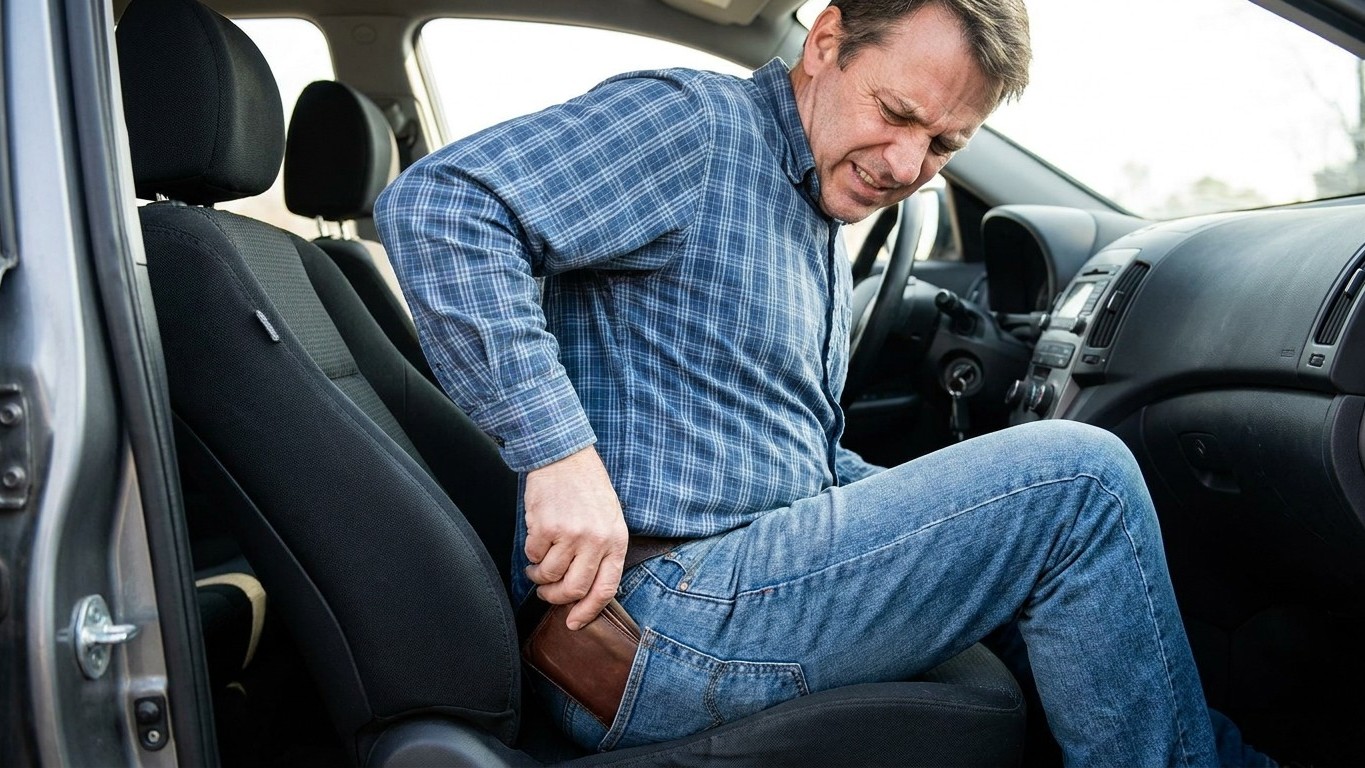
For fifteen years, my father kept a wallet so thick it looked like a small brick shoved into his back pocket, and every family car ride I remember him sitting slightly cocked to one side, like a man perpetually listening for something behind him. I used to tease him about it constantly. Then his doctor asked him a single question during a routine physical, and the joke stopped being funny.
The question was simple: did his lower back pain get worse after long drives, and did it radiate down one leg? It did. What followed was a diagnosis my father had never heard of, one that sounds almost too mundane to be medical: fat wallet syndrome, sometimes called wallet neuritis or, more bluntly, wallet sciatica.
Key takeaways
- A thick back-pocket wallet can compress your sciatic nerve and cause mysterious lower back pain that radiates down your leg
- This condition has been documented by doctors since 1966, but most people don’t realize their wallet is the culprit
- The fix is surprisingly simple—but it’s not just about moving your wallet to the front pocket
What a Bulky Wallet Actually Does to Your Spine
The mechanism is more elegant, and more absurd, than most people assume. Keeping a wallet in your back pocket can cause spinal alignment problems that cause back pain, because when a person sits on a bulky wallet, their pelvis and spine tilt and rotate to the side. That tilt isn’t a one-time inconvenience. Over time, this stress on the spine can lead to problems like piriformis syndrome, a condition also known as “fat wallet syndrome,” which can cause painful nerve problems like sciatica.
The piriformis itself is an unglamorous little muscle most people have never thought about. It lies inside the hip and gluteal area, beginning at the sacrum and running to the top of the thigh, where it helps rotate the hips outward. The sciatic nerve, the longest and thickest nerve in the human body, runs directly beneath or through it in most people. Squeeze that muscle against a hard rectangular object for eight hours a day, five days a week, for years, and something eventually gives. The sciatic nerve runs from the lower spine through the buttock and down the back of each leg, and the piriformis sits right on top of it; compress that area against a hard wedge long enough and the nerve can become irritated, sending signals that feel like burning, tingling, or numbness down the leg.
My father’s symptoms matched almost exactly. The typical patient with piriformis syndrome complains of “sciatica,” sharp, severe, radiating pain from the lower back or buttock down the back of the leg and into the thigh, calf, and foot. What made his case tricky, and what makes this condition tricky for anyone, is that it hides behind more common diagnoses. Symptoms may seem to be due to hip bursitis or disc herniation, but the doctor’s examination helps sort out the true cause because with piriformis syndrome the person also has difficulty sitting or putting weight on the buttock on one side, especially with prolonged sitting while carrying a thick wallet in a pocket directly behind the piriformis muscle.
Not a New Complaint, Just a Newly Named One
Here’s the part that genuinely surprised me: this isn’t some TikTok-era wellness theory. Doctors have been writing about it since men started carrying credit cards. This condition is sometimes called “wallet sciatica,” first described in the Journal of the American Medical Association in 1978. An even earlier reference traces the complaint to the New England Journal of Medicine in 1966, back when the phenomenon was linked to the rise of the credit card itself, thick stacks of plastic replacing the slim leather billfolds of the previous generation.
The terminology has multiplied ever since, which tells you something about how often clinicians encounter it. Synonyms used frequently for the condition include deep gluteal syndrome, extra-spinal sciatica, and wallet neuritis. Researchers have gone back and forth on whether these terms describe the exact same thing. It would not be wise to use piriformis syndrome and wallet neuritis interchangeably, as many published papers have done, since one is a subset of the other. That distinction matters clinically, but for the average person sitting lopsided in a Honda Civic, it’s mostly academic.
What’s harder to pin down is how common the condition actually is, largely because there’s no test for it. In many cases the cause cannot be identified, and the diagnosis is clinical, meaning it’s based on symptoms and physical examination rather than any specific blood test, biopsy, or imaging test. Harvard Health has gone as far as calling it “the most common cause of sciatic-type back pain you’ve never heard of,” while noting that no one is entirely sure how frequently it occurs. Interestingly, it also seems to be more common among women, though the reason for this is not known, which complicates the old stereotype of it being strictly a “man with a fat wallet” problem.
What Actually Fixes It (and What Doesn’t)
My father’s doctor didn’t prescribe anything exotic. He prescribed a smaller wallet and a new habit. The first, most obvious fix is removing the wedge entirely. Switching to a wallet designed for the front pocket avoids the mechanical spine problems that come from misaligning your spine with a back-pocket wallet. But there’s a nuance most people miss here, and it tripped my father up initially: you shouldn’t wear a back-pocket wallet in the front pocket, since its shape can cause a misalignment between the front of your thigh and your torso, leading to different pain. The wallet itself needs to change shape, not just its location.
For anyone unsure whether their own wallet is the culprit, there’s a genuinely useful, low-tech gut check some clinics recommend: look at the bulge. If your wallet shows a bulge through the pocket, it’s thick enough to tilt you. If you’re already sitting on one, the simplest immediate fix costs nothing. If you want to keep your wallet, just take it out of your back pocket when you are sitting. Beyond that, physical therapists tend to recommend targeted movement rather than passive rest. Stretching exercises for the thighs, legs, and buttocks can help relieve sciatica from piriformis syndrome and return the muscles to proper alignment, alongside strengthening exercises for the hip abductors, external rotators, and extensors.
What struck me most, going back through my father’s old wallet years later (he’d kept it, of all things, in a drawer), wasn’t the thickness. It was the contents: expired insurance cards, a decade-old grocery receipt, a photo he’d forgotten he was carrying. He hadn’t been sitting on a wallet so much as sitting on an archive. Turns out the doctor’s real advice wasn’t just “move it to the front pocket.” It was “throw half of it away.”
Sources : gentcreate.com | firststatehealth.com