
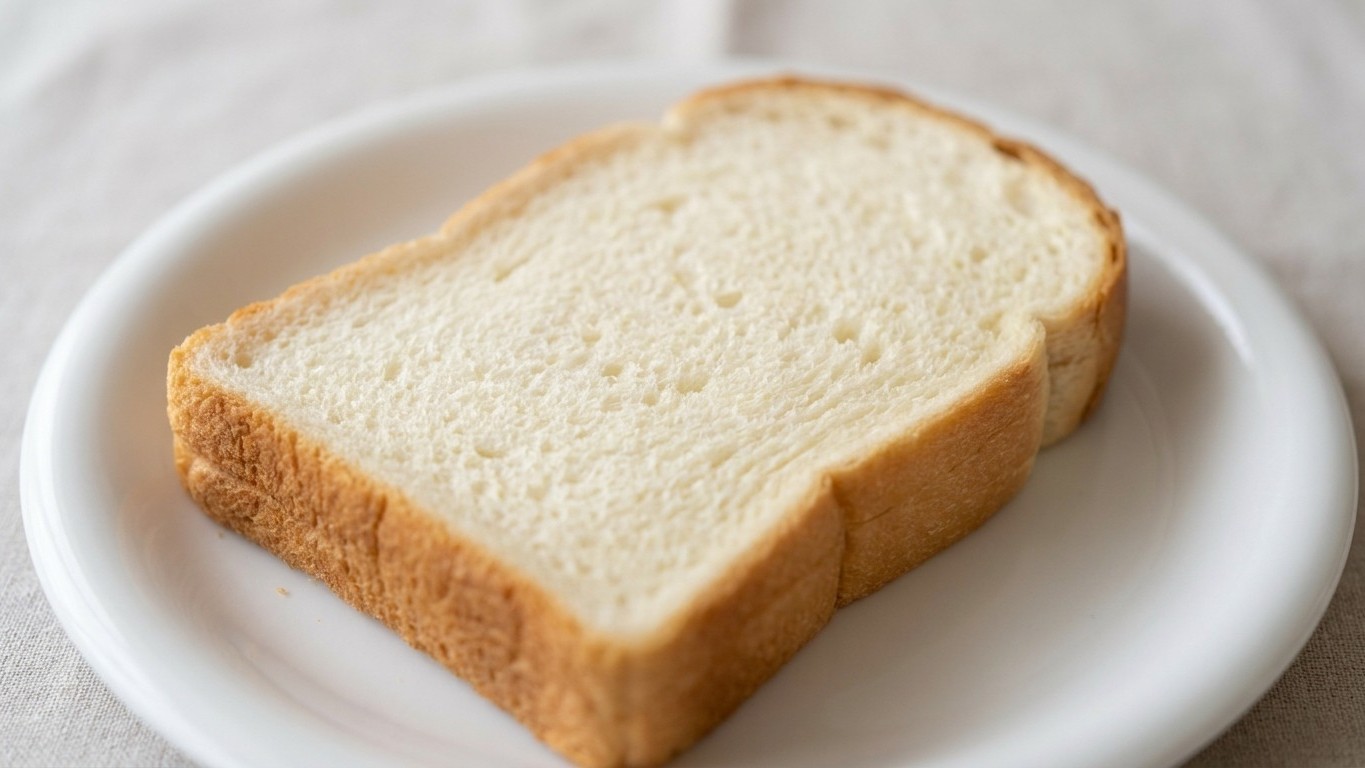
A single slice of soft white sandwich bread can push blood glucose higher, faster, than a spoonful of white table sugar. It sounds like a nutrition myth, but it’s backed by decades of glycemic index research, and it’s the kind of detail that upends how most people think about “healthy” carbs.
Sugar has a reputation problem. Bread, meanwhole, gets a free pass because it doesn’t taste sweet and it’s sold in the “wholesome” aisle next to flour and butter. The chemistry tells a different story entirely.
Key takeaways
- White bread has a glycemic index of 75—higher than table sugar’s 63
- The reason: starch is pure glucose chains; sugar is half glucose, half fructose
- Not all bread is equal: sourdough and dense whole grains behave very differently
The number that surprises everyone
The glycemic index measures how quickly a food raises blood glucose compared to a reference standard, and white bread has long served as that very benchmark. The GI of a food or beverage is determined by the rise in blood glucose levels during the two-hour period following its ingestion versus the blood glucose response to an equivalent amount of carbohydrate in a standard food such as white bread, which serves as a reference point with a GI of 100.
On the more commonly used glucose scale (where pure glucose equals 100), white bread still lands remarkably high. Traditional white bread typically has a high GI of 75, while 100% whole wheat bread averages around 59, making it a more stable choice for metabolic health. Some clinical measurements push even higher: one study found the GI value of white bread was measured at 77 before any intervention.
Table sugar, the stuff in the bowl on your kitchen counter, actually scores lower on that same scale. Two teaspoons of table sugar (sucrose) has a glycemic index rating of 63. That’s a meaningful gap. Comfortably below the 70-75 territory where white bread sits, and squarely in the “moderate” zone rather than the “high” one.
Franchement, that’s the kind of detail that makes you side-eye your morning toast. The Harvard Health guide, one of the most cited references on the topic, puts it bluntly when discussing refined carbohydrates: a serving of white rice has almost the same effect as eating pure table sugar, a quick, high spike in blood sugar. White bread, chemically speaking, plays in the same league.
Why starch outpaces sugar in your bloodstream
The explanation comes down to molecular structure, not sweetness. Sucrose, or table sugar, is a disaccharide, meaning each molecule is built from one unit of glucose bonded to one unit of fructose. Carbohydrates composed of one or two simple sugars like fructose or sucrose were labeled simple, while starchy foods were labeled complex because starch is composed of long chains of the simple sugar, glucose.
Here’s the catch: fructose doesn’t spike blood glucose the way glucose does. It gets metabolized differently, largely by the liver, and barely registers on a glucose meter. So when sucrose breaks apart during digestion, only half of it (the glucose half) shows up as a blood sugar spike. The fructose half essentially sits out of the equation, at least as far as your glucometer is concerned.
White bread doesn’t get that buffer. Refined wheat flour is almost pure starch, a long chain of glucose molecules with the bran and germ (and their fiber) stripped away during milling. Generally speaking, anything made from white flour will have a high GI rating due to its lack of fiber content, meaning it breaks down quickly. Every glucose unit in that chain gets liberated by digestive enzymes and dumped into the bloodstream almost simultaneously. There’s no fructose detour, no fiber roadblock. Just a fast, uninterrupted flood of glucose.
The result. A steeper, faster spike than sugar itself produces, even though bread doesn’t taste remotely sweet.
Not every bread behaves the same way
This is where the story gets more nuanced, and honestly, more useful. GI isn’t a fixed property of “bread” as a category, it swings wildly depending on how the loaf is made. Bread GI ranges from 41 for pumpernickel to 95 for French baguette, with grain density, fermentation, and how finely the flour is milled being the biggest factors.
Density Matters More Than most shoppers realize. A loaf that feels heavy for its size, thanks to intact grain fragments and a tighter crumb, digests slower because enzymes have less surface area to attack. Long fermentation (as in true sourdough) also seems to soften the glucose response, likely through changes to the starch structure and the organic acids produced during proofing.
Whole wheat isn’t the automatic fix people assume it to be, either. Standard whole wheat bread, with a GI around 69, is only marginally better than white bread at around 75. The marketing gap between “white” and “wheat” is far wider than the metabolic one.
What actually moves the needle is what sits on the plate alongside the bread. A slice of sourdough with avocado and a poached egg is a fundamentally different glycemic experience than a slice of bread with jam, because the protein and fat slow gastric emptying and reduce the overall glucose response by 25-40%. Toast eaten alone, straight out of the toaster, is close to the worst-case scenario for a fast glucose swing.
None of this means sugar deserves a rehabilitation tour, or that bread should be treated as a health food. But the next time a bakery counter feels like the “safe” choice compared to the pastry case, remember that the innocuous white loaf might be doing more to your blood sugar curve than the thing it’s sitting next to.
Sources : quora.com | ncbi.nlm.nih.gov