
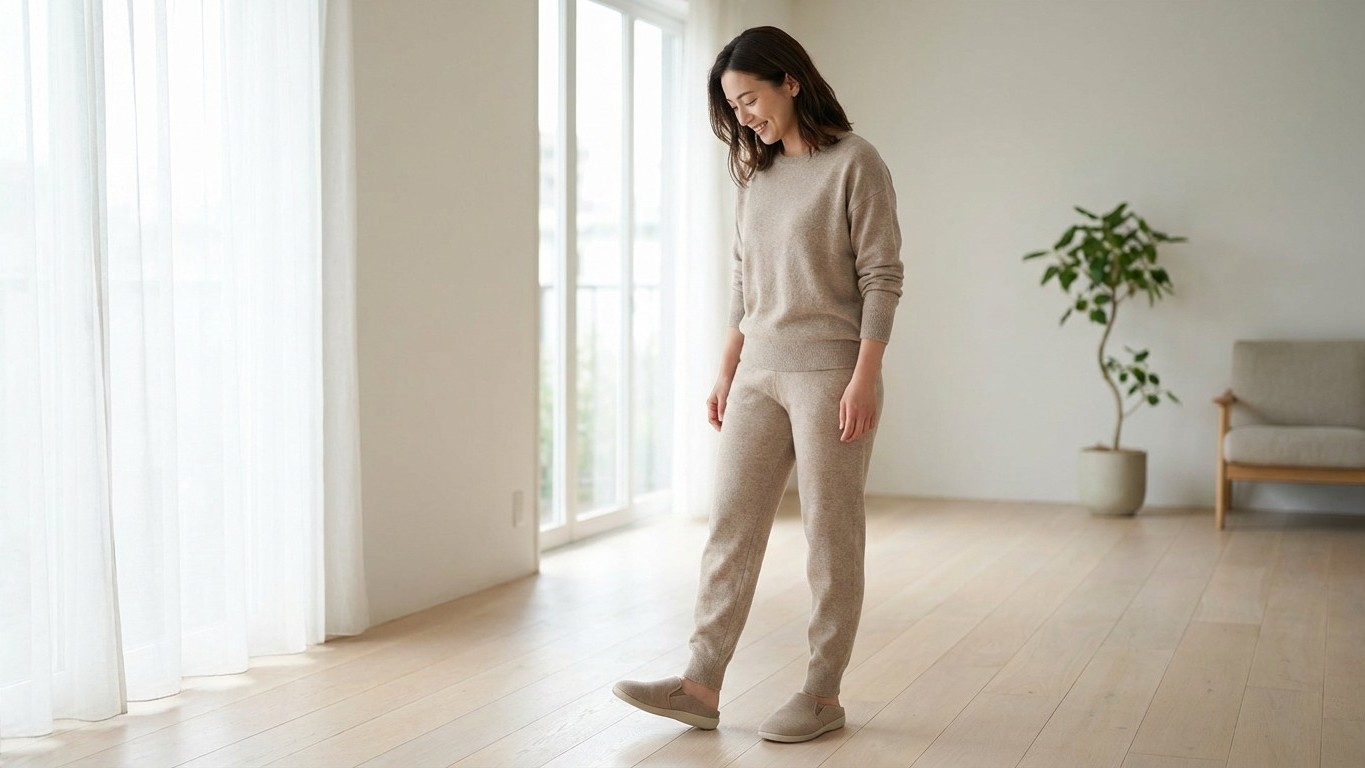
The moment I kicked off my shoes at the front door and padded around in socks, I thought I was doing something good for myself. Cozy. Relaxed. A small act of self-care after a long day. Then my podiatrist looked at me during a routine appointment, tilted her head slightly, and said: “Actually, that might be part of the problem.”
Turns out, the Barefoot-at-home habit, one that millions of Americans have adopted, especially since 2020 when home became everything — is considerably more complicated than it feels. And the conversation that followed genuinely shifted how I think about my floors, my feet, and what counts as “taking care of yourself.”
Key takeaways
- Your kitchen floor isn’t the same as natural terrain—hard surfaces offer zero shock absorption
- Prolonged barefoot time on unyielding surfaces stretches your plantar fascia like holding your arm out for eight hours straight
- The fix isn’t minimalist—it’s surprisingly practical and rooted in centuries of household wisdom
The barefoot myth we all bought into
There’s a deeply appealing narrative around going Barefoot: it feels natural, grounding, connected to something primal. The wellness world has amplified this for years, pointing to indigenous populations who walk unshod their entire lives with enviable foot mechanics. And yes, there’s real science behind the idea that restrictive footwear can weaken intrinsic foot muscles over time. The counter-intuitive part, the thing my podiatrist had to spell out for me, is that “barefoot in nature” and “barefoot on hardwood floors” are not the same experience at all.
Natural terrain is forgiving. It absorbs impact, shifts under your weight, and subtly activates dozens of small stabilizing muscles with every step. Your kitchen floor does none of that. Hard, flat surfaces like tile, hardwood, and polished concrete offer zero shock absorption. Walking on them Without support, hour after hour, puts sustained pressure on the plantar fascia, the thick band of tissue connecting your heel to your toes. Over time, that can translate into heel pain, arch strain, and that specific kind of morning soreness where your first steps feel like walking on broken glass. Plantar fasciitis affects roughly two million Americans annually, and podiatrists increasingly point to prolonged barefoot time on hard indoor surfaces as a contributing factor.
What actually happens to your feet at home
My podiatrist explained it with an analogy I haven’t been able to forget. She said to imagine holding your arm straight out in front of you for eight hours. Your muscles aren’t doing anything complicated, they’re just holding a static position. By hour two, they’re fatigued. By hour eight, you’ve created a stress problem. Your plantar fascia works the same way when it’s stretched flat against an unyielding surface with no arch support, all day long.
The issue isn’t just the fascia, either. Knees and lower back compensation patterns often trace back to foot mechanics. When the arch collapses, even slightly, even temporarily, the kinetic chain above it adjusts. Which is why some people who’ve never had “foot problems” end up with mysterious knee aches or persistent lumbar tension they can’t explain. They’re not connecting it to their floors. They should be.
Socks, for the record, are not a solution. They offer no arch support and add the bonus hazard of reduced traction on smooth surfaces. If anything, they give you the sensory illusion of being protected while providing none of the structural benefit.
The case for dedicated indoor shoes (and what to actually look for)
This is where I expected my podiatrist to hand me a brochure for something clinical and beige. She didn’t. Her recommendation was more nuanced: a lightweight, supportive indoor shoe, something with a firm midsole, a modest arch, and a non-compressive toe box. Not a slipper. Not a rubber-soled sock. An actual shoe designed for the kind of low-impact but prolonged activity that is simply moving around your home.
The global market caught on to this. The category often called “house shoes” or “indoor footwear” has expanded considerably over the past several years, with brands ranging from orthopedic specialists to fashion-forward labels developing dedicated lines. The criteria worth prioritizing: good arch support, a heel cup that holds your foot in alignment, and a sole firm enough that you can’t fold the shoe in half. If it bends easily in your hand, it won’t do much for your foot.
What you don’t need: excessive cushioning that compresses completely under weight (that’s just a soft surface, not support), zero-drop soles if you’re already dealing with any heel or fascia sensitivity, or anything with a backless design that forces your foot to grip. The gripping motion, that subtle toe-curling that comes with mules and backless slippers — creates its own tension pattern over time.
The cultural shift worth paying attention to
In Japan and across much of East and Southeast Asia, the separation between outdoor and indoor footwear has been a household standard for generations. It was never about aesthetics alone, there’s an embedded logic about clean zones, about the body’s transition from public space to private refuge. Western homes are slowly arriving at this same conclusion, though often through the back door of a wellness trend rather than cultural inheritance.
Some interior designers have started incorporating dedicated entryway storage specifically for the indoor-outdoor shoe swap, built-in benches, recessed cubbies, hooks that make the transition feel intentional rather than inconvenient. The ritual itself may be part of the point. That moment of changing shoes signals something to the nervous system: you’re home, you can decompress. Except now, the decompression comes with arch support.
My feet feel different after three months of making this change. Less tight in the mornings. Fewer of those vague mid-afternoon aches I’d normalized so thoroughly I’d Stopped noticing them. I genuinely didn’t expect something this small to matter this much.
Which makes me wonder what else we’re doing every day, in the name of comfort, that’s quietly working against us.