
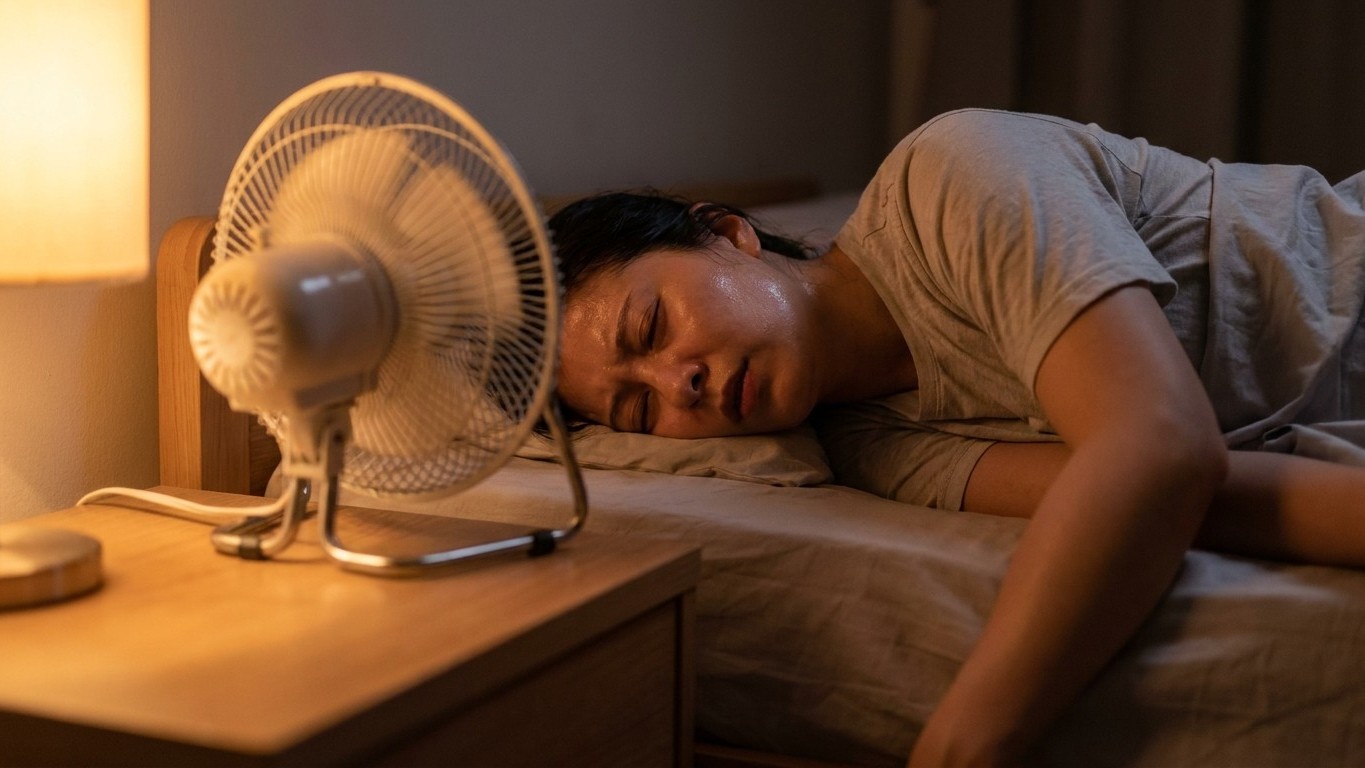
Ninety-six degrees at midnight, fan on full blast, and still I woke up at 4 a.m. with a headache pounding behind my eyes and my mouth dry as chalk. Three nights of this during last week’s heatwave, and each morning felt worse than the one before. Turns out there’s a reason, and it’s backed by actual health guidance: electric fans stop helping, and can start hurting, once the air around you climbs past 95°F.
The World Health Organization’s guidance on heat and health notes that fans may not prevent heat-related illness once air temperature exceeds the mid-90s Fahrenheit, and can even accelerate heat gain in certain conditions. That single line rearranged Everything I thought I knew about surviving a heatwave.
Key takeaways
- A fan above 95°F acts like a convection oven, pushing hot air onto your skin instead of cooling it
- Your brain’s false sense of cooling makes you drink less water and ignore heat warning signs
- Direct skin cooling methods—wet cloths, cold showers, strategic ventilation—outperform fans in extreme heat
Why a Fan Turns Against You Past 95°F
A fan doesn’t cool the air. It moves it. Below body temperature, that moving air pulls heat off your skin and speeds up the evaporation of sweat, which is genuinely cooling. Simple physics, and it works beautifully on a regular 85-degree summer night.
Push past 95°F, though, and the air being circulated is now hotter than your skin. At that point a fan behaves less like relief and more like a convection oven set to low. You’re not being cooled anymore, you’re being basted in warm air, and the effect compounds if the room lacks any cross-ventilation to actually exchange that hot air for something cooler.
The humidity piece matters just as much, maybe more. Sweat only cools you when it evaporates. In a room where humidity sits above 60%, a fan just pushes around damp, saturated air that can’t absorb any more moisture from your skin. You sweat, the sweat sits there, and the fan simply redistributes the heat instead of removing it. That combination, high heat plus high humidity plus constant airflow, is exactly the scenario public health agencies flag as risky for dehydration and heat Exhaustion, particularly for older adults and anyone with cardiovascular conditions.
The Body Doesn’t Register “Windy” as “Cool”
Here’s the part that surprised me most. Feeling a breeze tricks your brain into thinking you’re cooler than you actually are, so you don’t drink water as often, you don’t seek shade, you don’t take the situational cues your body would normally give you. Researchers studying heatwave mortality have pointed to this exact mechanism, sometimes called the “false sense of cooling,” as a contributing factor in fan-related heat illness among elderly populations during extreme heat events in Europe and the U.S. Midwest.
My own version of that: I skipped my usual bedside glass of water three nights running because the fan noise and breeze made the room feel tolerable, even as my body temperature was quietly climbing. Waking up with a headache and stiff joints wasn’t random. It was mild dehydration, compounded night after night, because the airflow masked the actual heat load I was under.
What Actually Works When It’s This Hot
Cooling your skin directly does more than moving air ever will above 95°F. A cool (not ice-cold) shower before bed drops your core temperature for a couple of hours. Wetting a washcloth and draping it over your neck or wrists, where blood vessels sit close to the surface, cools your blood as it circulates. Freezing a water bottle and holding it against your palms works surprisingly fast too, a trick used in some hospital protocols for managing heat exhaustion.
Positioning Matters More Than most people assume. A fan aimed directly at damp skin, right after that shower, still helps because it speeds evaporation of the water rather than sweat, and water evaporates faster and cools more efficiently. The distinction is subtle but real: fan plus moisture equals cooling, fan alone in dry heat equals nothing, fan in humid heat equals actively worse.
Timing your ventilation also changes the equation entirely. Opening windows during the two or three hottest hours just invites more hot air in. Cracking them open before dawn, when outdoor temperatures often dip 15 to 20 degrees below the daytime peak, and then sealing the room with blinds drawn once the sun is up, keeps trapped cool air working for you through the afternoon. I started doing this on night four of the heatwave and slept without waking once.
Reading Your Own Body’s Signals
Persistent headache, dry mouth, dizziness on standing, and unusually dark urine in the morning are the body’s early flags for heat-related dehydration, according to guidance from the CDC’s heat and health program. I had three of the four and dismissed them as “just a bad night’s sleep” for far too long, because the fan noise made the room feel manageable.
Older adults and people managing heart or kidney conditions face higher stakes here, since their bodies regulate temperature less efficiently to begin with, and a false sense of cooling can delay the moment someone realizes they need water, shade, or air conditioning. Checking in on elderly neighbors during a heatwave isn’t just neighborly instinct. It’s a genuinely protective habit, especially for anyone relying on a fan alone.
One thing I didn’t expect to learn: portable fans placed directly over a shallow tray of ice water can drop the effective room temperature by several degrees through basic evaporative cooling, essentially a homemade swamp cooler. It’s not glamorous, and the tray needs refilling every couple of hours, but on night five it was the difference between another rough wake-up and finally, mercifully, sleeping straight through.