
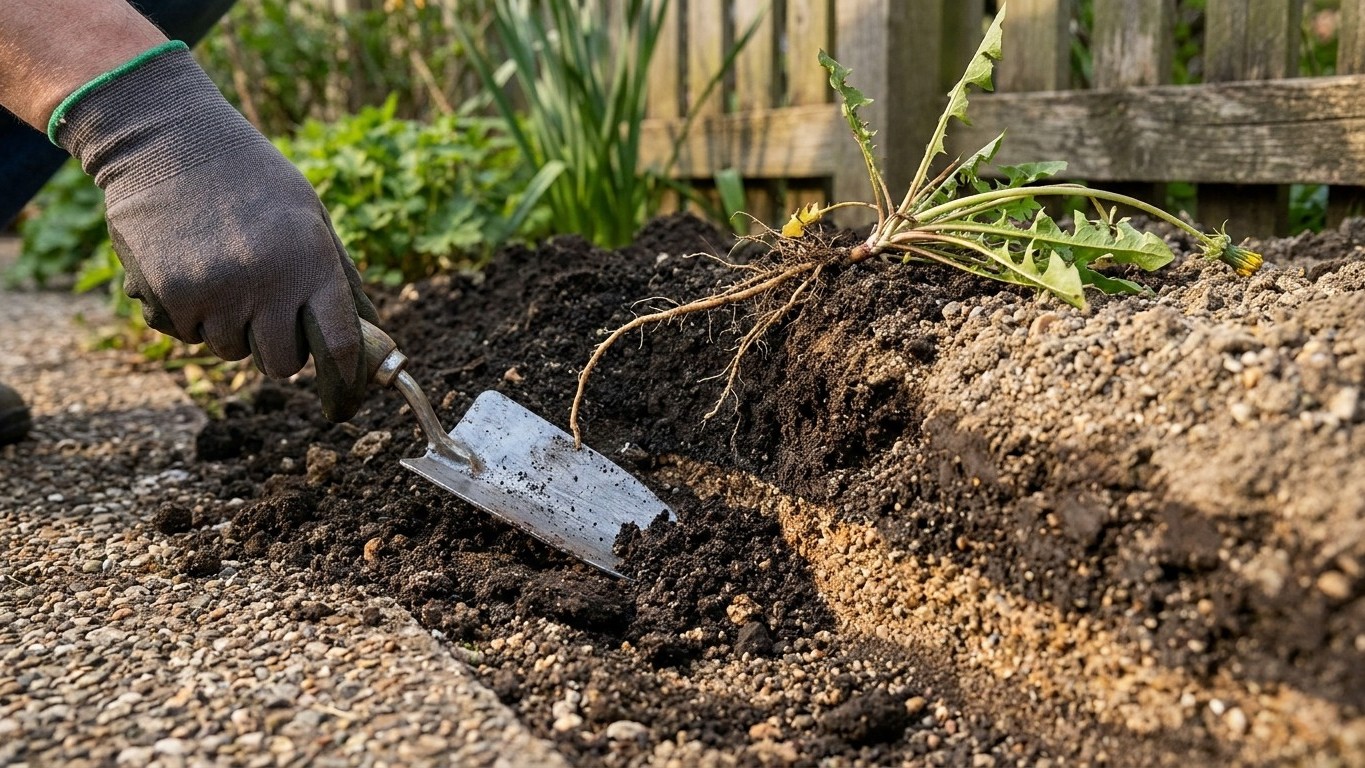
Acetic acid does exactly what the label promises: it burns the leaves it touches. What most gravel-path owners don’t realize is that a heavy, repeated pour doesn’t stop at the foliage. It travels straight down into the base layer, past the stones, into whatever thin ribbon of living soil sits beneath the gravel bedding, and that’s where the real damage happens.
A gravel path looks inert. It isn’t. Beneath the stones there’s usually a compacted layer of sand, grit and soil that hosts a surprisingly active little ecosystem: fungal threads, bacteria, the occasional earthworm tunneling through in search of moisture. Pour a full-strength bottle of white vinegar on top every week for a month, and you’re not just discouraging dandelions. You’re running a chemistry experiment on that hidden layer, and the results aren’t pretty when you finally dig down to check.
Key takeaways
- Weekly vinegar treatments acidify hidden soil layers, disrupting the bacteria and fungi that make soil fertile
- Earthworm populations plummeted 30% in acid-treated soils, eliminating crucial aeration and nutrient cycling
- The weeds you thought you killed probably survived with intact root systems, ready to regrow within weeks
What’s actually happening under the stones
Household white vinegar sits at roughly 5% acetic acid, which sounds mild until you realize it’s still acidic enough to reshape soil chemistry with sustained use. Acetic acid lowers soil pH, and a single application in a spot where weeds are growing isn’t likely to cause lasting damage. The problem starts with repetition, which is exactly what most people do once they see the first satisfying wilt.
Repeated applications in the same area can push pH down far enough to disrupt the microbial activity that keeps soil healthy. The beneficial bacteria and fungi that break down organic matter and support plant roots are sensitive to soil pH shifts, and once that balance tips, the soil essentially stops doing its job. Nutrient cycling slows down. Organic matter stops breaking down efficiently. A soil that’s been repeatedly dosed with acid isn’t a great environment for growing anything intentional afterward.
The concentrated horticultural version of the product, sold at 20 to 30% acetic acid for serious weed control, makes the point even more starkly. Applying 20 percent acetic acid as a soil drench can lower soil pH for at least a month. Even the household stuff, poured over and over, mimics a diluted version of that same assault, just spread across four weeks instead of one afternoon.
The creatures nobody thinks about
Here’s the detail that tends to surprise people most: it’s not really the weeds that suffer long-term, it’s Everything living underneath them. Earthworms, in particular, take a direct hit. A study in Environmental Toxicology and Chemistry noted a 30% reduction in earthworm populations in soils treated with 20% acetic acid. That’s not a marginal dip. That’s nearly a third of the soil’s aeration and composting workforce gone, in an area no bigger than a garden path.
Dig a spade’s width into a heavily treated section a month later and the contrast with untreated soil nearby is often visible to the naked eye: fewer worm castings, a drier, more compacted texture, less of that faint, earthy smell that healthy dirt usually carries. These beneficial microbes are responsible for breaking down organic matter and making nutrients available to plants, and when the pH drops too low, these microbes die off, and the soil becomes lazy. “Lazy soil” is a strangely gentle way to describe what’s essentially a temporary dead zone, but it captures the mood of what you find when you dig.
The weeds you were trying to kill probably survived anyway
This is the part that stings most. All that soil damage, and the actual target often bounces back within weeks. Vinegar is a contact herbicide, which means it destroys whatever it physically touches and nothing else. Acetic acid acts as a contact herbicide, meaning it impacts only the parts of the plant it touches, rupturing plant cells and causing fluids to leak and plant tissues to dry out, but it does not translocate or move within the plant to the roots or other plant parts.
Translation: the top of a young weed dies in a satisfying, almost theatrical way, browning within hours on a sunny day. The root system, sitting safely below the acid’s reach, often doesn’t even notice. For tough, perennial weeds with long tap roots, the acid only kills off the above-ground portion of the plant, and often the plant will grow back unless that tap root is removed too. Dandelions, thistle, plantain, the usual gravel-path suspects, all fall into that category. So the frustrating cycle repeats: spray, wilt, regrowth, spray again, and each round quietly acidifies the layer underneath a little further.
There’s a genuinely counterintuitive point buried in the research here. Taproots will eventually starve once soil pH is lowered enough, but before dying they will often have one last flush of growth from nutrients stored in the roots, which means a weed that looks like it’s recovering might actually be in its final gasp, not a comeback. It’s easy to mistake that flush for failure and reach for the bottle again, which is exactly how a one-time treatment turns into a monthlong soil-acidifying habit.
What actually makes sense for a gravel path
None of this means vinegar deserves to be banned from the shed. Used sparingly and aimed precisely, it remains a reasonable, low-toxicity option for hardscape. Using vinegar to clear a patio crack or a gravel path is genuinely low-stakes, because nothing’s supposed to grow there anyway. The mistake isn’t the ingredient, it’s the volume and the frequency, plus the assumption that gravel somehow seals off the soil beneath it from whatever gets poured on top.
The fix is almost embarrassingly simple: spray the foliage directly on a hot, dry day rather than drenching the ground, skip the daily reapplications, and give the area a break between treatments. Acetic acid is both volatile and readily biodegradable, with a half-life of around 1 to 10 days depending on the weather, and rain will cause it to break down faster. That window matters. Space applications out by even a week or two and the soil gets a real chance to buffer itself before the next dose lands.
One more thing worth knowing before the next bottle comes out of the pantry: gardening extension researchers routinely test vinegar against tougher, stubborn perennials and find that concentration matters more than most people assume. Five and ten percent concentrations killed weeds during the first two weeks after emergence, but older plants required higher concentrations to kill them. If the path in question has been fighting the same clump of thistle for three summers running, the household bottle was never going to be the tool for the job, no matter how many times it got poured.
Sources : shopping.yahoo.com | shuncy.com