
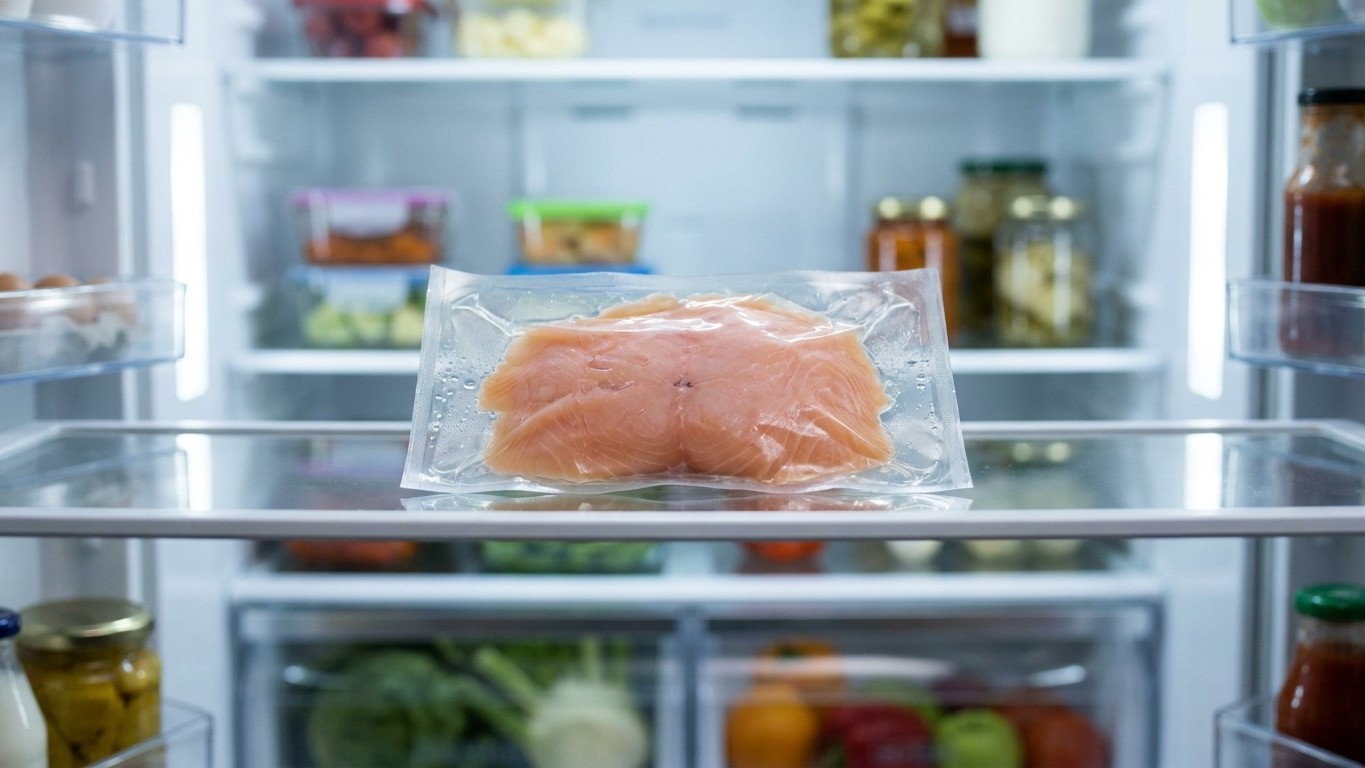
Vacuum-sealed. Pale pink. Sitting at a perfect 39°F on the second shelf of the fridge, right where every food safety guide says it should be. And still dangerous enough to trigger the FDA’s highest-risk recall classification. That’s the uncomfortable truth behind the Haifa Smoked Fish recall of cold smoked salmon and seabass, a case that should make anyone who trusts their refrigerator a little more suspicious.
D&M Smoked Fish Inc., doing business as Haifa Smoked Fish, issued a voluntary recall for set lots of its cold smoked salmon and seabass products on September 17 due to the possible contamination. A month later, the situation escalated. The FDA later issued a Class I risk classification for the recall on October 10. That’s not a bureaucratic technicality,, it’s the agency’s way of saying this product could kill someone. A Class I risk classification represents “a situation in which there is a reasonable probability that the use of, or exposure to, a violative product will cause serious adverse health consequences or death,” according to the FDA.
The contamination wasn’t caught by the company. The contamination was discovered after sampling conducted by food inspectors at the New York State Department of Agriculture and Markets, and subsequent analysis by personnel at The Food Laboratory, revealed the presence of listeria in both products. Which raises an obvious question: if state inspectors hadn’t happened to test that particular batch, would anyone have known?
Key takeaways
- A bacteria with an unusual appetite for cold storage is quietly multiplying in refrigerated smoked fish with no warning signs
- State inspectors discovered the contamination by chance—what if they hadn’t tested that particular batch?
- Listeria causes the third-leading foodborne death toll in America, yet it grows exactly where we feel safest
Why Your Fridge Isn’t the Fortress You Think It Is
Here’s where most of us get it wrong,, refrigeration stops bacteria. Except Listeria monocytogenes never got that memo. Mary O’Riordan, a professor of microbiology and immunology at the University of Michigan Medical School, put it bluntly to Newsweek: “Listeria has an unusual capacity to grow at refrigerated temperatures. Although the bacterium can contaminate many types of food, cheeses or deli meats that are kept in cold storage for long periods in stores or at home are a place where listeria can keep growing.”
That single fact upends the whole logic of “if it’s cold, it’s safe.” Most foodborne pathogens go dormant below 40°F. Listeria treats your crisper drawer like a slow-motion incubator, quietly multiplying while the package looks, smells and tastes completely normal. There’s no off odor to warn you, no visible mold, no bloated packaging. The bacteria simply build up, week after week, in a product that was fine at first.
The symptoms don’t make detection any easier. Haley F. Oliver, a professor of food science at Purdue University, explained that “Listeria monocytogenes is a common microorganism that can be found in the natural environment, for example, in soil. There are many factors that determine if someone gets listeriosis, a listeria infection. In most instances, an immunocompromised person, so young, old, pregnant or otherwise immunocompromised, must eat contaminated food. The number of bacteria resulting in infection and the amount of time before illness varies considerably. Symptoms vary among people but can include fever, flu-like symptoms, headache, stiff neck, confusion and loss of balance.”
And here’s the part that catches people off guard: early symptoms of listeria infection look similar to other common foodborne infections, including fever, diarrhea and vomiting, so it’s often not diagnosed right away. By the time someone connects the dots back to that bagel-shop lox or the salmon platter from the holiday party, the incubation window has long closed. In severe cases, according to O’Riordan, sometimes listeria can spread into the brain and cause more serious illness, like meningitis. In those cases, if people experience headache, stiff neck or confusion, they should seek urgent medical attention.
Not an Isolated Case
The Haifa recall wasn’t a one-off scare. Smoked salmon has quietly become one of the more recurring names on the FDA’s recall list. In late 2024, Acme Smoked Fish Corporation, the supplier behind Costco’s Kirkland Signature Smoked Salmon, pulled product after laboratory testing confirming Listeria monocytogenes on October 21, 2024. Three months later, that recall was upgraded, not downgraded. Kirkland Signature Smoked Salmon products that were recalled in October 2024 have officially been re-classified by the U.S. Food and Drug Administration as a Class I recall, indicating the FDA’s highest risk level, cautions that there is a “reasonable probability” the recalled item could cause “serious adverse health consequences or death.”
Then came 2026. In February, a different kind of salmon, farm-raised rather than smoked, joined the list. Exposure to this product could cause miscarriages and stillbirths as well as serious infections. That recalled batch, sold under the Wellsley Farms label at BJ’s Wholesale Club, was pulled after “The presence of Listeria monocytogenes was found through a sample collected randomly by the FDA,” Slade Gorton & Co., Inc said in a statement, adding that it was “investigating how the contamination occurred and taking steps to keep it from happening again.”
What connects all three cases isn’t sloppy handling in someone’s home kitchen. It’s contamination that happened somewhere upstream, in processing facilities, on slicing equipment, in the packaging environment,, well before the product ever reached a refrigerator shelf. The scale of the risk is worth sitting with, too. Listeriosis, per federal data cited by Newsweek, is the third leading cause of death from foodborne illness in the country, according to the Centers for Disease Control and Prevention, and the agency estimates it is responsible for 260 deaths each year.
What Actually Reduces the Risk
None of this means banning smoked salmon from the Sunday brunch table. It means treating cold storage as damage control, not a guarantee. A few habits actually move the needle: checking FDA and USDA recall notices periodically rather than assuming a silent inbox means all clear, buying smoked salmon in smaller quantities so it doesn’t sit for weeks, and taking pregnancy, advanced age or immune suppression seriously as reasons to skip cold-smoked fish altogether, since those groups face the sharpest consequences if something slips through.
The lot numbers and best-by dates printed on the back of these packages aren’t decorative,, they’re the only real link between your fridge and a recall notice you might otherwise never see. Worth a glance before that bagel gets its second layer.