
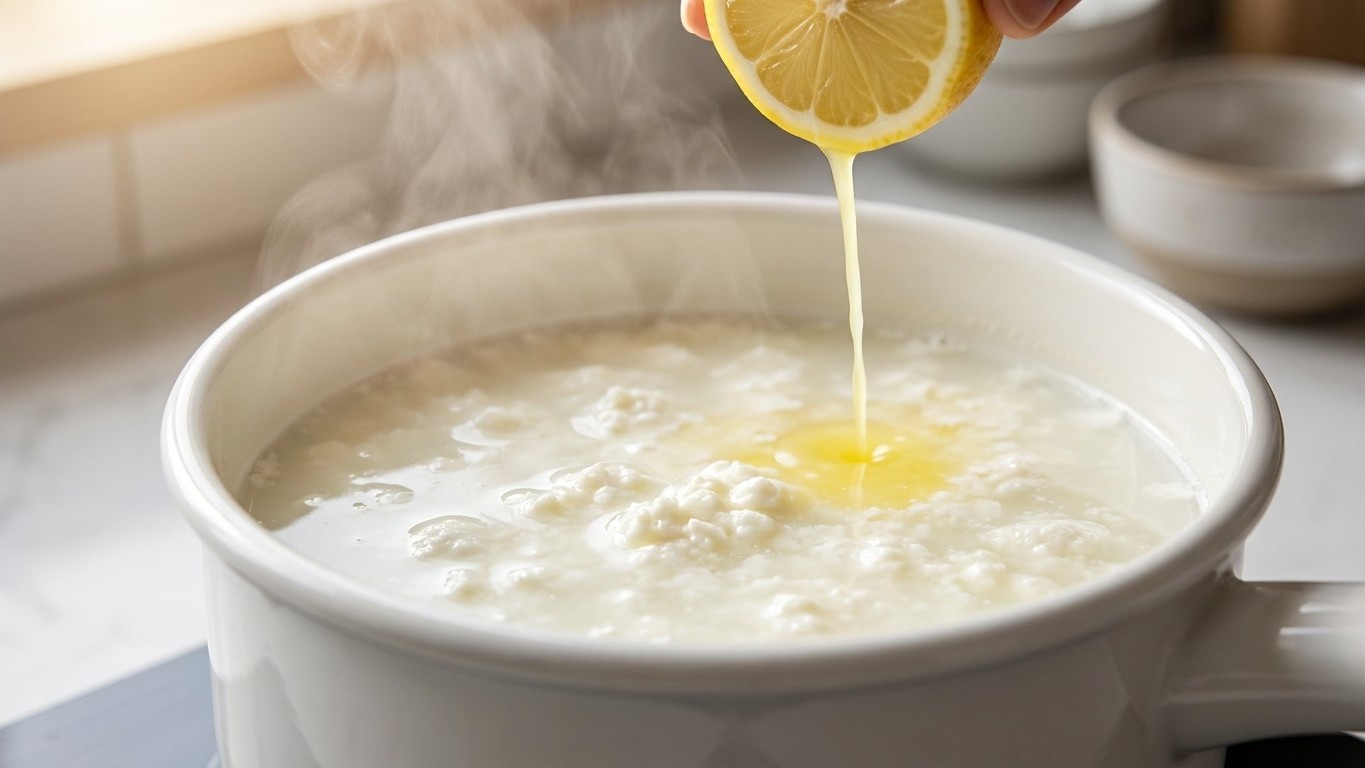
At exactly 85°C, something invisible happens to milk that no amount of stirring alone could achieve: the microscopic clusters of casein protein, until then floating peacefully in suspension, suddenly lose their electrical armor and start clinging to each other. That’s the moment lemon juice, or any acid, turns a pot of milk into curds and whey. The trick isn’t magic. It’s chemistry, and a cheesemaker explained to me exactly what’s going on beneath the surface.
Key takeaways
- Milk proteins carry an invisible electrical charge that keeps them suspended—until acid neutralizes it
- 85°C isn’t random: at this temperature, whey proteins unfold and strengthen the entire curd structure
- The difference between silky paneer and crumbly cottage cheese comes down to acid concentration and a few crucial degrees
The charge that keeps milk from becoming cheese on its own
Milk looks stable because it is, chemically speaking, a tiny electrical standoff. Little groupings of casein float around in the milk without bonding to anything, and these groupings, technically called micelles, have a negative charge, which makes them repel other groupings of casein and keeps the casein evenly dispersed in the milk. Think of thousands of magnets all pointed the same way, pushing each other apart. That’s raw milk, sitting quietly in your fridge.
Acid changes the equation entirely. When a strong acid, such as the citric acid found in lemons, is added, it introduces positively charged hydrogen ions into the mix, and these ions are drawn to the negatively charged casein micelles, effectively neutralizing their charge, and with their natural repulsion gone, the protein micelles are free to clump together. The magnets stop repelling. They start sticking.
There’s a precise number behind this, and it’s the one my cheesemaker friend kept coming back to: 4.6. Milk typically has a pH range of 6.4 to 6.8, which is above the isoelectric point of casein, and casein proteins carry a net negative charge because the pH of milk is above their isoelectric point of 4.6. Drop the pH down to that threshold with enough lemon juice, and the negative charge disappears almost entirely. At this point, the neutral molecules become zwitterions, having both positive and negative charges combined in the same molecule with a net charge of zero, and due to their static nature they precipitate out of the water. That’s the curd forming in front of your eyes. Franchement, it’s oddly satisfying to watch, like a magic trick you can finally explain to your dinner guests.
Why 85°C isn’t a random number
Here’s the part I hadn’t considered before standing in that cheesemaker’s kitchen: temperature isn’t just there to speed things up. It’s doing its own separate chemistry, on a completely different set of proteins. Heat speeds up the curdling process because it helps denature the milk’s proteins, making them more susceptible to the effects of the acid. But the real story involves whey proteins, the ones that normally have nothing to do with casein’s antics.
Above 60°C, globular whey proteins unfold, exposing reactive sulfhydryl groups that participate in disulfide bond formation and cross-linking with casein micelles, and this denaturation is irreversible, strengthening the curd structure. That’s why professional acid-heat cheeses, paneer, ricotta, queso blanco among them, all lean so heavily on high heat before the acid ever touches the pot. Several cheeses made worldwide by acid-coagulation of highly heated milk, including Paneer, Queso Blanco, and Ricotta, are typically made from whole milk, skim milk, cream, or whey, and to effect coagulation, dilute acid is added to the hot milk, which has been previously heated to at least 85°C for 30 minutes. That’s not an arbitrary tradition. It’s the temperature at which whey proteins finally join the casein network instead of draining away uselessly into the whey.
The payoff is measurable, and it’s the reason paneer holds its shape in a curry while cottage cheese falls apart in your hand. Acid-coagulated cheeses made from highly heated milk have a pH above 5.2, and they have high yields due to coprecipitation of caseins and whey proteins, and generally do not melt and flow when heated. A lower, gentler heat gives you a softer, wetter curd. Push past 90°C and hold it too long, and you start losing structure the other way. Too low, and you’ll lose proteins to the whey, but too high, and you risk denaturing the proteins, leading to a lower yield. There’s a narrow window, and it turns out home cooks have been unknowingly aiming for it for generations.
What actually determines texture (and why my lemon-juice habit wasn’t wrong, just unexamined)
I’d always assumed more acid meant a better curdle. Not quite. The concentration of coagulant affects the body and texture of the finished cheese: acid diluted to 2% gives a soft body and texture compared to acid diluted to 5%, which gives a harder body. Too much acid, and you’re not making a delicate curd, you’re making something dense and slightly chalky. Too little, and proteins slip straight through into the whey, wasting good milk.
The industry standard sequence, heat first, then acid, then a short rest, isn’t fussy tradition either. Paneer is made from cows’ or buffalo’s milk that is heated to 85 to 90°C, cooled slightly to around 72°C, with lemon juice, citric acid, or sour whey added to coagulate the milk, which usually takes only a few minutes. That brief cooling window Matters More Than most home recipes admit: cow milk follows a similar heating pattern up to 90°C, but instead of cooling all the way to 70°C like buffalo milk, it’s cooled only to 85°C before coagulation begins. A few degrees, and the texture shifts entirely.
So no, pouring lemon juice into a pot of steaming milk was never a random kitchen superstition passed down without logic. It’s a two-part reaction happening in sequence: heat unlocking whey proteins that would otherwise sit idle, then acid stripping casein of the negative charge that kept it dissolved in the first place. The next time curds bloom in your pot within seconds of that first squeeze of lemon, you’ll know you’re watching an isoelectric point being crossed in real time, at a temperature dairy Scientists have been fine-tuning in industrial vats for decades. The only question left is whether 2% acid or 5% suits the cheese you’re actually trying to make.
Sources : brainly.com | educationcircleweb.wordpress.com