
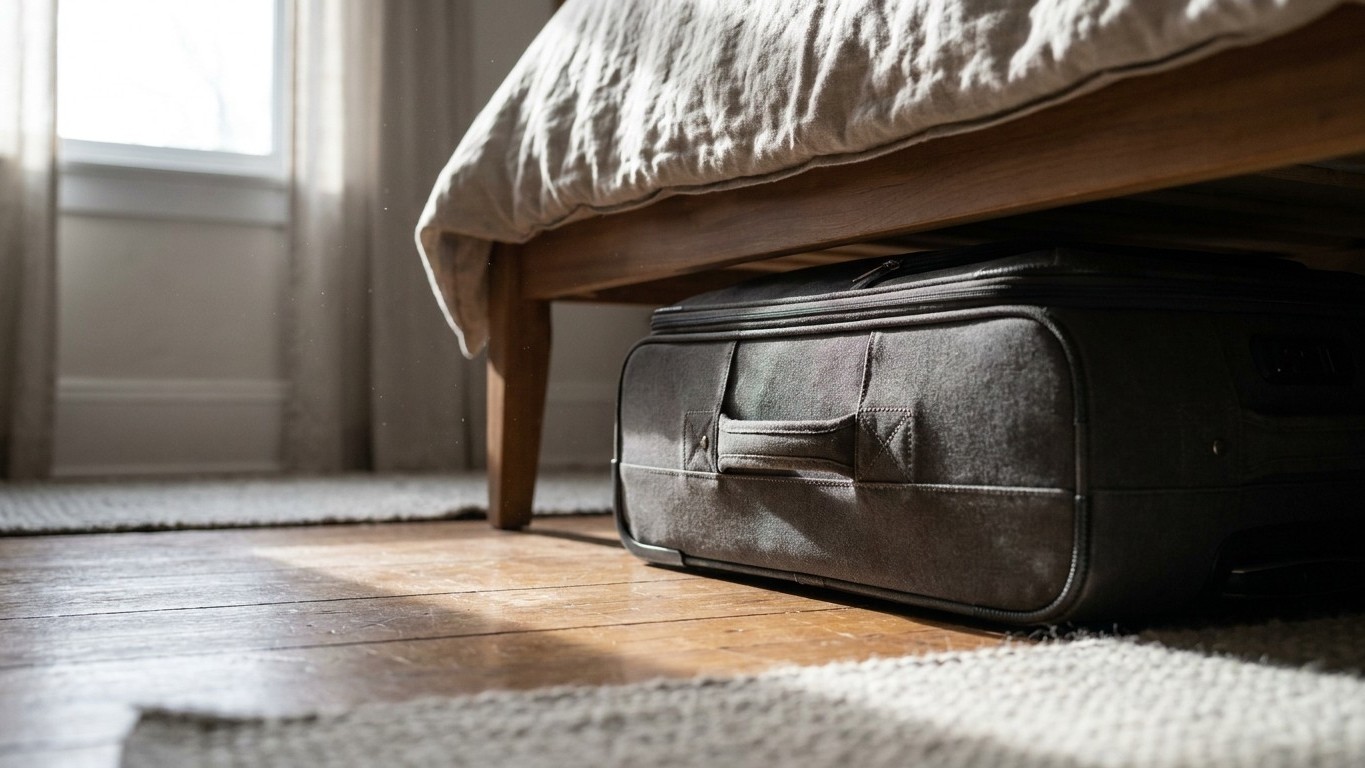
The suitcase looked harmless enough. Zipped shut, dusty from the airport carousel, sitting flush against the wall under the bed frame, exactly where it always went after a trip. Three nights later came the itching: small, angry welts in a neat line along one forearm, the kind that don’t match a mosquito bite and don’t go away by morning.
That line of bites is one of the most common tells that something hitched a ride home. Waking up with itchy red welts is often the first clue, with clusters of itchy, red bed bug bites often appearing in straight lines. And the seams of a suitcase, those tight folds where fabric meets zipper, are exactly the kind of dark, warm crevice these insects are built to exploit.
Key takeaways
- A seemingly innocent suitcase can carry live bed bugs or eggs for weeks—even months—without showing signs
- Storing luggage under your bed is the worst possible move, placing potential infestations inches from where bed bugs thrive
- One in five Americans report bed bug problems annually, and it happens in five-star hotels just as easily as budget chains
Why the seams, specifically
Bed bugs don’t fly. They don’t jump. What they do brilliantly is hide, flat, patient, and nearly invisible, in cracks barely wider than a credit card. Bed bugs can crawl into luggage when it is placed on infested beds, carpets, or furniture, and they are known to hide in the seams and pockets of bags, making it easy for them to travel undetected. A soft-sided suitcase, with its dozens of stitched folds, offers exactly the architecture they crave, which is why hard-shell suitcases with minimal seams give bed bugs fewer hiding spots than soft-sided bags.
Sliding that same suitcase under the bed is, frankly, the worst possible move, even though it feels like the tidiest one. You’re placing a potential hiding spot inches from the exact zone where bed bugs thrive. Over 70 percent of bed bugs are located in bed-related areas, and they don’t need to travel far to reach you. They rarely travel more than 8 feet to feed. Under your own bed, they’re already home.
Here’s the part that surprises most people: these insects can wait you out. Bed bugs in luggage can survive for weeks, even months, without a blood meal, making them a sneaky souvenir you definitely don’t want to bring home. So a suitcase that seems empty and harmless in October can still be carrying live insects, or their eggs, well into the following month. Stashing it away undisturbed for the season is essentially giving them a private incubator.
This isn’t a rare hotel horror story
It’s tempting to assume this only happens to people who stayed somewhere questionable. It doesn’t work that way. The CDC says bed bugs can turn up in five-star hotels and resorts, and cleanliness alone does not determine whether they are present. The bugs follow people and mattresses, not star ratings.
The scale is bigger than most travelers assume. 1 in every 5 Americans report some level of bed bug infestation annually, and about 20% of US homes and hotels have an annual bed bug problem. Pest control companies see it constantly: 97% of pest control professionals have dealt with a bed bug infestation in the prior year. And residential homes, not hotels, absorb most of the fallout. Residential houses are thought to be home to almost half of all bed bug infestations.
Where you live matters too. Recent industry rankings put Philadelphia at the top spot for the second straight year on the Terminix list, with New York City second, Cleveland-Akron third, Los Angeles fourth, and Dallas-Fort Worth fifth, while Orkin’s separate ranking placed Chicago at No. 1, followed by Cleveland, Detroit, Los Angeles, and Indianapolis. The two lists disagree on order, which is itself telling, since they’re measuring pest-control call volume rather than any single official tally. The takeaway isn’t which city “wins.” It’s that dense, heavily traveled metro areas everywhere carry real risk, no matter what neighborhood you live in.
The good news, if there is one: these bites, however miserable, aren’t a medical emergency. Bedbugs are not believed to transmit any diseases, according to the Centers for Disease Control and Prevention. The damage is mostly to sleep, sanity, and, if it spreads, your wallet. Professional extermination for a real infestation typically runs between $1,000 and $6,000, depending on the severity and size of the infestation, which puts a five-minute suitcase check into some perspective.
What actually works, and what’s a waste of time
The fix isn’t complicated, but it does need to happen before the suitcase goes anywhere near a bedroom. When arriving home, unpack your bags in some location other than the bedroom, such as the garage, mud room, laundry room, or foyer. That single habit change, unpacking on a hard floor under bright light instead of on the bedroom carpet, does more than most people realize.
From there, the routine is straightforward. Run a flashlight along every seam, zipper pull, and interior pocket, since bed bugs often hide in the seams and pockets of luggage. Clothes should skip the hamper and go straight into the wash, because a dryer on the hottest setting will kill them, according to the EPA. The heat threshold Matters More Than the detergent: bed bugs and their eggs die at temperatures above 120°F. For the empty suitcase itself, a vacuum with a crevice attachment reaches what fingers can’t, and once finished, the vacuum bag or the dirt should be enclosed into a plastic bag sealed with tape before it leaves the house.
One thing worth skipping: reaching for a can of bug spray as a shortcut. Health officials advise against spraying luggage, clothing, or bedding with insect repellent or pesticides, since pesticides alone do not eliminate bed bugs, in part because the insects have evolved Resistance against many of them. Heat, vacuuming, and a bit of patience do the job pesticide sprays can’t.
None of this requires panic. It requires five minutes on a garage floor before that suitcase gets anywhere near a mattress. The next time a trip ends and the urge hits to shove the bag out of sight under the bed frame, that small delay, flashlight in hand, checking every seam first, might be the only thing standing between a good night’s sleep and a very different kind of souvenir story.
Sources : fox-pest.com | bedbugbbq.com