
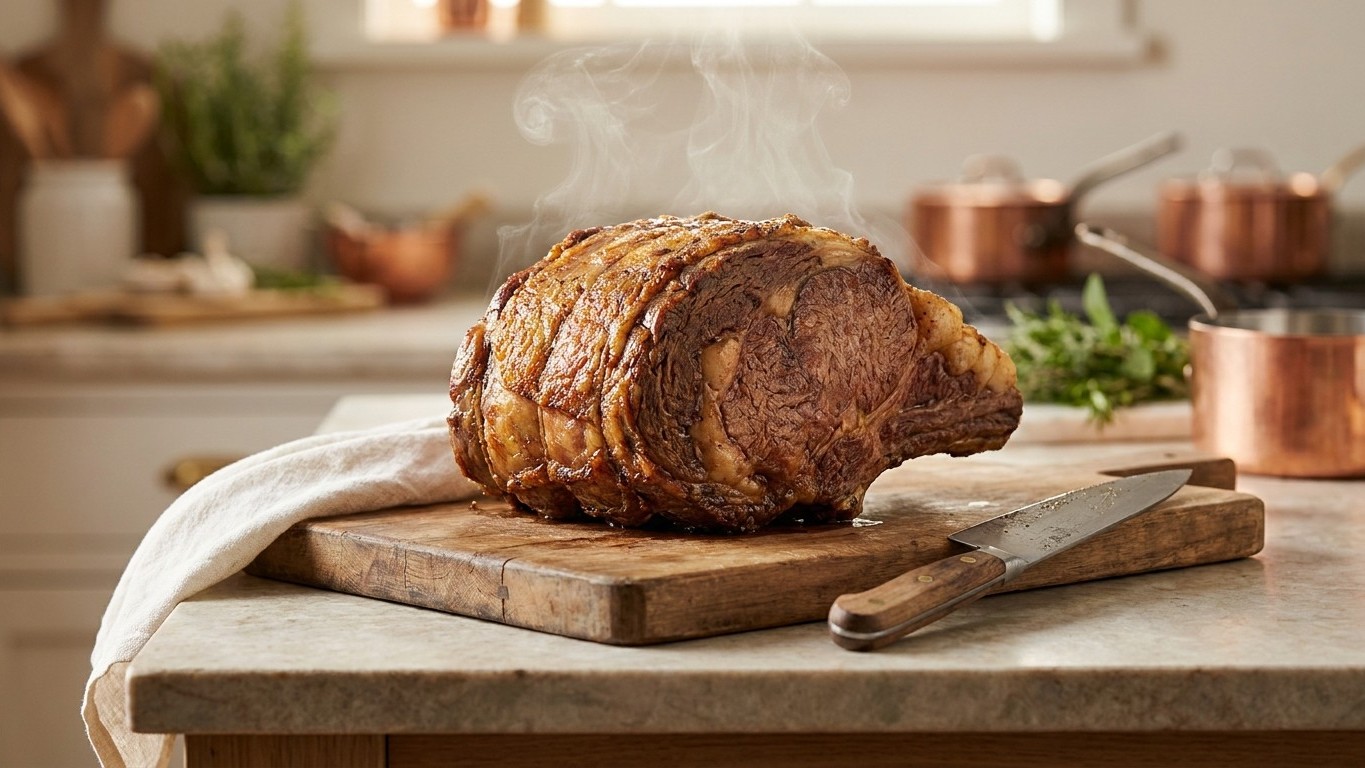
He’d pull the roast out of the oven, set it on the counter, and just… wait. No slicing, no serving, nothing. Just him, arms crossed, staring at a perfectly cooked piece of meat while the rest of us hovered around the table with empty plates and growing impatience. For years, I thought this was some kind of theatrical pause, a little performance of patience he’d picked up from a cooking show. Turns out he was running a science experiment in real time, and he was right about every part of it.
The eye-rolling started around age twelve and lasted well into my twenties. Dinner was ready, I was hungry, and there he stood, tenting foil over a Sunday roast like he was tucking it into bed. Just cut it already, I’d think. What changed my mind wasn’t a lecture. It was watching what happens on the cutting board when you don’t wait.
Key takeaways
- Heat physically squeezes moisture out of meat; resting allows proteins to relax and reabsorb some of it
- America’s Test Kitchen proved a 10-minute rest reduces juice loss by 40-60 percent compared to immediate slicing
- The USDA recommends resting meat for food safety reasons—temperatures continue rising and killing bacteria during rest
What actually happens when meat cooks
Here’s the part nobody explains at the dinner table: heat doesn’t just cook meat, it physically squeezes it. Meat is made up of bundles of muscular fibres and smaller filaments called myofibrils, which consist of two proteins called myosin and actin. When meat is heated, myosin and actin come together causing the larger myofibrils to contract forcing moisture out. In plainer terms, when heat is applied to meat the muscle fibres firm up, and water and juices get pushed to the surface of the meat.
Cut into that meat while it’s still hot and tense, and you’re basically releasing a valve. Resting meats after cooking is key to them being juicy and tender. In cooking, heat forces the moisture towards the center of the cut, and if the meat is cut immediately after cooking without a resting period, valuable meat juices will leak out. That puddle spreading across the cutting board isn’t seasoning liquid escaping for no reason. It’s the flavor you paid for, running away in real time.
What actually happens during the wait is more interesting than “juices redistribute,” the phrase everyone repeats without really unpacking it. Food Scientists-really-know/”>Scientists-just-discovered”>Scientists who’ve mapped this at a molecular level found something more specific: during cooking, heat causes muscle proteins to contract and squeeze moisture out of the protein matrix. While the meat is still very hot, that moisture is expelled and hasn’t had time to reabsorb. As the meat cools slightly, protein contraction eases and some of that moisture gets drawn back into the muscle structure. Nothing magical, no juices swirling around finding new homes. Just proteins relaxing their grip. And it’s only partial. This reabsorption is real but partial. You don’t recover all the moisture lost to protein contraction. The rest simply reduces what’s lost when you cut into the meat.
The numbers my father never quoted, but understood instinctively
He never ran a controlled experiment in his kitchen, obviously. But America’s Test Kitchen did exactly that, and the results are almost comically dramatic. In one test, they grilled four steaks and let two rest while slicing into the other two immediately. The steaks that had rested for 10 minutes shed 40 percent less juice than the steaks sliced right after cooking. The meat on the unrested steaks also looked grayer and was not as tender.
A separate roasting experiment pushed the numbers even further. If you allow the meat to rest just 10 minutes, it could mean a 60 percent decrease in juices lost to the cutting board. The breakdown is worth sitting with: the roasts that we sliced immediately after cooking shed an average of 10 tablespoons of liquid. In contrast, the roasts that we allowed to rest for 10 minutes before carving shed an average of just 4 tablespoons of liquid. That’s a 60 percent decrease in moisture loss by waiting 10 minutes to slice. Letting it go even longer helped more, though with diminishing returns: the roasts that rested for 20, 30, and 40 minutes lost 2½ tablespoons, 1 tablespoon, and 2 teaspoons of juice, respectively. That said, while a longer resting time means less moisture loss, the difference might not be significant enough to warrant the added time. Ten tablespoons versus a couple of teaspoons. That’s not a subtle difference, that’s the entire reason a roast tastes dry or doesn’t.
It’s not just about juiciness, it’s about food safety too
This is the part that surprised me most, because it flips the “just impatience” narrative on its head. Resting isn’t only a texture trick, it’s an actual USDA safety recommendation. The agency states plainly: cook raw beef, pork, lamb and veal steaks, chops, and roasts to a minimum internal temperature of 145 F as measured with a food thermometer before removing meat from the heat source. For safety and quality, allow meat to rest for at least three minutes before cutting or consuming.
That three-minute window isn’t arbitrary padding. During it, something continues happening inside the meat that a thermometer reading alone doesn’t capture. After you remove meat from a grill, oven, or other heat source, allow it to rest for the specified amount of time. During the rest time, its temperature remains constant or continues to rise, which destroys harmful germs. Skip the rest, and you might be serving meat that hit 145°F for an instant but didn’t actually hold that temperature long enough to do its job against bacteria.
There’s also carryover cooking to factor in, which explains why a roast pulled at the “right” temperature can end up overcooked if you don’t account for the rest. Carryover cooking occurs when the internal temperature of the meat continues to rise even after it’s removed from the heat source. During the resting period, this can cause the temperature to increase by 5-10°F (3-6°C), depending on the size and thickness of the meat. My father, without ever using the phrase “carryover cooking,” always pulled his roasts a few degrees early. I used to think he was just cautious. He was calculating.
So how long, actually?
The timing scales with size, which is why a steak and a Thanksgiving turkey shouldn’t be treated the same way. General guidance breaks down roughly like this:
- Steaks and chops: rest 5 to 10 minutes, or roughly a minute per 100 grams of meat
- Roasts (beef tenderloin, leg of lamb): 20 to 30 minutes, tented loosely with foil
- Whole poultry, including turkey: 20 to 45 minutes depending on size, especially if carving tableside
My father’s roast, now that I do the math, always sat for exactly the amount of time the science says it should. He wasn’t performing patience. He was running the same ten-minute equation America’s Test Kitchen would later prove with tablespoons and a cutting board. I’ve since started tenting my own roasts, setting a timer instead of eyeballing it, and watching the same thing he must have watched for decades: a knife going in clean, with almost nothing pooling out. It’s a small, quiet kind of vindication, the kind that arrives thirty years too late and tastes, appropriately, a lot better than the meat I used to serve too fast.
Sources : headcountcoffee.com | 123foodscience.com