
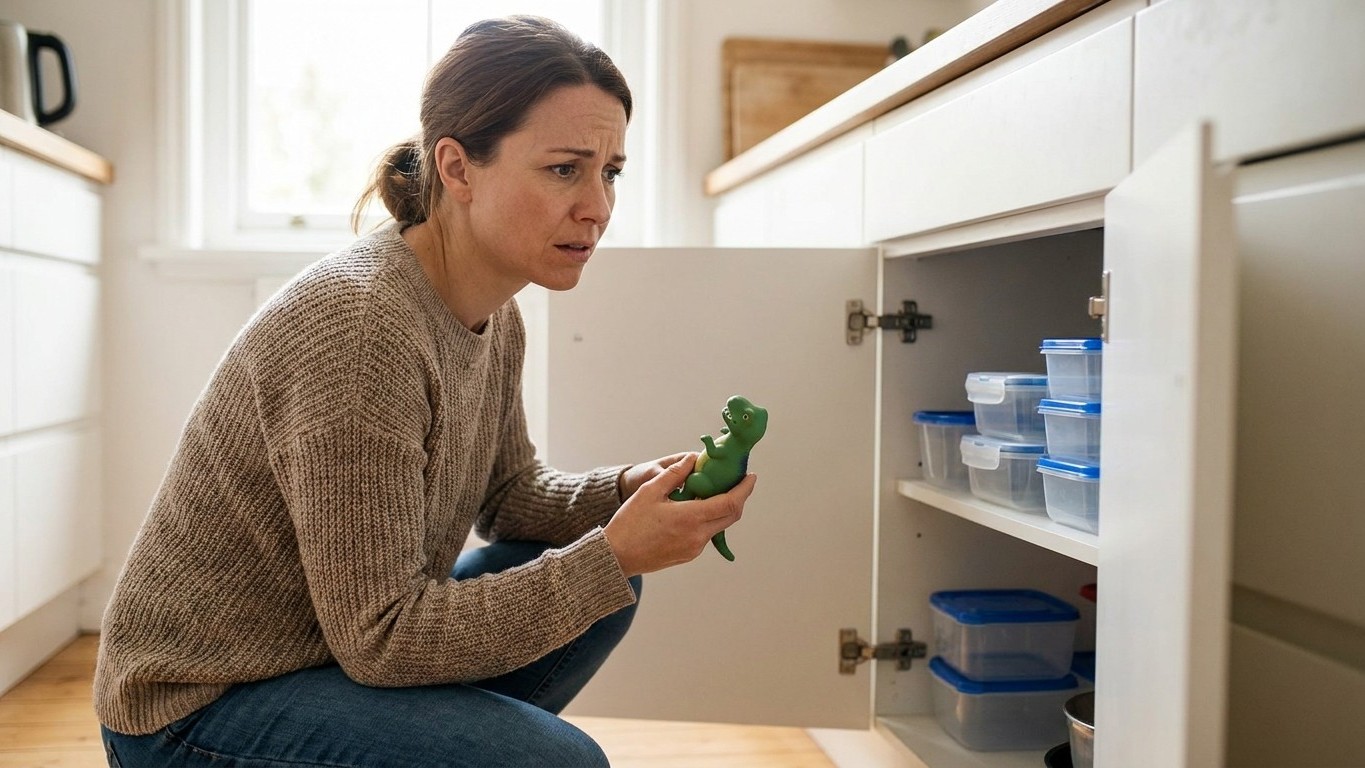
Phthalates. That’s the word my daughter’s pediatrician used, standing in the exam room with a plastic dinosaur toy in her hand, the same one my daughter had been chewing on since she was eighteen months old. I’d never heard it pronounced out loud before. She said it slowly, almost apologetically, like she knew what was coming next: an afternoon spent on my knees in front of the kitchen cupboard, pulling out every soft plastic bowl, every dinosaur, every squeeze toy we owned.
For years, I hadn’t given it a second thought. The bright, squishy dinosaur. The bendable bath toys. The plastic lunch containers that went through the dishwasher two or three times a week, then got reheated in the microwave the next morning. None of it seemed dangerous. It seemed, frankly, like ordinary parenting gear, the stuff every store aisle is stacked with. What the pediatrician explained changed that completely.
Key takeaways
- Soft plastic toys contain phthalates that leach chemicals when children chew on them—and the youngest kids are most at risk
- Lunch boxes are a silent repeat offender: microwaving and dishwashing plastic containers releases BPA and phthalates directly into your child’s food
- ‘BPA-free’ labels hide a darker truth: manufacturers swap BPA for BPS or BPF, which pose nearly identical health risks
What’s Actually Leaching Out of Soft Plastic
Phthalates don’t chemically bind to the plastic products they’re added to, which means they can leach out and release into the environment, air, or household dust, and get absorbed by the body. They’re what give a toy its squish, its bend, its rubbery softness. Phthalates give a plastic toy its soft, squishy feel, and they’re the hormone-affecting culprits known as endocrine disruptors. The mechanism is almost mundane in how simple it is: phthalates don’t bind chemically to their plastic host but float freely, so they can be released through small cracks or breaks in a product, for example when a child chews on a toy and scratches its surface, allowing the chemical to evaporate or leach out and potentially enter the child’s body through their mouth.
Here’s the part that stopped me cold. The youngest children are particularly at risk because plastic toys may contain unsafe phthalates, and babies and toddlers explore toys by putting them into their mouths, which makes them especially vulnerable to phthalate exposures with endocrine-disrupting effects. My daughter didn’t just play with that dinosaur. She gnawed on it during every long car ride for the better part of a year.
A 2018 lab study out of Philadelphia childcare centers put actual numbers on this. Researchers developed wipe tests to measure how much of these chemicals came off toys kids handled every day, and the studies showed an average leaching of 13 to 280 ng/cm2 of BPA and phthalates. Interestingly, the amount wasn’t fixed. The leaching of chemicals depended on washing procedures and the location of the facility, and using a bleach and water mixture two or more times a week to clean the toys seemed to reduce chemical leaching. Which tells you something counterintuitive: the toys my daughter never washed enough were probably worse offenders than the ones I babied through regular cleaning.
Lunch Boxes Are the Quiet Repeat Offender
If toys felt like an obvious blind spot once it was pointed out, the lunch box situation felt personal. Kids eat out of their lunch boxes five days a week for years, which adds up to a lot of cumulative contact time between food and container material, and unlike adults, children eat more food relative to their body weight, so any chemical exposure from food-contact materials hits them harder. That’s not a minor detail. That’s the entire elementary school experience, multiplied by a growing appetite.
The heat factor is what really got me. I used to reheat my daughter’s lunch containers in the microwave without thinking twice. Plastic lunch boxes can contain BPA, phthalates, and other plasticizers that migrate into food, especially when exposed to heat. The American Academy of Pediatrics has said the same thing directly: since heat can cause plastics to leak BPA and phthalates into food, families should avoid microwaving food or beverages, including infant formula and pumped human milk, in plastic when possible, and also try to avoid putting plastics in the dishwasher. Every single lunch container I owned had been through both, repeatedly, for years.
The health concerns aren’t vague or theoretical. Bisphenols such as BPA, used to harden plastic containers and line metal cans, can act like estrogen in the body and potentially change the timing of puberty, decrease fertility, increase body fat, and affect the nervous and immune systems. Phthalates carry their own separate list of concerns: phthalates, which make plastic and vinyl tubes used in industrial food production flexible, may affect male genital development, increase childhood obesity, and contribute to cardiovascular disease.
The “BPA-Free” Label Isn’t the Relief It Sounds Like
This is the part that genuinely surprised me, the contradiction nobody warns you about at the store. I’d specifically sought out “BPA-free” lunch boxes, feeling smug about it, assuming I’d solved the problem. I hadn’t. Despite brands’ claims, BPA-free plastics aren’t necessarily safe, because manufacturers often replace BPA with BPS or BPF, which are chemically similar and may pose similar risks. A 2025 review echoed the same finding: “BPA-free” products often substitute BPS or BPF, which show similar endocrine-disrupting activity in research.
So the label wasn’t lying, exactly. It just wasn’t answering the question I thought it was answering.
What Actually Changed in My Cupboard
I didn’t replace everything overnight, and I don’t think that’s realistic advice for most families anyway. What I did do was triage. The soft PVC toys, the ones with that unmistakable rubbery give, went first, since one of the safer plastics for toys is polypropylene, which is heat resistant, unlikely to leach even when exposed to warm or hot water, and approved for use with food and beverage storage. For anything my daughter still mouths regularly, I now check for a recycling code, since pediatric guidance is specific on this point: avoid plastics with recycling codes 3 (phthalates), 6 (styrene), and 7 (bisphenols) unless they’re labeled as biobased or greenware.
The lunch box was the easiest swap, honestly. Stainless steel doesn’t care about the microwave because it never goes in one, and it doesn’t off-gas anything when it gets warm from sitting in a backpack in August. The toys are harder, because kids get attached to specific objects in a way that has nothing to do with material science.
One detail from that Philadelphia leaching study stuck with me more than anything else: the chemical exposure wasn’t uniform across every daycare tested, it shifted based on something as unglamorous as how often staff wiped the toys down with a bleach solution. Which means the fix, at least partially, was never about buying the perfect toy. It was about a habit I’d simply never built.
Sources : healthychildren.org | children.muschealth.org