
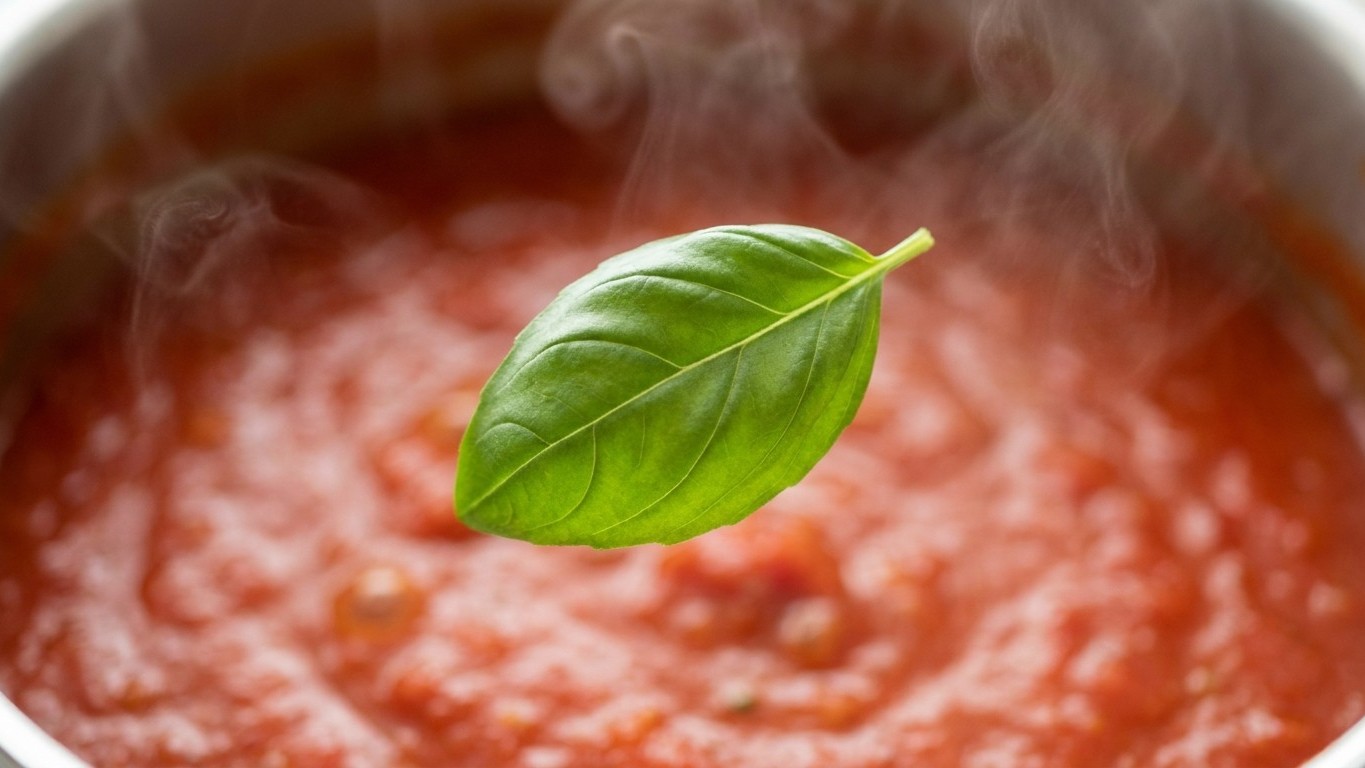
Basil contains more than eighty aromatic compounds, and most of them start breaking down the moment they hit real heat. That’s the blunt science behind a habit almost every home cook repeats without thinking: tearing basil leaves into a simmering marinara, stirring, and moving on. The gesture feels generous. The result is closer to sabotage.
The culprit is a class of molecules called terpenes, alcohols, and phenylpropanoids, the same volatile compounds that make basil smell like basil in the first place. The most abundant compounds identified in basil are eucalyptol, trans-ocimene, β-linalool, and β-myrcene, most belonging to the terpenes and alcohols groups. These molecules are light, unstable, and built to evaporate at low temperatures. That volatility is exactly what makes them detectable to your nose from across the kitchen. It’s also what makes them vanish the instant they’re exposed to a rolling boil.
Key takeaways
- Basil’s signature aroma comes from volatile compounds that vanish instantly at high temperatures
- Research shows longer, hotter cooking removes the very scent and flavor you’re trying to preserve
- The window for adding fresh basil is shockingly narrow—and it’s the opposite of what most home cooks do
What actually happens in the pot
Researchers who ran fresh basil through controlled heat treatments, comparing traditional boiling infusions against gentler sous-vide methods at 65°C, 75°C, and 85°C, found that a smaller number of volatile compounds in the samples heated at higher temperatures were identified, and that long heat treatment under vacuum at higher temperatures causes a pronounced change in the aroma composition. Translation for anyone standing over a Dutch oven: the longer and hotter the exposure, the more of that signature scent simply disappears into steam.
It’s not only about smell. Chefs who work with basil daily report a parallel problem with color and texture. Adding basil at the end preserves its delicate essential oils, which give the herb its signature sweet, peppery aroma and bright flavor, while prolonged exposure to heat can cause basil to lose its fragrance, darken in color, and develop a slightly bitter taste. That bitterness is the part nobody warns you about. You don’t just lose the perfume, you can actively introduce an off-note that wasn’t there before, and most people blame the tomatoes or the garlic instead of the herb quietly cooking itself into submission.
The timing that actually works
Professional advice on this is oddly consistent across cuisines and continents. Basil does not stand up to long cooking times very well, especially compared to other herbs like oregano or thyme, and some experts recommend adding fresh basil as late as the last 60 seconds of cooking. Sixty seconds. Not five minutes simmering with the rest of the aromatics, not stirred in halfway through reducing the sauce. The window is almost comically narrow, and that’s precisely why the reflex to toss it in early feels so natural, and is so wrong.
Kitchen guides that track this across soups, stews, and sautéed dishes tend to land on a similar rule of thumb. Fresh basil is best added during the last 1 to 3 minutes of cooking or sprinkled on as a garnish just before serving. For a pasta sauce that’s been bubbling for forty minutes, that means killing the heat, or at minimum dropping it to the barest simmer, before folding in your leaves. A pizza tells the same story from a different angle. Chef Franco Pepe, one of the most respected pizzaiolos working today, treats basil placement as a technical decision rather than a garnish afterthought, because basil placed directly on top of a pizza and exposed to intense heat burns, and burnt basil turns bitter with no saving it. The fix in professional kitchens is almost always the same: add it after the bake, not before.
Fresh basil and dried basil don’t play by the same rules
Here’s the part that trips people up in the opposite direction. The “add it late” rule applies specifically to fresh leaves. Dried basil behaves almost like a different ingredient entirely, because drying strips out moisture and changes how the remaining compounds are locked into the leaf structure. Dried basil follows an entirely different set of rules than its fresh counterpart, needing to be introduced early in the cooking process because drying removes the moisture from the leaves, making it challenging for them to release their essential oils effectively without water. Food writers generally suggest giving dried basil at least 20 minutes before finishing the cooking to rehydrate and bloom.
So the households mixing both jars end up with the timing exactly backwards more often than not: dried basil tossed in as an afterthought, fresh basil dumped in at the start alongside the onions. Flip that logic and the difference in the finished dish is immediate. A chef specializing in herb-forward pasta and cream sauces put it plainly when discussing a similarly delicate variety: “The flavor and aroma from lemon are very bright and fresh but also quite delicate. These delicate flavor compounds can easily disappear with prolonged heat exposure.” The same logic scales down to ordinary sweet basil in an ordinary tomato sauce simmering on an ordinary Tuesday night.
A small habit, a real difference
None of this requires new equipment or a rewritten recipe. It requires resisting the urge to treat basil like a base seasoning that needs time to “cook in,” the way you might treat bay leaves or dried oregano. Basil isn’t building flavor over time in the pot. It’s releasing Everything it has almost instantly, and everything released before you smell it is gone before you taste it.
One detail worth keeping in your back pocket for backyard herb gardeners: cold storage isn’t gentler on basil than heat is. Fresh basil has a short shelf life and high chilling sensitivity resulting in leaf browning and loss of characteristic aroma, meaning a basil plant stashed in the refrigerator crisper can lose its punch almost as fast as one left too long in a simmering pan. The lesson runs both directions: basil hates the cold, and it hates prolonged heat even more. Somewhere in that narrow, room-temperature middle ground is where the actual flavor lives.
Sources : pmc.ncbi.nlm.nih.gov | ncbi.nlm.nih.gov