
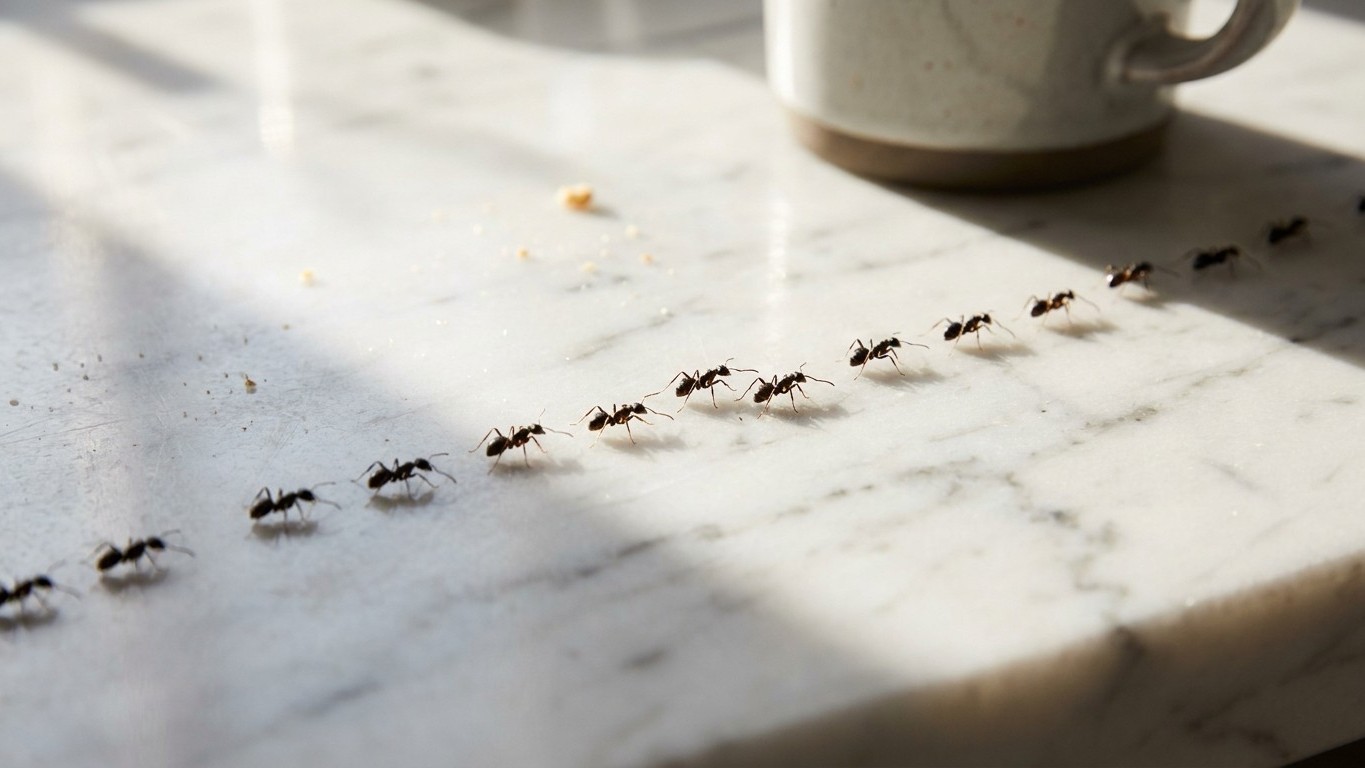
Every morning, same routine: a trail of tiny black ants marching across my kitchen counter, and me, coffee half-poured, reaching for the spray bottle. I’d hit them dead-on, wipe up the casualties, feel briefly victorious. By the next morning, they were back. Same spot, same formation, same infuriating persistence, for nearly three weeks straight.
Turns out I was fighting the wrong battle entirely. When I finally called an exterminator (pride fully swallowed), the first thing he told me stopped me cold: the ants I was spraying weren’t the problem. They were just messengers.
Key takeaways
- Contact sprays only kill visible ants—the colony and queen remain untouched underneath
- Your daily spraying might trigger ‘budding,’ splitting one colony into several new ones
- The real solution involves finding the nest entrance and using bait, not spray
Why Spraying the Trail Solves Nothing
Contact sprays do exactly what the name suggests, they kill on contact. Nothing more. Most consumer ant killer spray options are contact killers, meaning they eliminate ants on direct contact but do not travel back to the colony. Spraying a trail of ants removes the workers you can see but leaves the colony, and the queen, untouched. Which means every morning, I was essentially clearing a battlefield while the command center kept churning out fresh recruits, undisturbed, somewhere behind my walls or under my foundation.
Here’s the part that really got me: when ants detect a chemical barrier, some species respond by splitting into smaller satellite colonies, a process known as budding. So my nightly spray sessions may have actively made things worse, encouraging one colony to fracture into several. This triggers a behavior called budding, where ants, along with their queen, move to a different location and create new nests to replace those they’ve lost. I wasn’t shrinking the problem. I was potentially multiplying it.
The trail itself is chemical infrastructure, not a random path. As each ant passes along the trail, more trail pheromone is released from the tip of the abdomen, and the release of pheromones keeps the trail strong, allowing other colony members to determine the quality of the trail and direction of the food source. Spraying dead ants onto that pheromone highway does nothing to erase the signal underneath. New scouts just step over the bodies and keep following the scent.
What the Exterminator Actually Did Differently
He didn’t reach for a spray can at all, at least not the kind I’d been using. His first move was tracing the trail backward, past the counter, along the baseboard, toward a hairline gap near the window frame. Ants use pheromone trails to guide other ants to food sources, so they often return along the same established routes, and following that trail back from the food source typically leads to the nest. Finding that access point mattered more than anything happening on my countertop.
Then came the part that felt almost anticlimactic: bait, not spray. Spraying kills on contact but only gets the ants you can see, while baiting is slower but wipes out the whole colony, including the queen. The logic is almost sneaky in its simplicity, instead of repelling ants, you make the poison irresistible. Contact sprays don’t get carried back to the nest, which means the queen remains alive and active, while baits are designed to be carried back to the colony, feeding the queen and larvae and wiping them out over time.
Placement, it turns out, is everything. Ant bait should be placed directly on or along active ant trails, since bait placed away from foraging routes is unlikely to be found or carried back to the colony. He also warned me, sharply, against combining the two methods carelessly. Never spray bug spray near ant bait, because repellent sprays contaminate the bait, and ants will smell the poison, avoid the bait, and create a brand new trail around the sprayed area. Meaning all those weeks I’d sprayed, if I’d also tried bait stations, I’d have been sabotaging them without knowing it.
The Cleanup Step Nobody Mentions
Before setting any bait, he wiped the entire trail route with a degreasing cleaner. Not decorative tidiness, a deliberate erasure of the scent map. Ants leave pheromone trails to guide others to food sources, and if these trails aren’t completely eradicated, other ants will follow the same path into your home. Soap and water, or a degreaser, physically breaks down the chemical marker so new scouts can’t just pick up where the last ones left off.
He also pointed out something I’d never considered: my kitchen was basically an all-you-can-eat buffet competing with his own bait. If other food is available, ants may ignore the bait entirely, and crumbs, spills, open trash containers, and pet food dishes all compete with ant baits and reduce their effectiveness. Airtight containers, wiped-down counters overnight, pet bowls not left out, small habits, but apparently they decide whether bait even gets a fair shot.
Patience was the last lesson, and the hardest one for someone who’d spent three weeks craving instant results. Baits take a week or so to work, since the goal is killing the local colony, and meanwhile the bait will attract ants so there may be more around temporarily. Seeing slightly more activity right after treatment isn’t failure, it’s the trap working exactly as intended, right before the whole thing collapses.
Within ten days, the counter stayed clear. No trail, no morning ritual, no spray bottle standing guard by the coffee maker. What finally worked wasn’t a stronger chemical or a more aggressive spray pattern — it was accepting that the ants on my counter were never really the target. They were just the visible tip of something operating entirely out of sight, and no amount of daily spraying was ever going to reach it.
Sources : squishempestsupplies.com.au | facilitypestcontrol.com