
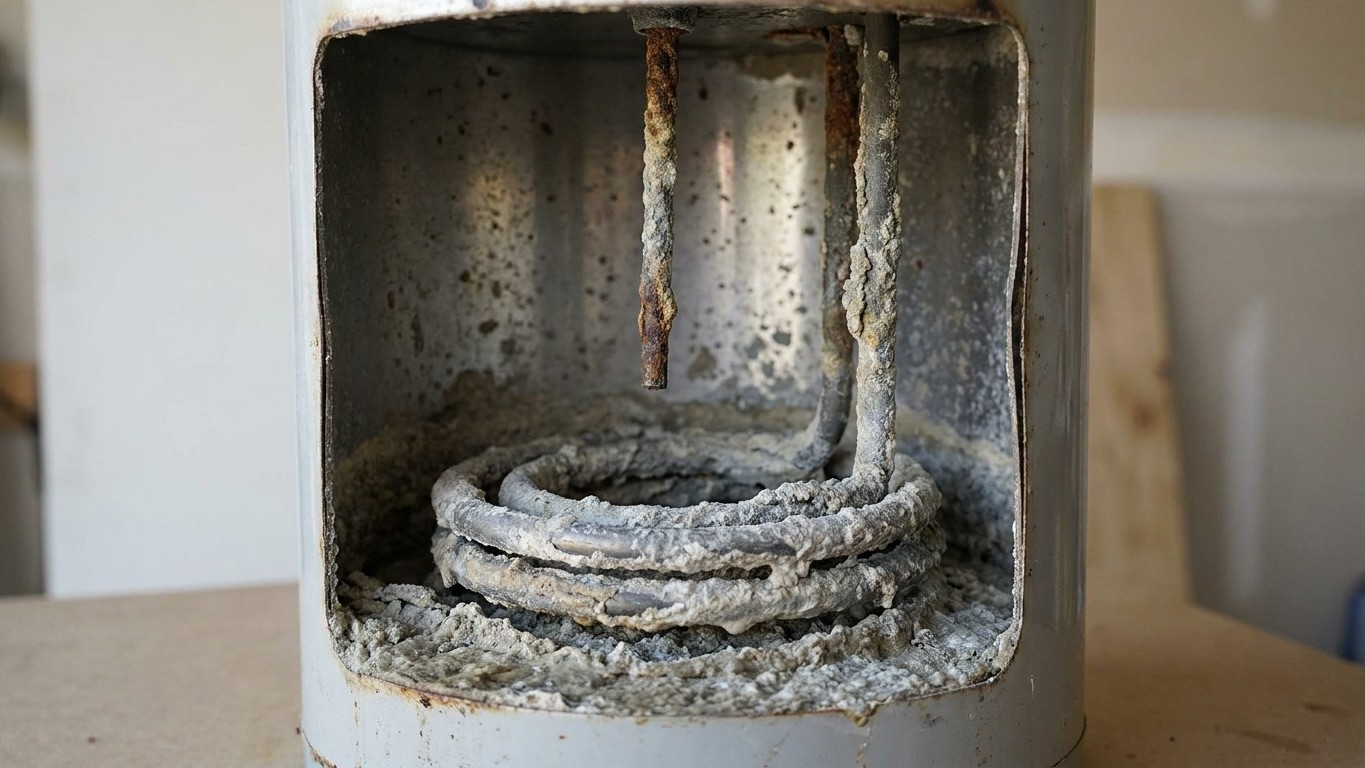
Seventy degrees Celsius. That’s 158°F, a full 38 degrees above the Department of Energy’s standard recommendation of 120°F. When the plumber finally cracked open the tank after a summer of “playing it safe,” what came out wasn’t just water. It was a thick, gray-white crust coating the bottom like a layer of concrete, clinging to the heating element and dulling the anode rod to a stub.
The instinct made sense on paper. Warmer water, fewer bacteria, more peace of mind. But dialing a residential water heater up to near-boiling territory doesn’t just kill germs faster, it also turns dissolved minerals into solid deposits at a dramatically accelerated rate. Franchement, that’s the trade-off nobody mentions on the box.
Key takeaways
- Why extra heat accidentally fast-tracks your water heater toward failure
- The bacteria concern that made sense on paper but backfired in reality
- What a plumber discovered inside that tank, and why it cost more than expected
Why Extra Heat Turns Water Into Scale
Calcium and magnesium are dissolved in tap water. Not visible, not dangerous on their own, until heat forces them out of solution. Water naturally contains minerals like calcium and magnesium, which settle at the bottom of your water heater tank over time, and this sediment, primarily made of calcium carbonate, accumulates faster in areas with hard water. The hotter the tank runs, the faster that transformation happens.
The numbers here are almost shocking. Minerals precipitate much faster as the water gets hotter, roughly seven to eight times faster at 140 degrees than at 120 in DOE testing. At 158°F, the pace is even more aggressive than that comparison suggests. What would normally take years to build up can accumulate in a single season, especially in regions with moderately hard water where minerals are already primed to drop out of solution the moment temperatures climb.
Inside a gas water heater, that sediment doesn’t just sit harmlessly at the bottom. In gas water heaters, sediment builds up at the bottom of the tank, directly on the burner plate, acting as an insulator that prevents heat from efficiently transferring to the water. The burner has to work harder and longer to reach the same temperature, which burns more gas and stresses the tank lining. This causes the glass lining of the heater to break down at high temperatures, which can lead to leaks and tank failure. A crust that started as an invisible mineral film becomes, weeks later, a structural problem.
The Legionella Trade-Off Nobody Explains Well
Here’s the contradiction that trips up most well-meaning homeowners. Setting the tank scalding hot feels like the responsible move against Legionella, the bacteria behind Legionnaires’ disease. And there’s real science behind that instinct. Legionella grows best between 77°F–113°F (25°C–45°C). In order to begin to kill Legionella, your water temperature must be set to 131 degrees or higher, at which point Legionella will begin to die off within five or six hours, though it takes only 32 minutes on average for Legionella to die at temperatures of 140 degrees.
So 140°F already does the job. Pushing to 158°F doesn’t add meaningful extra protection, it just adds risk on the other side of the ledger: scalding. The CPSC states that third-degree burns can occur at 150 degrees (two seconds), 140 degrees (six seconds), and 130 degrees (30 seconds). At 158°F, a child’s hand under the tap could suffer a serious burn before anyone has time to react. That’s precisely why the standard recommendation, backed by studies from organizations like the U.S. Environmental Protection Agency, is to set your water heater thermostat to 120°F.
The CDC’s own guidance threads this needle differently than most people assume. “Set your property’s water heater at or above 120°F to minimize the growth of Legionella,” says the CDC, and “ensure hot water in circulation doesn’t fall below 120°F.” Nowhere does that guidance call for 158°F in a home. For households genuinely worried about immunocompromised family members, the smarter workaround is a tempering or thermostatic mixing valve. If someone in your home is immunocompromised, you can set the tank to 140F and install thermostatic mixing valves at every point of use, which blend super-heated tank water with cold water to deliver a safe 120F at the faucet. Hot storage, safe delivery. Not one dial cranked to an extreme.
What the Plumber Actually Found, and What It Costs
Back to that tank. Sediment doesn’t just reduce efficiency, it changes the entire chemistry inside the unit. When sediment accumulates in a water heater, it creates conditions where corrosive processes accelerate, and this compounds with heat and sediment to cause more significant damage to the tank’s internal components. One giveaway shows up before you ever see the crust yourself. One of the telltale signs of bacterial growth in your water heater is a rotten-egg odor or sulfur smell coming from your hot water. That smell, easy to blame on plumbing quirks, is often the first warning that something’s building up at the bottom of the tank.
The anode rod tells its own story too. Running a tank scorching hot for months accelerates its sacrificial corrosion, meaning it wears out faster than it should, leaving the steel tank itself exposed sooner. Running a tank water heater at excessively high temperatures accelerates sediment buildup on the heating element at the base of the tank, degrades the anode rod more rapidly, and increases tank pressure during heating cycles, and over time, these effects shorten the unit’s useful life. None of this happens overnight, but a summer at 158°F is enough to visibly speed the clock forward.
There’s a financial angle too, one that rarely gets mentioned in the safety debate. Assuming your cold water is at 60 degrees Fahrenheit, you’ll use nearly 25% less energy to heat the water to 120 degrees Fahrenheit than to 140 degrees Fahrenheit. Push past 140°F toward 158°F, and that gap only widens. So the “safety margin” ends up costing more on the utility bill while quietly shortening the tank’s lifespan, an eight-to-twelve-year appliance that can fail closer to year six under sustained high heat and scale.
The fix a plumber will usually suggest isn’t complicated: drain and flush the tank, scrape what’s clinging to the element, check the anode rod, and dial the thermostat back down to a range that still protects against bacteria without accelerating decay. A yearly flush, done before scale has time to bond permanently to metal, is the difference between a tank that quietly does its job for a decade and one that ends up back on a plumber’s worktable well ahead of schedule.
Sources : simbaplumbingphx.com | northerncomfortsystems.com