
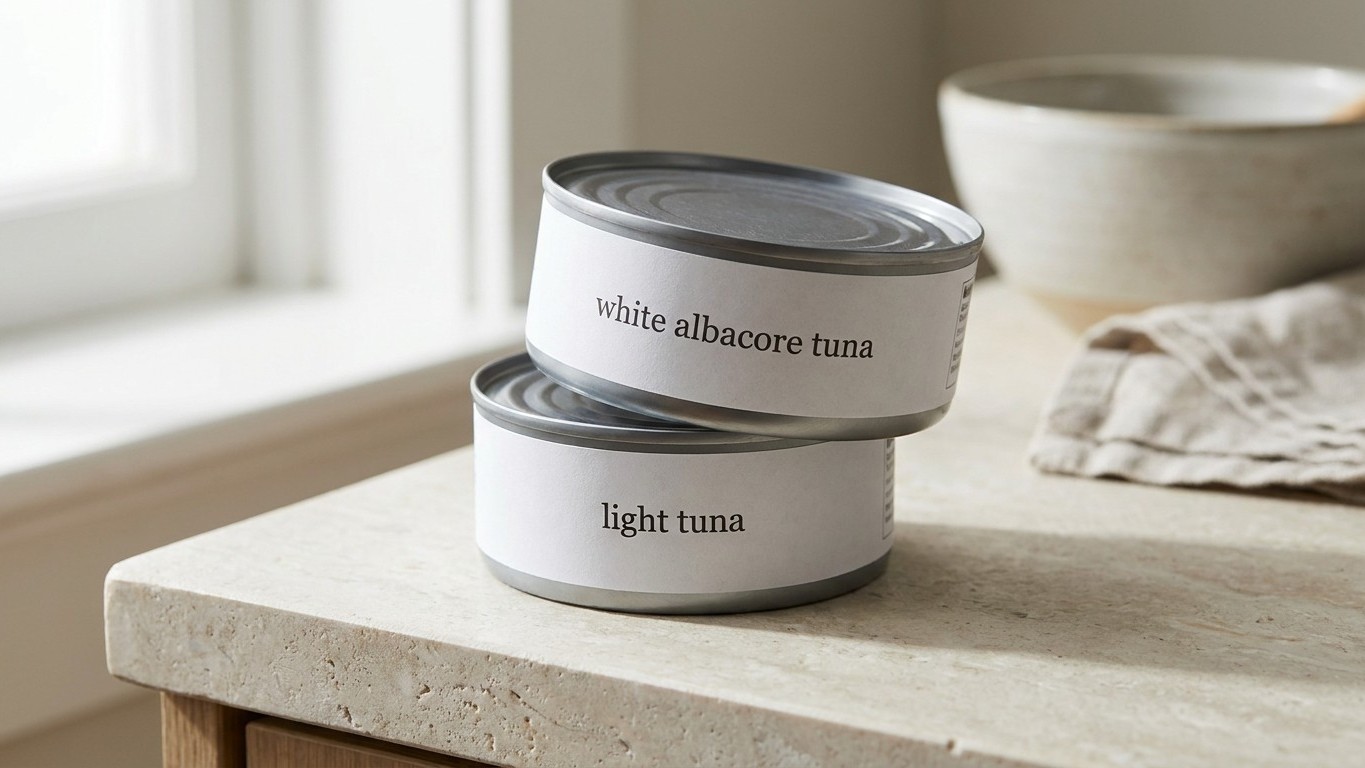
Two cans, same aisle, same silver lid, one word different: “white” versus “light.” For years, the “white” albacore felt like the upgrade, firmer flesh, milder taste, the kind of thing you’d serve to guests without apologizing. Then one afternoon, waiting for the microwave, I flipped the can over and actually read the fine print near the nutrition panel. The word that stopped me wasn’t fat or sodium. It was mercury. That’s when the twice-a-week tuna salad habit started looking a lot less harmless.
Key takeaways
- White and light tuna aren’t quality grades—they’re completely different fish species with drastically different mercury loads
- Federal testing shows albacore contains over 3 times more mercury than skipjack-based light tuna, plus hidden arsenic concerns
- The FDA recommends only 1 serving per week of white albacore, not the twice-weekly habit most people unknowingly maintain
White Isn’t Better. It’s Just a Different Fish, With a Different Mercury Load
Here’s the part nobody tells you at the shelf: “white tuna” and “light tuna” aren’t quality grades, they’re different species entirely. Albacore, the fish behind every can labeled “white,” is a bigger, longer-lived animal than skipjack, the small schooling fish that mostly fills “light” cans. Albacore is a larger and longer-living fish than skipjack and other types of light tuna, giving it more mass and more time to ingest more mercury. Size and lifespan matter enormously in the ocean’s mercury math, because mercury doesn’t wash out, it accumulates.
The mechanism is almost mundane once you understand it. Mercury is an impurity in coal; when coal is burned, elemental mercury goes to the clouds and comes down when it rains, ending up in the ocean as methylmercury. Fish eat it and then large fish eat the smaller fish, and that’s how they accumulate mercury. An albacore that’s lived for years, working its way up the food chain, is simply carrying more of it than a skipjack caught young and small. Nothing sinister, no scandal, just biology, but biology that never makes it onto the front label.
The Numbers I Wish I’d Seen Sooner
The gap isn’t subtle. Federal testing has repeatedly shown the same pattern: albacore tuna, also known as white tuna, typically contains three times more mercury than canned light tuna. Older FDA sampling put it at an average of 0.35 parts per million for canned albacore, while light tuna had 0.12 ppm, and Consumer Reports’ more recent lab work landed on a similar ratio, finding that albacore tuna contains over three times more mercury than skipjack or light tuna on average.
That difference translates directly into how federal guidance treats the two cans. Under the joint FDA/EPA fish advisory, canned light sits in the “Best Choices” tier, while albacore gets bumped down a category. Canned light tuna is in the “Best Choices” category, albacore (or white) tuna and yellowfin tuna are in the “Good Choices” category, and bigeye tuna is in the “Choices to Avoid” category. Practically, that means when you eat albacore or any of the other fish from the “Good Choices” category, you should have only 1 serving and no other fish that week. One serving. Not the twice-weekly rotation I’d been running, convinced I was doing the responsible thing.
What really got under my skin, though, was the inconsistency. Consumer Reports tested three lots each of ten products and found real can-to-can spikes: out of 30 samples, they found six individual spikes in mercury content, amounting to one in five cans, that would change the FDA’s recommendation about how often someone should eat that particular tuna. Same brand, same label, wildly different result depending on which lot landed in your pantry. None of the albacore CR tested had mercury levels low enough for an adult to have three servings a week, only one brand’s albacore allowed two weekly servings, and the rest warranted just one serving a week, with children advised to avoid albacore Completely. That’s a category built around caution, and I’d been treating it like a lunchbox staple.
What I Actually Changed in My Cart
Mercury isn’t the only guest crashing the albacore party, either. A more recent independent lab analysis flagged another contaminant hiding in the same cans: arsenic was particularly problematic in canned albacore tuna, with five out of six products found to contain more than 100 mcg of arsenic per 85-gram serving, and two of these products also contained significant amounts of mercury. Two heavy metals, one can, and I’d been serving it as the “safe” choice.
None of this means tuna is off the table, and honestly, panic is the wrong reaction here. Canned light, made mostly from skipjack, remains a genuinely solid option. When buying tuna, opt for skipjack or canned light varieties, which do not contain as much mercury as albacore or bigeye tuna. I still keep light tuna in the pantry, still make the same sandwich my kids ask for. What changed is the albacore can, now an occasional treat rather than a Tuesday-and-Friday ritual, and a habit of glancing at labels before assuming “premium” means “better for you.” Pregnant women and young children get the strictest guidance of all, and for good reason, since developing brains are the most vulnerable to accumulated mercury exposure.
The small type on that can didn’t just change what’s in my pantry. It changed how I read every “premium” label after, because in food marketing, the word that sounds like an upgrade is sometimes just the one nobody bothered to test twice.
Sources : ksat.com | food-safety.com