
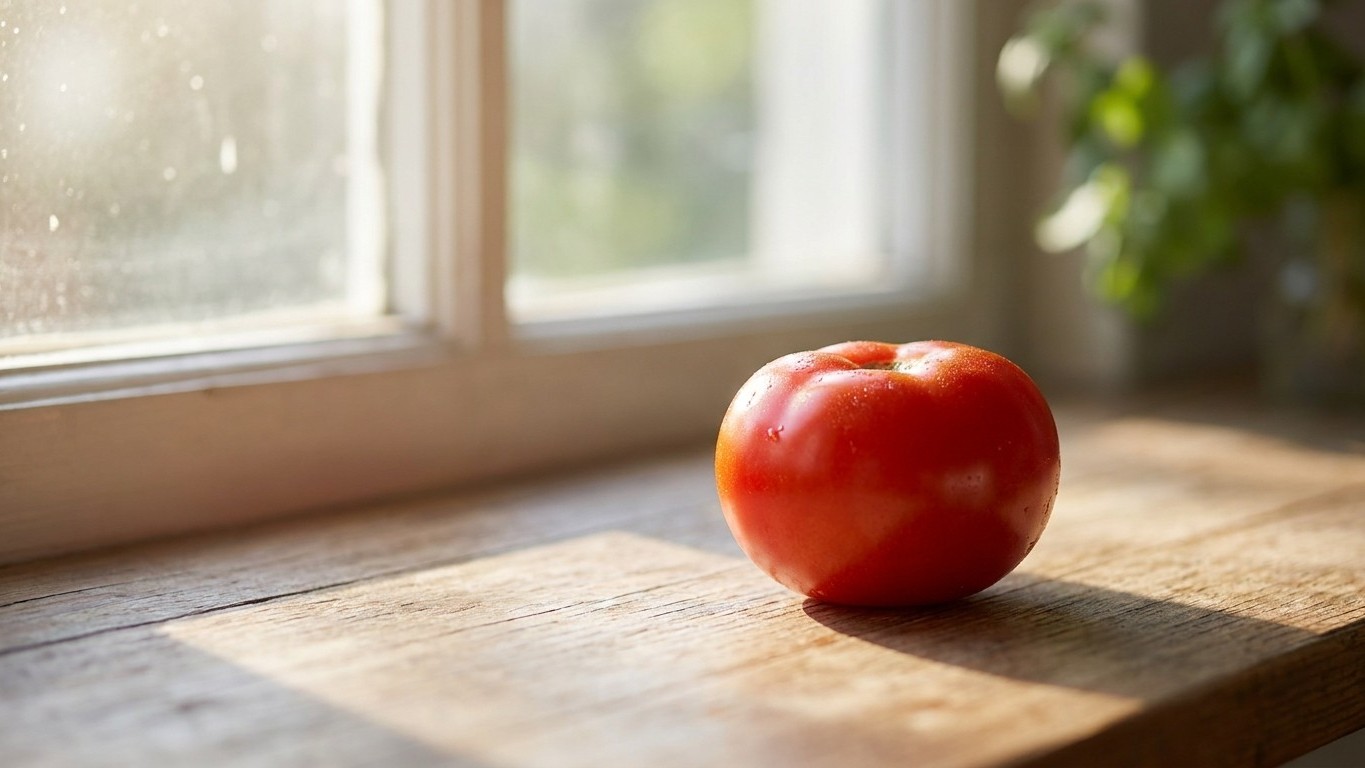
Every summer, the same domestic drama plays out in kitchens across the country: a farmers-market tomato, still warm from the sun, gets carried straight to the crisper drawer. Within days, that tomato tastes like nothing at all. Not because it went bad. Because something switched off inside it the moment the temperature dropped.
Scientists have actually pinpointed the number. Flavor-associated volatiles in tomatoes are sensitive to temperatures below 12°C, and their loss greatly reduces flavor quality. That’s roughly 54°F, a temperature most refrigerators blow past without hesitation. A standard home fridge sits closer to 39°F, according to research published in Food and Bioprocess Technology, which notes that home refrigerator storage at around 4–6 °C may cause a severe alteration of the tomato aroma profile and it could be considered as one of the most contributing factors to consumer complaints about inferior tomato flavour. So the fruit isn’t just chilled a little. It’s plunged well past the point of no return.
Key takeaways
- A specific temperature threshold triggers a molecular switch that dims flavor genes inside tomatoes
- The damage is partially irreversible, even after days of sitting at room temperature
- Green tomatoes in the fridge face an entirely different (and worse) fate
The Gene That Goes Quiet
Here’s where it gets genuinely interesting, and a little unsettling if you think about it too long. A landmark study from a University of Florida team led by Harry J. Klee, published in the Proceedings of the National Academy of Sciences, didn’t just confirm that cold kills flavor. It found out why, down at the molecular level. When tomatoes were stored at temperatures below 12°C, genes involved in ripening flavor development were methylated, leading to reduced expression of those genes.
Methylation, for anyone who skipped high school biology, is essentially a chemical tag that tells a gene to pipe down. The researchers found this happening to master switches like RIN, NOR, and CNR, the transcription factors that orchestrate ripening itself. RNAs encoding transcription factors essential for ripening, including RIPENING INHIBITOR, NONRIPENING, and COLORLESS NONRIPENING are reduced in response to chilling and may be responsible for reduced transcript levels in many downstream genes during chilling. Practically speaking, that means the fruit stops manufacturing the very enzymes needed to produce its signature scent compounds. Levels of messenger RNA coding for enzymes involved in producing flavor, including those responsible for several consumer-favorite volatiles such as isovaleraldehyde, 3-methyl-1-butanol, and 2-methyl-1-butanol, dropped when tomatoes were chilled.
What’s almost poetic, in a grim way, is that the sugar and acid content barely budges. Chilling did not alter fruit sugar and acid contents, but significant loss of flavor volatiles was observed for fruit stored at 5°C for 8 days. A chilled tomato can still measure “sweet” and “acidic” on paper while tasting utterly flat on the tongue, because taste and aroma are not the same sense, and it’s the aroma molecules, the volatiles that hit your nose as you chew, that carry most of what we call flavor. Tomato characteristic flavor is the result of complex interactions among organic acids, sugars and more than 400 volatile compounds. Kill even a fraction of those 400, and the whole architecture of taste collapses.
Why You Can’t Just Warm It Back Up
The instinct is obvious: leave the tomato out for an hour before dinner, let it “wake up,” problem solved. Except the science says otherwise, and this is the part that genuinely surprised the researchers themselves. Even after a 1-day recovery period at 20°C, volatile composition was still significantly lower than in unchilled fruit, resulting in lower overall consumer liking. A follow-up report on the same findings put it bluntly: after roughly a week in the fridge, “three days of sitting at room temperature didn’t remedy that, and a taste test by 76 people confirmed the chilled tomatoes weren’t as good as fresh fruit.”
There is a small window of forgiveness, though. Other trials have shown partial recovery is possible if the chilling period was brief. A strong negative effect on the volatile profile of red-ripe fruits stored at 4°C could, up to a week, be restored by reconditioning the tomatoes at room temperature for 24 hours. So the damage is dose-dependent: a quick overnight chill is more forgivable than a full week languishing in the crisper drawer. The real problem, honestly, is that most of us don’t buy a tomato and eat it the same day. It sits in the fridge for five, six, seven days, right in the window where the flavor loss becomes essentially permanent.
Green Tomatoes Have Their Own Rules
Underripe, green-shouldered tomatoes complicate the picture further. Refrigerating them doesn’t just mute future flavor, it can halt ripening altogether and trigger cold damage that shows up as pitting or a mealy, waterlogged texture. Tomato fruits are very sensitive to cold stress and storage at temperatures below 10°C triggers several chilling injury symptoms such as flavor loss, impaired ripening, surface pitting, poor texture, increased susceptibility to postharvest decay and discoloration. Put a green tomato in the fridge and you’re not preserving it for later. You’re locking in mediocrity.
None of this means refrigeration is always the villain. If a tomato is already overripe, bruised, or you genuinely can’t finish it before it spoils, the fridge slows decay and that’s a legitimate trade-off. The mistake is treating it as the default home for every tomato, all the time, out of habit rather than necessity.
So Where Should They Actually Live?
The consensus among postharvest researchers is refreshingly simple: keep ripe tomatoes on the counter, ideally in the 54 to 68°F range, away from direct sun, and eat them within a few days. That’s it. No special produce bag, no elaborate ripening bowl ritual. Just distance from the compressor humming in the corner of your kitchen.
What strikes me, reporting on this, is how counterintuitive it feels in a culture trained to refrigerate almost everything on principle. We’ve been taught that cold equals safe, cold equals fresh. For a tomato, cold below that 12°C line is closer to an off switch, flipped at the genetic level, for the very thing that makes it worth eating in the first place. Next time a heatwave tempts you to stash your tomatoes next to the milk, ask yourself whether you’re actually trying to keep them, or just trying to keep them out of the way.
Sources : pmc.ncbi.nlm.nih.gov | ncbi.nlm.nih.gov