
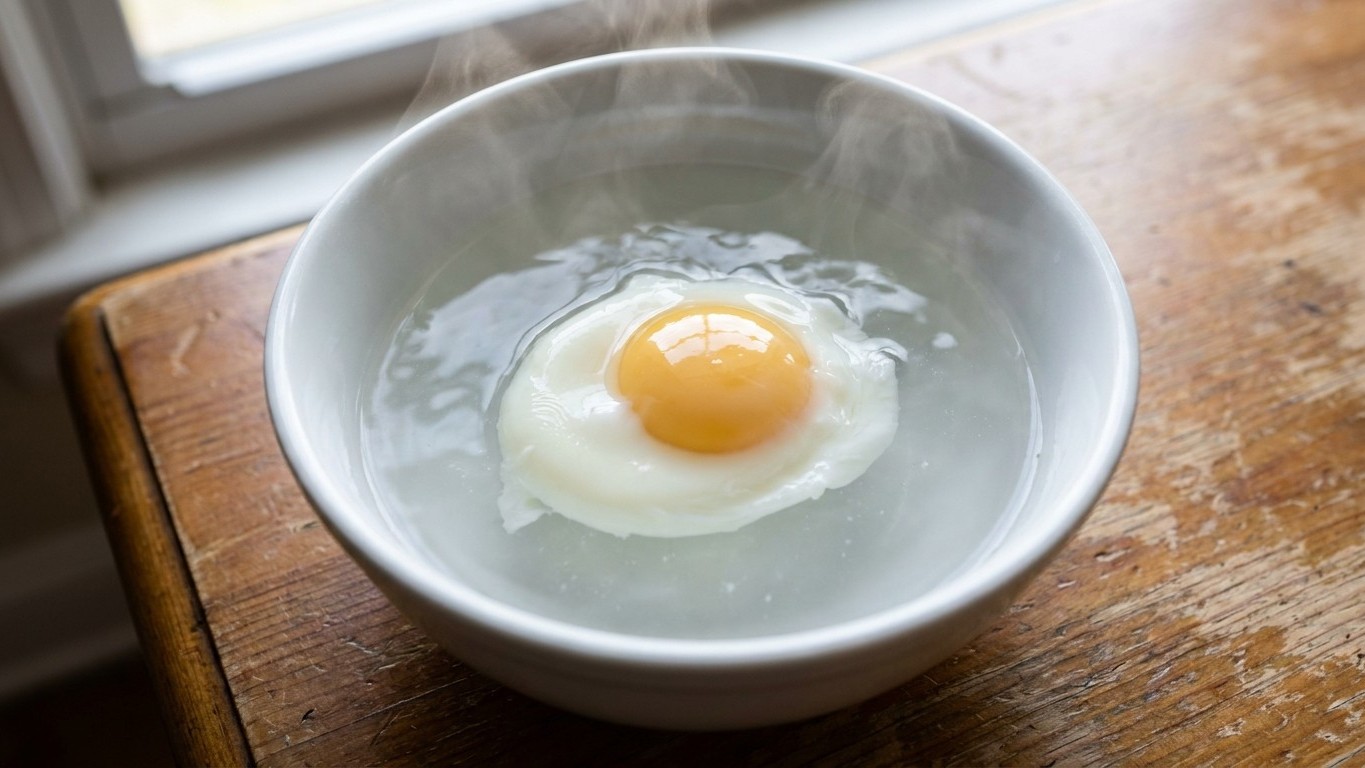
Three tablespoons of vinegar swirled into simmering water, a whisked vortex, eggs cracked at the exact right angle, and still, those wispy white tendrils spread across the pan like smoke. If this sounds familiar, the fix you’ve been missing isn’t in your vinegar bottle. It’s stamped in tiny numbers on the side of your egg carton, and it has almost everything to do with a ten-day window most home cooks never notice.
Key takeaways
- The protein structure inside eggs changes dramatically as CO₂ escapes, weakening the mesh that holds egg whites together
- That tiny three-digit Julian date on your carton reveals the true age—and it matters far more than the sell-by date
- Eggs older than ten days lose their ability to poach perfectly, no matter how much vinegar you use
The vinegar trick isn’t wrong, it’s just not the whole story
Let’s give vinegar its due first, because the chemistry is real. Vinegar lowers the pH of the cooking water, which causes the proteins in egg whites to coagulate faster, preventing the whites from feathering into long, stringy threads and helping form a compact, round poached egg. Acetic acid speeds up a process called denaturation, essentially forcing the egg’s proteins to firm up on contact instead of drifting apart in the pot.
But here’s where most kitchen advice stops short. The thicker, firmer whites in fresh eggs hold together around the yolk instead of spreading into wispy strands in the water, while older eggs have looser whites that dissolve and tend to make a cloudy mess. Vinegar can only speed up coagulation of whatever protein structure you hand it. If that structure is already loose and watery, no amount of acid rescues the shape. It’s a bit like tightening a belt on pants that are two sizes too big, helpful, sure, but not the actual solution.
What’s really happening inside the shell as an egg ages
The moment a hen lays an egg, a quiet chemical clock starts ticking. The chemical environment inside an egg changes significantly as it ages, and the most important driver of this change is the loss of CO2: in a freshly laid egg, albumen pH lies between 7.6 and 8.5, and as CO₂ escapes through the shell pores, the pH rises at a temperature-dependent rate, reaching a maximum of approximately 9.7. That rising alkalinity isn’t cosmetic. This increasingly alkaline environment activates enzymes that dismantle the ovomucin network, snapping the chemical bonds that give the white its structure.
Ovomucin is the unsung hero of a good poach, a fresh egg white has a thick, viscous portion that clings tightly around the yolk, and that thick portion gets its gel-like texture from a protein called ovomucin, which forms a mesh-like network that holds everything together. Once that mesh degrades, the thick white collapses into a watery liquid, and the two layers become indistinguishable. And this degradation doesn’t wait weeks to start. After just 3 days at 3°C, researchers recorded an albumen pH of 9.18; after 21 days it approached 9.4 regardless of storage temperature. Translation: your egg is aging noticeably before you’ve even finished the carton.
The number on the carton that matters more than “sell-by”
Here’s the part almost nobody checks. Every egg carton sold in the US carries a three-digit Julian date, tucked near the sell-by stamp, and it indicates the pack date, running consecutively starting with 001 for January 1, so 078 would indicate the eggs were packed on March 19. This date, not the sell-by date, tells you the true age of what’s in your fridge.
And the gap between the two can be shockingly wide. The “best by” or “use by” date can’t be more than 45 days past the packaging date, and the “sell by” or “expiration” date can’t be more than 30 days past the packaging date. Meaning eggs sitting in the dairy case with weeks left on the label could already be three or four weeks removed from the henhouse. Frankly, that’s the detail most poaching tutorials skip entirely, focused as they are on swirl technique and vinegar ratios.
So where does ten days come in? Food scientists and test kitchens converge on a narrower window than the legal safety limit. Look for eggs with the latest expiration date, and poach them within a few days to maximize the benefits of freshness, resulting in velvety yolks perfectly cocooned inside thin layers of egg whites. Beyond that early stretch, and particularly once you cross roughly the ten-day mark from the Julian pack date, the ovomucin network has already loosened enough that whites start to spread no matter what’s in your poaching liquid. The best eggs for poaching are the freshest eggs you can find; if eggs are more than a week old, the whites thin out, while whites of fresh eggs gather compactly around the yolk, making a rounder, neater shape.
A quick reality check before you blame your technique
Not sure how fresh your carton really is without decoding numbers? The float test is the most reliable at-home freshness check: fill a bowl with cool tap water, gently place the egg in, and if it sinks and lies flat on the bottom it’s very fresh, less than a week old; sinks but tilts means one to two weeks old; sinks but stands upright means three to four weeks old. An egg that stands bolt upright can still be perfectly safe to fry or scramble. For poaching, though, it’s already fighting an uphill battle against physics.
None of this means retiring the vinegar bottle — it still buys a faster set and slightly more forgiving whites, especially with eggs that are a week or so old. But the real lever, the one that actually determines whether your poached egg looks like a restaurant plate or a science experiment, sits three digits deep on the side of the carton. Next grocery run, skip the sell-by date entirely and hunt for the Julian code instead; whichever carton has the highest number wins, and that’s the dozen worth saving for a Sunday poach.
Sources : farmersalmanac.com | cookedbytaste.com