
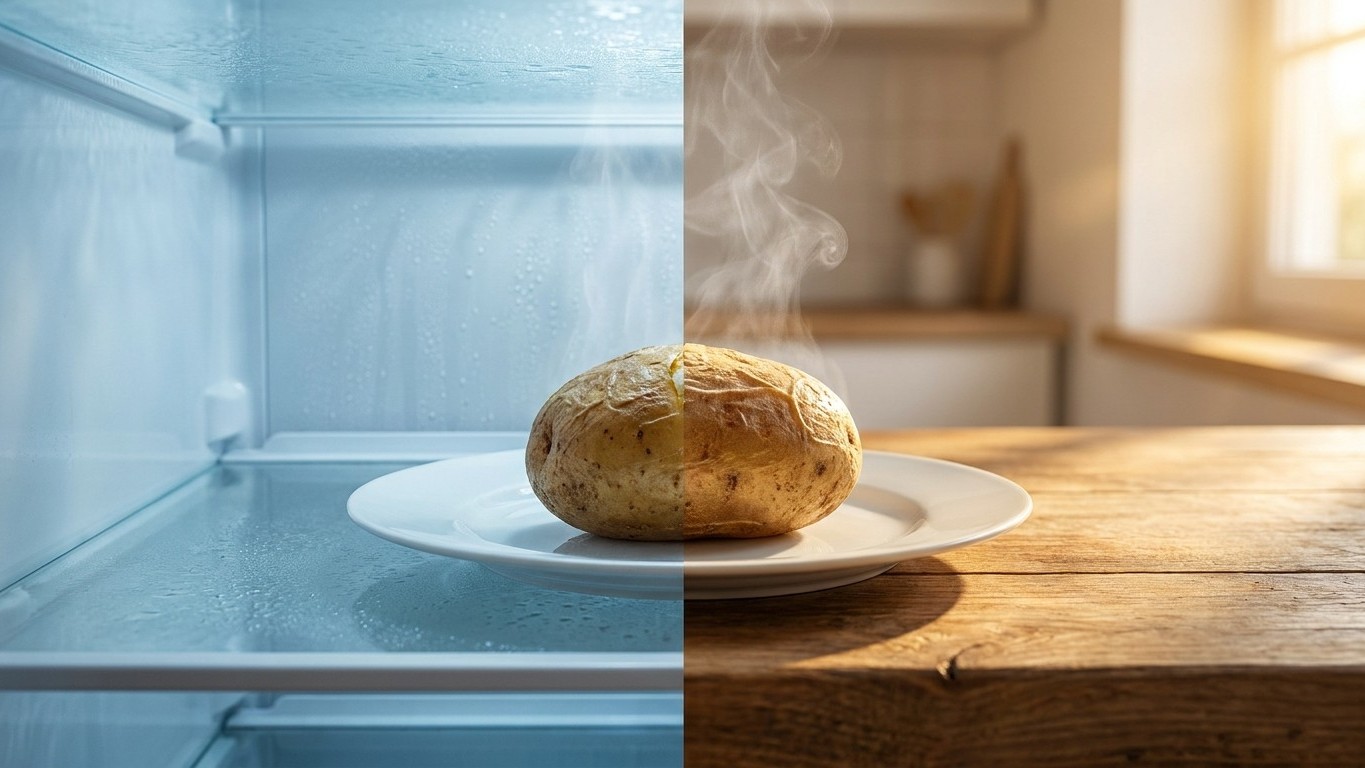
Two years ago, I started sliding my cooked potatoes into the fridge before eating them, not as a health strategy, just kitchen habit, batch-cooking on Sundays and reheating through the week. Then, on a random Tuesday last spring, a continuous glucose monitor I’d been wearing for an unrelated reason showed me a curve after lunch that stopped me cold: barely a bump, where I expected a spike. The potatoes I’d eaten straight from the fridge, cold, weren’t behaving like potatoes at all.
Turns out there’s a name for what happened on my plate, and a growing body of research behind it. It’s called retrogradation, and it quietly rewires starch into something your gut treats almost like fiber.
Key takeaways
- A continuous glucose monitor revealed cold potatoes caused minimal blood sugar rise compared to hot potatoes
- When potatoes cool, their starch structure reforms into resistant starch—which digestive enzymes can barely break down
- Human studies show 24 hours in the fridge can nearly double resistant starch content and cut glucose spikes by 28%
What actually happens when a potato goes cold
Potato starch is made of two molecules, amylose and amylopectin, tightly packed inside granules. Cooking with heat and water pries that structure open, making the starch easy for digestive enzymes to break down into glucose, which is exactly why a hot baked potato tends to send blood sugar climbing fast. Heat and water allow the amylose and amylopectin in the starch granule to disassociate, allowing increased accessibility to digestive enzymes, but chilling reforms the amylose and amylopectin into a packed structure, a process known as retrogradation.
The result of that re-packing is resistant starch, so named because it resists digestion in the small intestine. Resistant starch cannot be broken down by digestive enzymes and enters the large intestine intact, and of the five types, type 2 is found in raw and cooked potatoes, while type 3 is present in cooked, then chilled potatoes. That third type, RS3, is the one my fridge was manufacturing every night without my asking.
The numbers aren’t subtle, either. Boiled, baked, or microwaved potatoes contain less resistant starch (mean 2.3 g/100 g) than cooked then chilled potatoes (mean 5.6 g/100 g). Older analytical work found something similar: 7% resistant starch in cooked potato increases to about 13% upon cooling. Roughly double, sometimes more, just from sitting in the cold for a day.
The blood sugar numbers, spelled out
This isn’t a theory dreamed up in a lab and left there. Human trials keep landing on the same conclusion. A Swedish study on healthy adults found that cold storage of boiled potatoes increased resistant starch content significantly from 3.3 to 5.2% on a starch basis, and that cold storage per se lowered the insulinemic index by 28% compared with the corresponding value for freshly boiled potatoes.
A separate study comparing hot and cooled potato meals in men with varying insulin sensitivity reported that cold potatoes have significantly lower glycemic index than hot potatoes do, presumably due to higher resistant starch content, and that the difference showed up quickly, with mean postprandial glucose values at 30 minutes significantly greater after hot potato consumption than after cold.
A 2019 study focused specifically on women with elevated fasting glucose and insulin, the population that stands to gain the most, confirmed that chilled potatoes lowered the postprandial glucose response compared to freshly boiled ones. That’s not a marginal effect for someone watching their numbers after meals, it’s the difference between a curve that flattens and one that spikes.
Franchise diabetes advice tends to lump potatoes in with white bread and treat them as an automatic high-glycemic offender. The research suggests that’s an oversimplification. Variety and preparation swing the numbers wildly, waxy boiling potatoes sit at a different glycemic tier than a fluffy baked Russet — and Temperature at the moment of eating turns out to be one of the biggest levers home cooks actually control.
Why the fridge beats the microwave shortcut
Here’s the part that surprised me most: reheating doesn’t fully undo the benefit. Once retrogradation has crystallized the starch structure, warming the potato back up doesn’t reverse it completely, which is why meal-preppers can make a batch on Sunday, reheat portions through the week, and still get a meaningfully gentler glucose response than eating Everything fresh off the stove. Comparable research on cooked-and-cooled pasta and rice backs this up: cooling gelatinized starch promotes retrogradation and increases resistant starch, potentially attenuating postprandial glucose excursions, and analogous findings have been reported for rice and potatoes: cooling and/or reheating can increase resistant starch and lower postprandial glycemia in controlled studies, although the magnitude varies by food type and experimental design.
The practical translation: 24 hours in the fridge is the sweet spot cited across most of these trials, not a quick 20-minute chill. Longer chilling generally means more retrogradation, up to a point.
There’s a bonus most people don’t clock. Cooling or storing after processing of potatoes significantly reduces the glycemic index due to retrogradation of starch molecules, but that same resistant starch also behaves like a prebiotic fiber once it reaches the colon, feeding gut bacteria that produce short-chain fatty acids. So the fridge isn’t just softening a sugar spike, it’s rerouting some of that starch toward gut health instead of straight into your bloodstream.
None of this makes potatoes a diabetes-friendly miracle food, and portion size still matters more than any single trick. But the gap between a potato eaten hot off the stove and the same potato eaten cold a day later is real, measurable, and something anyone with a fridge and a little patience can put to use tonight.
Sources : ncbi.nlm.nih.gov | mdpi.com