
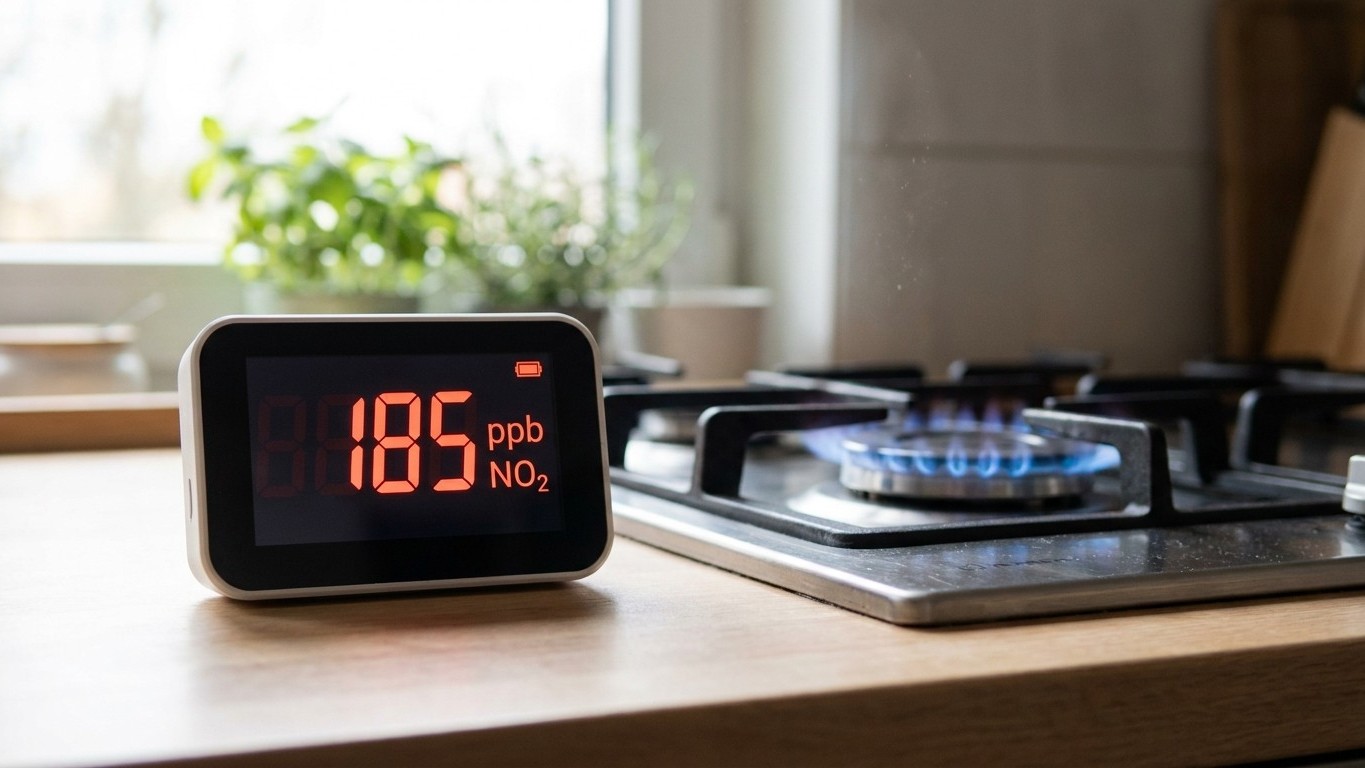
The meter sat on my counter for exactly 24 hours, blinking numbers I didn’t fully understand until the graph came back. Nitrogen dioxide, spiking past 200 parts per billion every time I lit a burner, then settling into a slow bleed that never quite returned to baseline before the next meal. Eight years of cooking under a recirculating hood, the kind that pulls air through a charcoal filter and pushes it right back into the room, and I’d assumed that little mesh pad was doing something. It wasn’t doing what I thought.
I’d avoided drilling through an exterior wall for years. Renters do this calculation constantly: the hassle of core-drilling brick or siding, the risk of voiding a lease agreement, the assumption that a filter is basically a smaller, quieter version of true ventilation. Many modern cooking appliance installations include recirculating hoods, which do not send smoke, grease, or combustion emissions to the outdoors but instead push it through a filter and back into the house. That single sentence, once I actually read it, reframed eight years of dinners.
Key takeaways
- A kitchen air quality meter recorded nitrogen dioxide levels more than double the EPA’s outdoor standard, every single meal
- Charcoal filters lose 80% of their NO₂ filtering ability within weeks, not months, without most people realizing it
- For someone cooking on gas, indoor NO₂ exposure often matches what you breathe from all outdoor sources combined
What the charcoal never touched
Grease and odor, sure. That part works. But combustion gases are a different animal entirely, and the filter in my hood was never built to stop them. A recirculating hood filters air through a grease mesh and a charcoal filter, then returns it to the room, and it’s genuinely useful for odors and captures some grease and particulate, but it’s the weaker choice for combustion gases. Independent testing backs this up with numbers that stopped me cold: recirculating hoods remove only around 30% of PM2.5, and a charcoal filter’s NO₂ performance can start near 60% but fall toward 20% within a few weeks as the filter loads up.
Twenty percent. After a few weeks. I hadn’t changed my filter in months, closer to a year, because nothing about it looked dirty enough to bother. A Dutch research organization found something nearly identical: a recirculation hood with a new activated carbon filter can reduce NO₂ peak concentration by 67%, but efficiency rapidly decreases to a 19% efficiency in as little as 19 days. Nineteen days. My filter had been coasting on fumes, literally, for the better part of a year.
The numbers behind the panic
Here’s what actually happens when a gas burner ignites, whether or not there’s a hood spinning above it. Every time a gas burner ignites, it produces nitrogen dioxide, carbon monoxide, formaldehyde, fine particulate matter, and ultrafine nanoparticles. None of that is visible. None of it smells like anything in particular, which is exactly why it’s so easy to ignore for eight straight years.
The scale surprised me more than the existence of the problem. Kitchen NO2 levels spike to 200 to 400 ppb within minutes of lighting a burner, more than double the EPA’s 1-hour outdoor standard of 100 ppb, and that pollution migrates into bedrooms within an hour. A landmark study out of Stanford put a number on the long game too: gas stoves increase long-term NO2 exposure by 4.0 ppb on average across the country, equivalent to roughly 75% of the World Health Organization’s safe annual guideline. A Stanford researcher framed it in a way that finally made the abstraction personal, noting that for someone cooking on gas, the NO2 you breathe indoors from your stove alone often matches what you absorb from all outdoor sources combined.
Home size Matters More Than most people realize, too. The exposure gap between small and large homes is dramatic, with residents of homes under 800 square feet experiencing four times the NO2 concentration compared to larger dwellings. My apartment, roughly the size of a generous studio, was doing me no favors on that front.
None of this exists in a regulatory vacuum either, which is its own quiet scandal. The United States has no federal indoor air quality standards for NO2, and the outdoor standard of 53 parts per billion hasn’t been updated since 1971, and it doesn’t apply indoors. Nobody is coming to check your kitchen. You’re the regulator, whether you signed up for the job or not.
Living with a wall you can’t drill through
Not everyone can duct outward. Layout, lease terms, historic building restrictions, they’re all real constraints, not excuses. Apartments and many older kitchens can’t easily add a vent to an exterior wall, and landlords may not permit it, but you still have meaningful options. A California-based advisory from physicians spelled out the maintenance schedule I’d been ignoring: if your range hood has a charcoal filter in addition to a grease filter it should be replaced every 3-4 months. That’s four times a year, not once every presidential election cycle, which is closer to what I was actually doing.
The same guidance pushes past the hood entirely, because a filter, even a fresh one, was never meant to work alone. Ductless ventilation circulates the air but does not remove indoor air, so you should open at least one window or door, two or more is better, while cooking to promote air circulation. When outdoor air quality makes that impossible, there’s a backup layer worth knowing about: use air purifiers with MERV-13 filters for particulates and activated charcoal filters for NO2 and other gases, including VOCs like benzene, to improve indoor air quality.
Genuinely swapping fuel sources changes the equation entirely, and it’s worth saying plainly. Induction produces no combustion gases, so there’s no NO₂ source, though you’ll still create PM2.5 from the cooking process, so ventilation still helps. I haven’t made that jump yet. But my filter now gets replaced every twelve weeks, marked on a calendar like a dentist appointment, and the window over my sink stays cracked the entire time a burner is lit, rain or shine, because a meter already told me exactly what happens when it doesn’t.
Sources : sciencedirect.com | us.ciarraappliances.com