
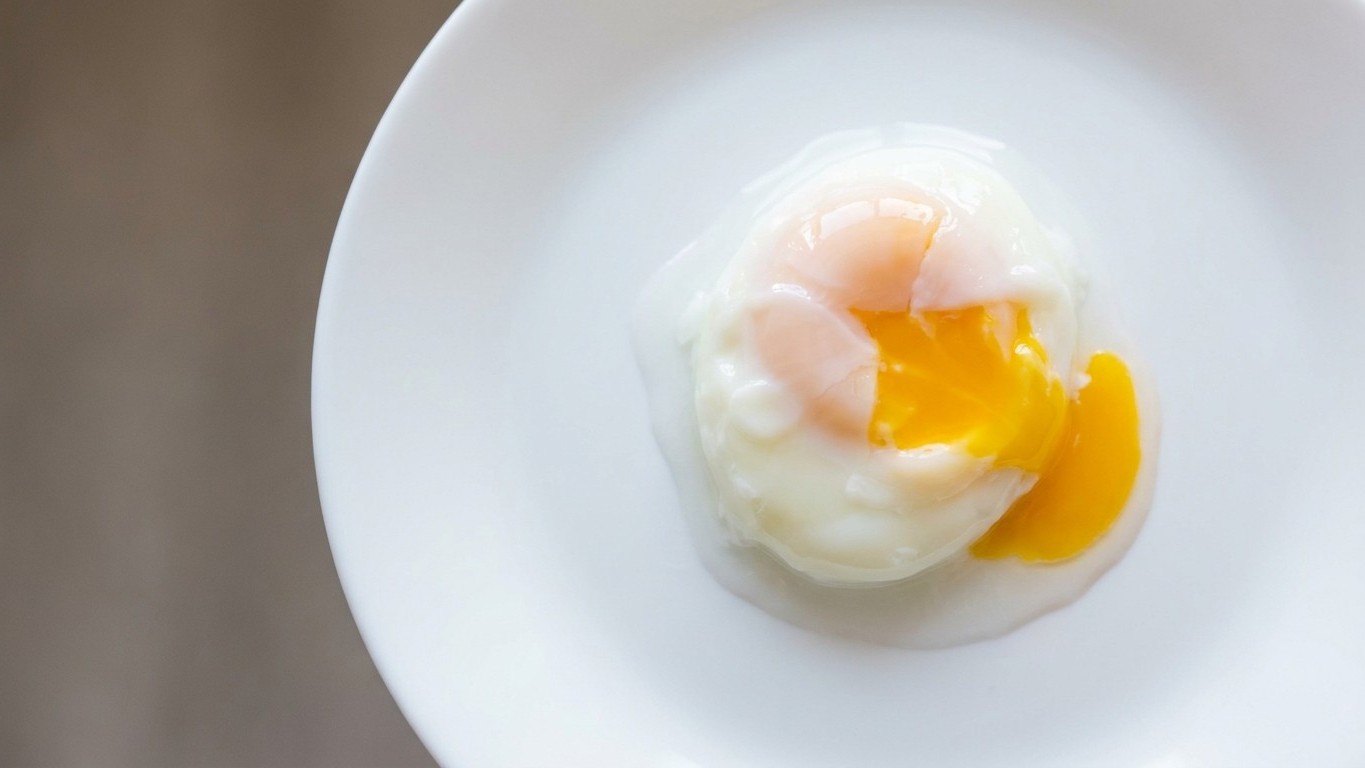
Nine days. That’s the real window that decides whether your poached egg holds a clean, glossy oval or dissolves into ragged little clouds, and no splash of vinegar in the simmering water is going to save an egg that’s already past it. The fix everyone reaches for happens at the stove. The actual fix happened at the henhouse, more than a week earlier.
Here’s the uncomfortable truth for anyone who’s been dutifully splashing white vinegar into their poaching liquid for years: it’s largely compensating for old eggs, and it comes with a real cost. Firming the whites faster with vinegar simply overcooks them before the yolks are ready, and whites cooked in vinegary water appear opaque rather than shiny, tough and chalky rather than tender and silky. Some cooks can even taste the difference. One longtime food writer says she can spot a vinegar-poached egg immediately, before she even takes a bite. That’s not a small aesthetic quibble. It’s the difference between a restaurant-worthy egg and one that just tastes like it tried.
Key takeaways
- That vinegar trick you’ve been using? It’s just hiding a bigger problem that started nine days ago
- Inside every egg, a protein network called ovomucin is slowly dismantling—and no acid can reverse what time has already done
- Two simple 15-second tests reveal exactly whether your eggs will poach into silky perfection or watery disaster
What actually happens inside an egg during those nine days
An egg white isn’t one uniform substance. It has structure, and that structure is exactly what falls apart with time. A fresh egg white has two distinct layers: a thick, viscous portion that clings tightly around the yolk, and a thinner, more liquid layer around the outside, with the thick portion getting its gel-like texture from a protein called ovomucin, which forms a mesh-like network that holds everything together.
The moment an egg leaves the hen, the clock starts. A freshly laid egg has an albumen pH of about 7.6 to 8.5 and is saturated with dissolved carbon dioxide, but over time CO2 escapes through the porous shell and the pH climbs toward 9.7. That shift sounds abstract until you see what it does structurally. The increasingly alkaline environment activates enzymes that dismantle the ovomucin network, snapping the chemical bonds that give the white its structure, and the higher the pH goes, the faster the thick white liquefies. No amount of acid dropped into a pan of simmering water reverses that chemistry. It just cauterizes the surface fast enough to hide the damage.
Which brings us back to nine days. Australia’s national science agency, CSIRO, notes that eggs keep their freshness for up to nine days after being laid, but the shelf-life will be shorter the higher the temperature. That’s not a random cutoff picked by a food blogger; it lines up with how egg grading actually works in places like the UK, where the tightest freshness category, sold as “Extra Fresh,” covers eggs that are nine days old or younger. In the United States, the system is a little different but tells the same story in disguise. Cartons carrying the USDA grade shield display a Julian pack date, and by regulation when a sell-by date appears on a carton with the USDA grade shield, that code date cannot exceed 30 days from the pack date. Safe to eat for weeks after, sure. Structurally ideal for poaching? That window closes much sooner.
Why the vinegar habit stuck around anyway
It’s not that vinegar does nothing. It genuinely speeds coagulation, and if your eggs are a few weeks old and you have no better option, it will hold a poach together that would otherwise fall apart. That’s precisely the problem: it became a permanent workaround for a temporary problem, baked into recipe after recipe as though it were mandatory rather than corrective. Plenty of professional cooks have quietly dropped it. As Food52’s poaching guide puts it, all you actually need is fresh eggs and a slotted spoon, no vinegar needed. Kitchen writers testing the technique side by side keep landing on the same conclusion: the freshest eggs have tight whites that stay together without vinegar.
There’s a second layer to the folklore, too. Salt gets added to poaching water on the theory that it firms things up, but the texture cost is similar to vinegar’s. Salted water also seems to make the egg whites slightly chalky, according to Food52, which is reason enough to season the plate instead of the pot.
How to actually check what you’re working with
Forget guessing. There are two low-tech tests that take fifteen seconds and tell you almost everything. Gently place the egg in a bowl of water: if it sinks and stays on its side, it is very fresh; if it stands on one end, it is aging but still safe; if it floats, discard it immediately. That sinking behavior isn’t magic, it’s physics: the float test works because the air pocket expands as the egg ages, changing its density.
The second test happens after cracking. Crack the egg onto a flat plate: a fresh yolk will stand high and plump, surrounded by a thick, clear ring of albumen, while an older egg will spread out quickly, appearing watery and thin. If your white spreads into a thin puddle before it even hits the water, no amount of stovetop technique is going to rescue it into a tidy sphere.
For eggs that are a bit past their prime but not spoiled, there’s still a decent workaround that has nothing to do with acid. Crack the egg into a fine-mesh strainer and let the thinnest liquid drain away for about 30 seconds; what stays in the strainer is the denser portion of the white, which will hold together much better once it hits the simmering water. It’s not as good as starting with a nine-day-old egg straight from a cold fridge, but it buys you a real second chance.
Check the carton next time you’re at the store: that three-digit Julian code printed near the sell-by date tells you the exact day those eggs were packed, not just some vague deadline before spoilage. Do the math from there, and you’ll know almost precisely how many days of “poachable” life you actually have left.
Sources : seafood-portal.com | scienceinsights.org