
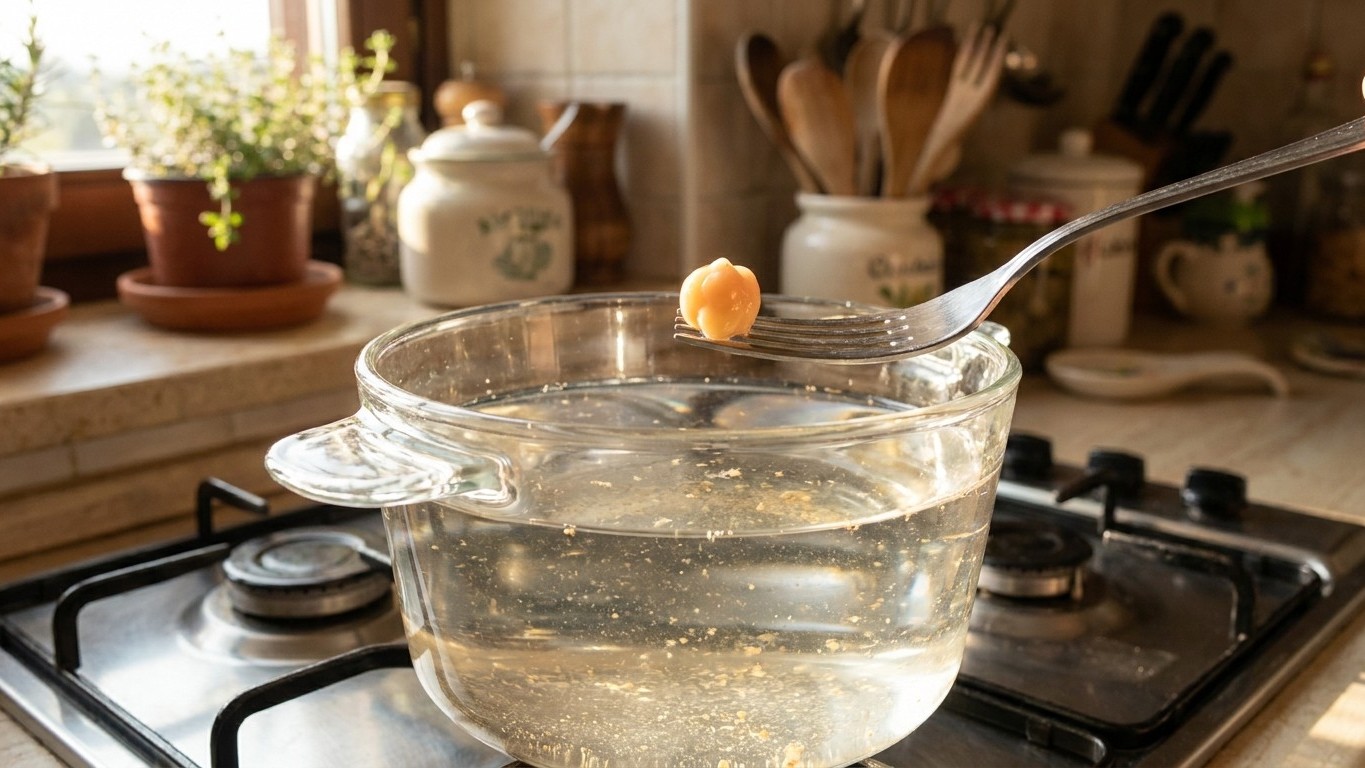
Three hours on the stove. A pinch more salt, a splash more water, maybe a lid tilted just so. And still, at the center of every chickpea, that same defiant “snap.” Most home cooks blame the beans. The real culprit is often sitting quietly in the faucet.
A whopping 85% of homes in the United States have hard water, which contains high levels of calcium and magnesium. Most people notice this as spots on glassware or a stubborn film on the shower door. Few connect it to a pot of legumes that refuses to yield after an entire afternoon of simmering. But the chemistry is precise, and once you understand it, the “bullet chickpea” phenomenon stops feeling like bad luck and starts feeling like basic kitchen science.
Key takeaways
- 85% of American homes have hard water that invisibly locks chickpea skins shut through a mineral-reinforcement process
- Extra cooking time makes it worse, not better—the longer you simmer in mineral-heavy water, the tougher the beans become
- Three unexpected solutions exist, from baking soda chemistry to reversing the ancient ‘never salt beans’ rule
The Cement Hiding in Your Tap
Chickpea skins and cell walls are held together by pectin, a natural structural glue found in the plant’s cell walls. Pectin breaks down at simmer temperatures through a heat-driven reaction that chops its long chains into shorter, soluble pieces, but pectin has a weakness: its chains carry acidic carboxyl groups, and double-charged metal ions like calcium and magnesium can grab two of those groups at once, bridging neighboring chains into a tight, insoluble network called calcium pectate. Hard water, unfortunately, is loaded with exactly those double-charged ions.
The result is almost architectural. Soft beans are not about softening the bricks, they are about loosening the mortar so the wall crumbles easily, and anything that hardens that mortar keeps the wall standing no matter how long it sits in hot water. One food science writer put it in a way that sticks: instead of the pectin dissolving and letting the bean soften, the calcium “reinforces” the cell walls, making them even tougher, almost like the beans are being reinforced with microscopic cement. Cook a pot of chickpeas in mineral-heavy water and you’re not just failing to soften them. You’re actively rebuilding their defenses, one simmering minute at a time.
Why “Longer” Never Fixes It
Here’s the counterintuitive part: extra cooking time doesn’t help, and can even work against you. When the calcium and magnesium in hard water penetrate the cell walls, the beans become less soluble and are prevented from becoming soft easily, you can boil for hours without achieving the texture you’re looking for. That’s the mechanism behind the classic kitchen complaint of chickpeas boiled for what feels like an eternity, still hard as little rocks after every trick in the book has been tried.
It’s also why the usual suspects (old beans, insufficient soaking, low heat) get blamed first, when water hardness deserves at least equal suspicion. Age genuinely matters, too. Dried beans eventually lose enough moisture that they cannot rehydrate properly, and if a bag has been in your pantry for years, it may never soften. But plenty of fresh, properly soaked chickpeas fail the fork test purely because of what’s dissolved in the cooking liquid, not what’s wrong with the bean itself.
Acid compounds the problem. Chana masala fans take note: adding acidic ingredients like tomatoes, lemon juice, vinegar, or wine too early in the cooking process is a common mistake, because acid toughens the skins of legumes, and tossing dried beans directly into a tomato-based sauce means they will likely stay hard forever. Combine that acid with hard water and you’ve essentially built a fortress twice.
The Fixes That Actually Work
The good news: none of the solutions require a plumber. Filtered or bottled water is the simplest first move. If you suspect hard water, use filtered water for both the soaking and cooking, or for especially stubborn batches, try a gallon of distilled water from the store to prove whether tap water was the problem.
Baking soda is the more surgical tool, and it works by flipping the water’s chemistry rather than avoiding it. Baking soda is naturally alkaline, and when added to soaking or cooking water it raises the pH level, weakening the pectin “glue” in the chickpea skins and interiors. The dosage Matters More Than people think. The reaction does not politely stop at tender, too much baking soda runs the cell walls past softening into collapse, turning beans mushy with a soapy, slippery texture and a faint metallic or off taste, while the useful dose is genuinely small, around a quarter teaspoon per pound of dried beans, not a heaping spoonful.
Salt, oddly enough, deserves a rehabilitation. The old rule about never salting beans until the end turns out to be backwards. You have probably heard that you should never salt beans until they are done because salt toughens them, but it is backwards: salt helps, because sodium is a single-charged ion, unlike calcium and magnesium. A brine before cooking allows some sodium ions to take the place of the calcium and magnesium ions already present in the beans, which will let more water penetrate the skins. Essentially, sodium evicts the calcium squatting in the pectin structure, without the collapse risk that comes with over-alkalizing.
For anyone who wants to skip the guesswork entirely, pre-boiling the water itself is a lesser-known trick. You can also try softening your hard water even without a water softener; there are filters and chemicals you can use, but you can also just pre-boil it. It won’t remove every mineral, but it changes the calculus enough that many stubborn pots finally give way.
None of this means old chickpeas get a free pass. Genuinely aged beans, the kind that have sat in a pantry for a year or two, do develop cell walls that turn nearly waterproof and simply won’t rehydrate no matter what’s in the water. But before tossing a batch and blaming the harvest date, it’s worth running one cheap experiment: swap the tap water for filtered, and watch what happens to the clock.
Sources : 123foodscience.com | quora.com