
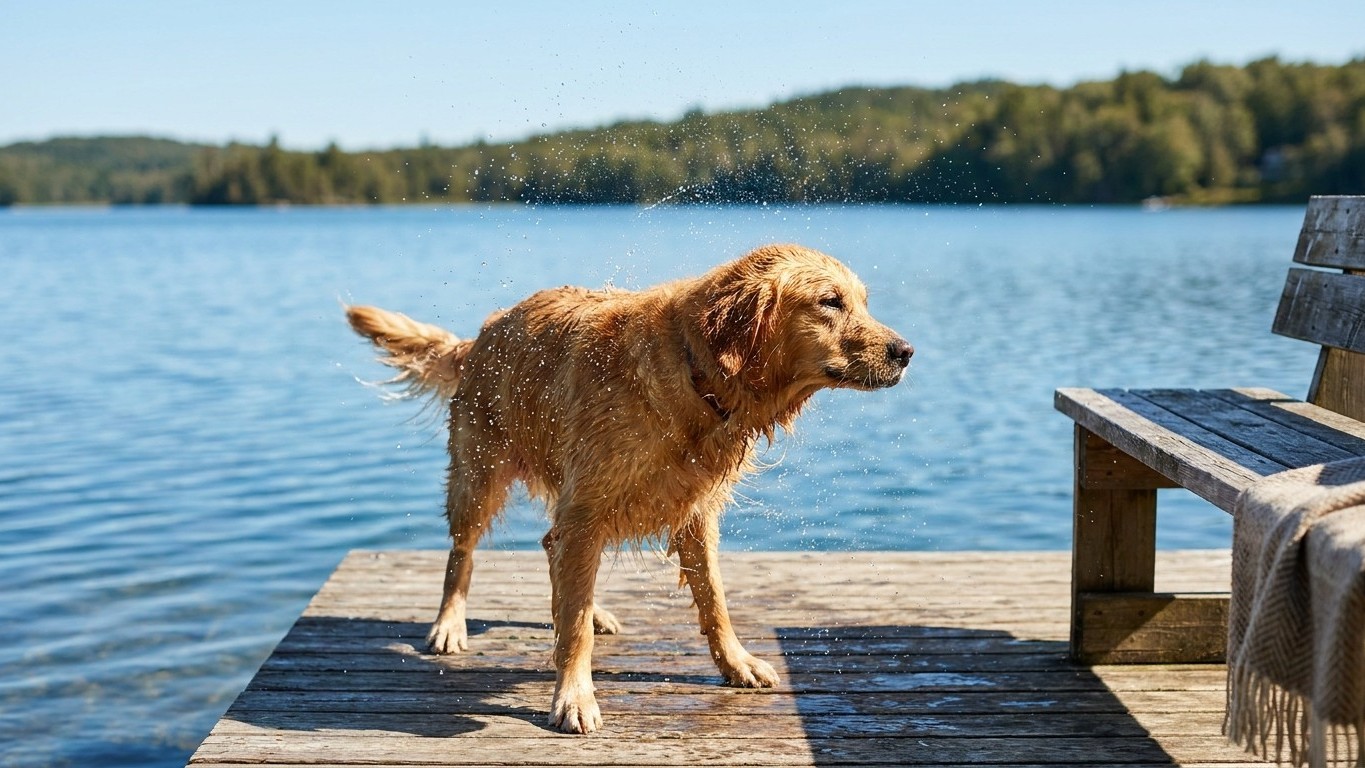
The green film was gone. That was the whole point. Three days after the surface scum had cleared from the lake near my parents’ place upstate, I figured the water was back to normal, safe enough for my golden retriever to paddle out after his tennis ball the way he’d done every August since he was a puppy. He swam for maybe twenty minutes, shook off on the dock, and licked himself dry in the sun the way dogs do. Nothing dramatic happened. That’s the part that still unsettles me.
It was the vet, three days later during an unrelated checkup, who asked the question that changed how I think about lake water entirely: had he licked his coat dry after swimming? I said yes, obviously, that’s just what dogs do. She didn’t panic. But her face did that thing vets’ faces do when they’re recalculating a risk they’d rather not have to explain twice.
Key takeaways
- A golden retriever swims in a lake three days after visible algae clears—nothing seems wrong at first
- A routine vet visit transforms into a moment of recalculation when one simple question is asked
- Cyanotoxins can remain deadly in water for weeks after algal blooms vanish from sight
Why a Disappeared Bloom Doesn’t Mean Disappeared Toxins
Here’s what I didn’t know, and what most lake-going dog owners don’t either: the toxins produced by a harmful algal bloom can outlive the bloom itself by weeks. Toxins can persist in the water for up to a few weeks after cyanobacteria die, so it’s essential to be cautious even after the visible bloom has disappeared. The Merck Veterinary Manual, which is about as unglamorous and reliable a source as exists in veterinary medicine, states it flatly: some cyanotoxins remain in the water for several weeks after cyanobacteria are killed.
the visual cue I’d been relying on, that satisfying green film vanishing from the surface, told me nothing about what was actually dissolved in the water. A veterinary emergency group put it just as bluntly: in some cases, toxins may remain in the water even after a visible bloom disappears, so if the water looks suspicious, stagnant, discolored, or has warning signs posted nearby, keep your pet away entirely.
The mechanism that makes dogs so uniquely vulnerable here has nothing to do with drinking the water, which is what most people picture. It’s the grooming. Dogs are especially vulnerable due to their behaviors of lapping up pond or lake water, licking wet fur and eating algae debris on beaches, as they are attracted to the smell. A veterinary researcher at Cornell explained it this way: dogs are more likely to be exposed, more likely to dive into water that a human may not swim in, more likely to get scum on their coats that they ingest through grooming and are, therefore, more vulnerable to poisoning. Every lick that dries a coat is also, potentially, a dose.
What Cyanotoxins Actually Do
Blue-green algae isn’t algae at all, technically. It’s cyanobacteria, and depending on the species blooming, it manufactures different chemical weapons. The primary toxins are microcystin and anatoxin. Microcystin can cause severe liver damage, which can lead to liver failure and death within hours to days. Anatoxin affects the nervous system and can cause neurologic signs, including seizures, excessive salivation, and rapid death.
The speed is what makes this genuinely frightening rather than just theoretically concerning. Signs can develop quickly, often within 15 minutes to several hours after exposure. And unlike almost every other poisoning scenario a dog owner might imagine, there’s no rescue drug waiting in the wings. There is no antidote for blue-green algae poisoning and it can be rapidly fatal. One British owner whose retriever died after simply licking a contaminated dead fish on a shoreline, never even entering the water, described the terror of watching it unfold: “something so dangerous, that was not even in the water, can kill your dog in 45 minutes.”
The trickiest part, and the reason I no longer trust my own eyes at any lake, is that toxicity and appearance don’t reliably correlate. A veterinarian interviewed by MSPCA-Angell was direct about it: it is impossible to tell if water contains the toxins just by looking. Even blooms that never surface as visible scum have killed dogs. A cluster of neurotoxin deaths in a Berlin lake involved cyanobacteria growing on submerged moss rather than floating on top; researchers noted that cyanobacterial blooms were not visible at the water surface or the shorelines in that case, yet the toxin concentrations recovered from the dogs’ stomachs were extraordinarily high.
What I Do Differently Now
My dog was fine, for what it’s worth. No vomiting, no tremors, no staggering. The vet ran through the warning signs to watch for over the following forty-eight hours, and none of them showed up. But I’ve changed my entire relationship with “the lake looks clear today” as a safety metric, because clear is not the same as clean when cyanobacteria are involved.
The practical shift is smaller than you’d think. Veterinary groups converge on a short list of habits rather than a complicated protocol: avoid any water that’s stagnant, discolored, or has recently carried an advisory, even after it visually clears; rinse a dog’s coat with clean water immediately after any lake swim, before he gets the chance to self-groom; and treat shoreline debris, not just open water, as a risk zone, since dogs can ingest toxins by licking fur or eating shoreline debris. One rescue organization summarized the coat-rinsing step simply: if exposure is suspected, remove the dog from the water immediately, prevent licking, and rinse the coat with clean water if it can be done safely.
What surprised me most, digging into this after the fact, is how recent some of the documented incidents are. Benthic cyanobacteria, the kind that grows on rocks and lakebeds rather than floating visibly, has been implicated in dog deaths as recently as 2024 along the Columbia River, in water that gave no surface warning at all. That’s the detail I keep coming back to: the danger isn’t always green, and it isn’t always gone just because the film is.
Sources : petuniapets.com | mspca.org