Bone loss around menopause isn’t a slow, even fade. It’s a five-year sprint that starts about a year before the final period and does most of its damage before a woman even notices anything is wrong. Milk, in this story, is almost a distraction.
The data comes from the Study of Women’s Health Across the Nation, or SWAN, which has tracked bone density in thousands of women through the menopause transition for more than two decades. The study demonstrated that BMD loss accelerates sharply one year before the final menstrual period, and from that point through two years after, bone decreases at its greatest rate, 2.5% per year at the lumbar spine and 1.8% per year at the femoral neck. That’s not a typo. Two and a half percent of spine density, gone, every single year, for roughly three years running.
Key takeaways
- Bone density plummets 2.5% yearly at the spine for three years around menopause—a rate most women don’t know is happening
- The landmark Women’s Health Initiative proved calcium supplements don’t reduce fracture risk in postmenopausal women
- Resistance training shows measurable bone density improvements where supplements consistently fail
The five-year window nobody warns you about
Here’s the part that should reframe how we think about “after 50.” Approximately two years after the final period, bone loss decelerates, but persists at a lower rate of 1.1% at both the lumbar spine and femoral neck. So the acceleration doesn’t stop cold, it just slows down, quietly continuing to chip away at a skeleton that already took its biggest hit in the preceding three years.
Underneath the density numbers, something else is happening at the cellular level. Bone resorption begins increasing two years before the final menstrual period, peaks approximately 1.5 years after, and then plateaus. Estrogen normally keeps that resorption process in check. When it drops, the cells that break down bone keep working while the cells that rebuild it can’t keep pace. The result, over a full decade spanning menopause, is a cumulative loss that averages about 10% at the spine. A tenth of a woman’s spinal bone mass, vanished in a window most of us spend worrying about hot flashes and sleep instead.
Researchers now describe this period bluntly, as a time-limited window of opportunity to intervene to prevent rapid bone loss and microarchitectural damage to stave off osteoporosis in later years. Miss it, and you’re managing damage instead of preventing it. And the stakes aren’t abstract: about one in two women over the age of 50 will experience at least one broken bone linked to bone thinning. There’s a reason clinicians now say the number of years elapsed since a woman’s final menstrual cycle is a better predictor of bone density than her chronological age. Two 54-year-olds can have wildly different skeletons depending on when their periods actually stopped.
Why the milk obsession misses the point
This is where the conventional wisdom gets uncomfortable. The instinct to reach for a glass of milk, or a calcium supplement, treats bone loss like a nutritional deficiency. But the mechanism driving that five-year collapse isn’t a lack of calcium in the diet. It’s the loss of estrogen’s braking effect on bone resorption. You can’t supplement your way out of a hormonal shift.
The clinical trial data backs this up, and it’s been consistent for over a decade now. Results of recent clinical trials indicate that calcium supplementation does not significantly reduce fracture risk in postmenopausal women. The landmark Women’s Health Initiative trial, which followed more than 36,000 postmenopausal women, found that calcium with vitamin D supplementation resulted in a small but significant improvement in hip bone density, did not significantly reduce hip fracture, and increased the risk of kidney stones. The US Preventive Services Task Force took note. The USPSTF currently recommends against daily supplementation with 400 IU or less of vitamin D and 1000 mg or less of calcium for primary prevention of fractures in community dwelling postmenopausal women.
None of this means calcium is useless, or that dairy has no place at the table. It means milk alone was never going to counteract a hormonal cliff. Framing dietary calcium as the frontline defense lets women feel proactive while the actual driver of loss, that five-year hormonal window, goes unaddressed.
What actually moves the needle during the window
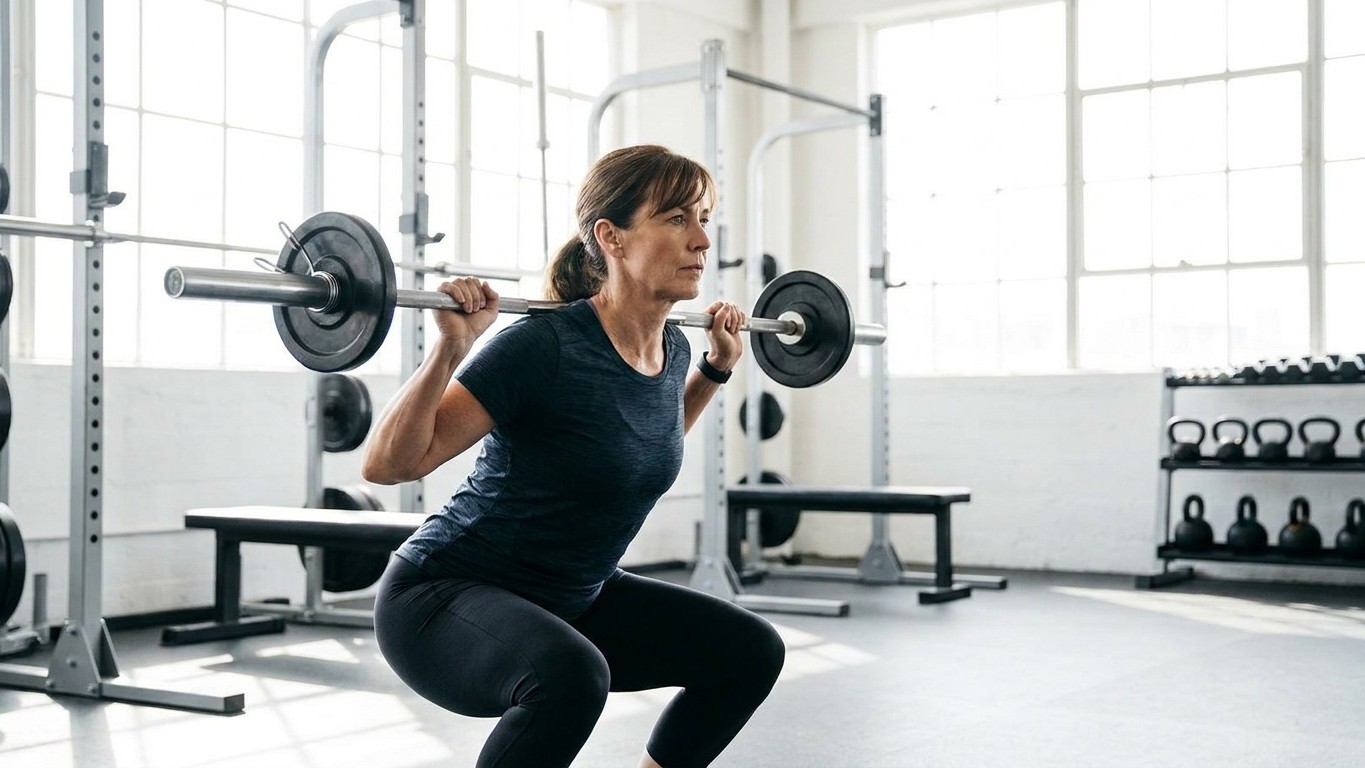
Mechanical stress on bone is the one intervention with consistent evidence behind it, and the effect is measurable even when training starts mid-transition. Research proves that moderate-intensity resistance training significantly improves bone mineral density at critical fracture-prevention sites in postmenopausal women. A network meta-analysis pooling 19 randomized controlled trials involving 919 postmenopausal women found that moderate-intensity resistance training significantly improved bone mineral density at the lumbar spine and femoral neck compared to control groups. Squats, deadlifts, loaded carries, anything that forces the skeleton to bear real weight, sends a direct signal to bone-building cells that a calcium supplement never will.
Mayo Clinic’s women’s health specialists have started framing this explicitly as a menopause strategy rather than a general fitness tip. “Weight-resistance exercises are really key for bone health,” notes Dr. May Al-Araji, who works with perimenopausal patients in London. Timing matters here too: a DXA scan done right at the final period, rather than years later once fractures start showing up, gives a far more useful baseline than one done at an arbitrary birthday.
There’s also a genuinely counterintuitive wrinkle in the research: obesity actually slows the rate of spine bone loss during this transition, likely because extra body weight itself acts as a form of mechanical loading. That’s not a case for weight gain, obviously, but it does explain why bone loss doesn’t hit every woman the same way, and why blanket advice about milk was always too blunt an instrument for a problem this precisely timed.
Sources : onlinelibrary.wiley.com | academic.oup.com