
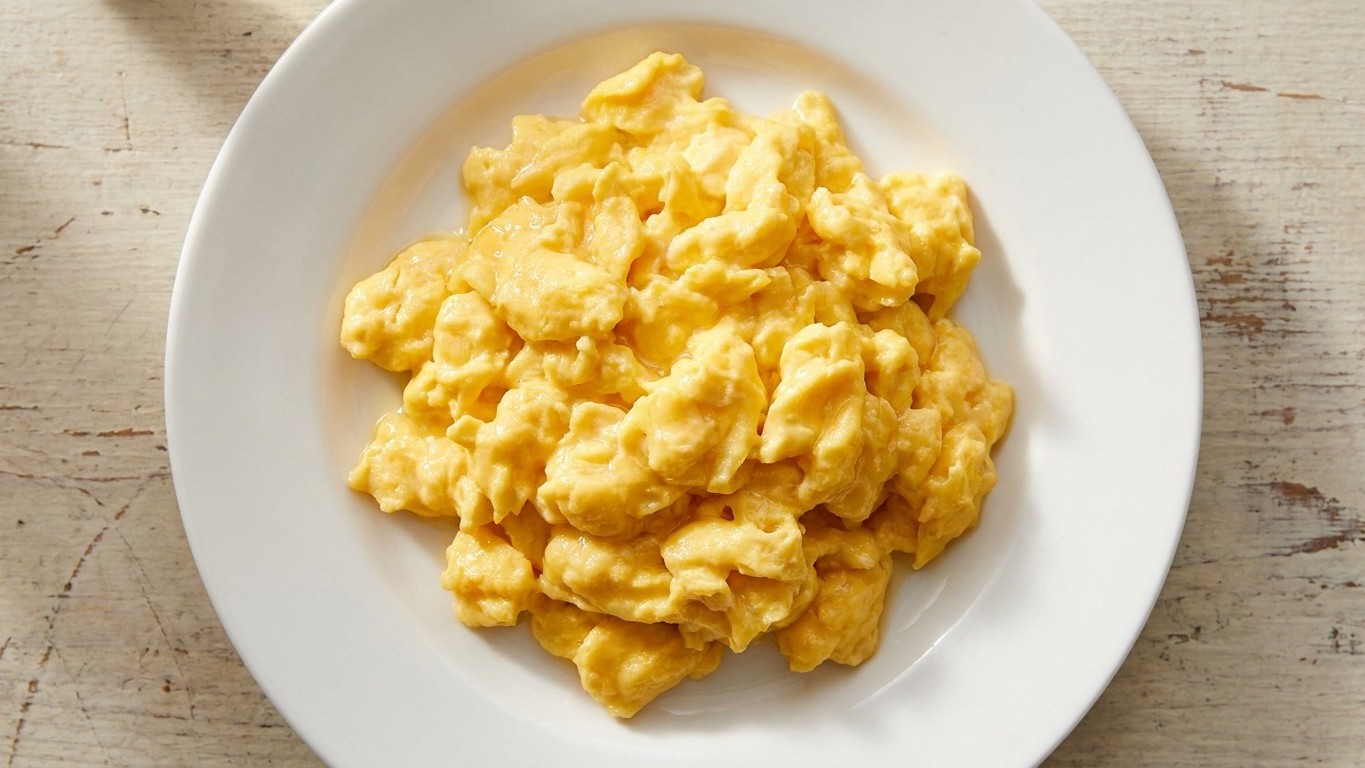
That milky puddle pooling around scrambled eggs on the plate isn’t a cooking mistake you can blame on a bad pan or the wrong spatula. It’s water, plain and simple, squeezed out of the eggs by proteins that tightened up faster than they should have. And a teaspoon of cornflour, whisked into the raw eggs before they ever touch the heat, stops that puddle from forming in the first place.
The realization came, as these things often do, out of pure pantry laziness. A half-empty packet of cornflour, leftover from some long-forgotten sauce, needed using up. A teaspoon went into the eggs almost as an afterthought. What followed wasn’t a subtle improvement. It was a completely different plate: dry, glossy, custardy eggs with not a drop of liquid in sight. That’s when the puddle finally made sense, not as a flaw in technique, but as a predictable, almost inevitable chemical event that a starch molecule can simply block.
Key takeaways
- A half-empty packet of cornflour transformed one cook’s scrambled eggs forever—but why did it work so dramatically?
- The puddle on your plate has a scientific explanation that changes how you understand egg protein
- One kitchen hack rooted in food chemistry that works every time, once you understand what’s actually happening
Why eggs leak in the first place
Eggs are essentially water held in a cage of proteins. Eggs are primarily composed of water and protein, and as heat is applied, the proteins in the egg denature, meaning they unravel and bond together. That bonding, called coagulation, is exactly what turns a liquid into something you can pile onto toast. The trouble starts when the heat runs too hot or too long. Overcooking can lead to excessive coagulation, squeezing out the water and resulting in dry, rubbery eggs. The proteins essentially over-tighten their grip, wringing out the water they’d been holding, and that water has nowhere to go but onto the plate.
Food scientist and cookbook author J. Kenji López-Alt has been vocal about this exact problem. He explains that when eggs are overcooked, proteins in them tighten up until they ultimately release liquid, leading to tough, rubbery eggs surrounded by watery liquid. He didn’t invent the cornstarch fix himself, either. He saw it on a food blog called Lady and Pups run by Mandy Lee, who discovered the method when she made an eggy goo mixture with cornstarch for her sick dog. Sometimes the best kitchen hacks really do come from the strangest places.
What the starch actually does, chemically speaking
Cornflour (cornstarch, if you’re shopping American) is not a thickener in the way people assume, just a passive sponge soaking up excess moisture. It’s an active participant in the cooking process. The powder is made of two different starch molecules, amylose and amylopectin, and it contains around 25% amylose, which means it will gel up and thicken more than other types of starches. That gelling happens at a very specific point on the stove. The slurry should be added before cooking, so the cornstarch has time to activate, gelling between 144 to 180 degrees Fahrenheit.
Here’s the part that actually explains the dry plate. The cornstarch blocks the proteins from linking together and overcoagulating, so the eggs hold onto moisture, and if you do overcook them and some moisture seeps out, it thickens the starch to form a creamy sauce instead of leaving your eggs dry. the starch acts like scaffolding wedged between the protein strands, physically preventing them from squeezing shut too fast. Kenji has described it as a thin barrier that keeps the proteins from tightening up too quickly, and even if the pan runs a touch hotter than intended, the cornstarch will help your eggs stay soft, tender and creamy.
Recent food-science analysis frames it in almost the same terms as classic gelatinization studies. This mirrors the thermal coagulation of egg white proteins, which begin unfolding and cross-linking at 63°C and fully set by 80°C, and crucially, both systems rely on controlled water mobility: in eggs, water is immobilized by hydrogen bonding to denatured globular proteins, and in cornstarch gels, water is physically entrapped within the amylose matrix. Two separate water-holding systems, working the same shift, side by side in the same pan. That’s not a kitchen myth. That’s measurable chemistry.
Getting the ratio right (and avoiding the clump disaster)
None of this works if the cornflour goes in dry and lumpy. You don’t want to simply add a spoonful of raw cornstarch to your eggs, since it will get clumpy, so the general rule of thumb is to make a slurry by combining equal amounts of water and cornstarch, then whisking it all together until it’s smooth. For everyday portions, use about one teaspoon each of cornstarch and water mixed per every two eggs you cook.
Flavor-wise, there’s nothing to worry about. Cornstarch is flavorless, so it won’t impact the taste of your scrambled eggs at all, it’ll just improve the texture of the final dish. Some cooks push the technique further, folding in extra butter since the starch does double duty. The cornstarch, or whichever starch you use, helps bind the butter to the eggs to keep them creamy, tender, velvety, and wonderfully rich. Potato starch and tapioca starch work through the same mechanism if cornflour isn’t on hand, though cornflour tends to be the one already sitting in most pantries, half-used, waiting for a reason to matter.
What’s genuinely counterintuitive here is that a puddle of liquid on the plate was never really a sign of “juicy” eggs, no matter how it looked. It was moisture escaping a structure that had already failed. The teaspoon doesn’t add creaminess so much as it prevents a loss, holding onto water the eggs were always going to try to keep if the proteins hadn’t clenched up too fast. One packet, half-forgotten in a cupboard, and an accidental fix for a breakfast flaw most people never thought to question.
Sources : chowhound.com | slate.com