
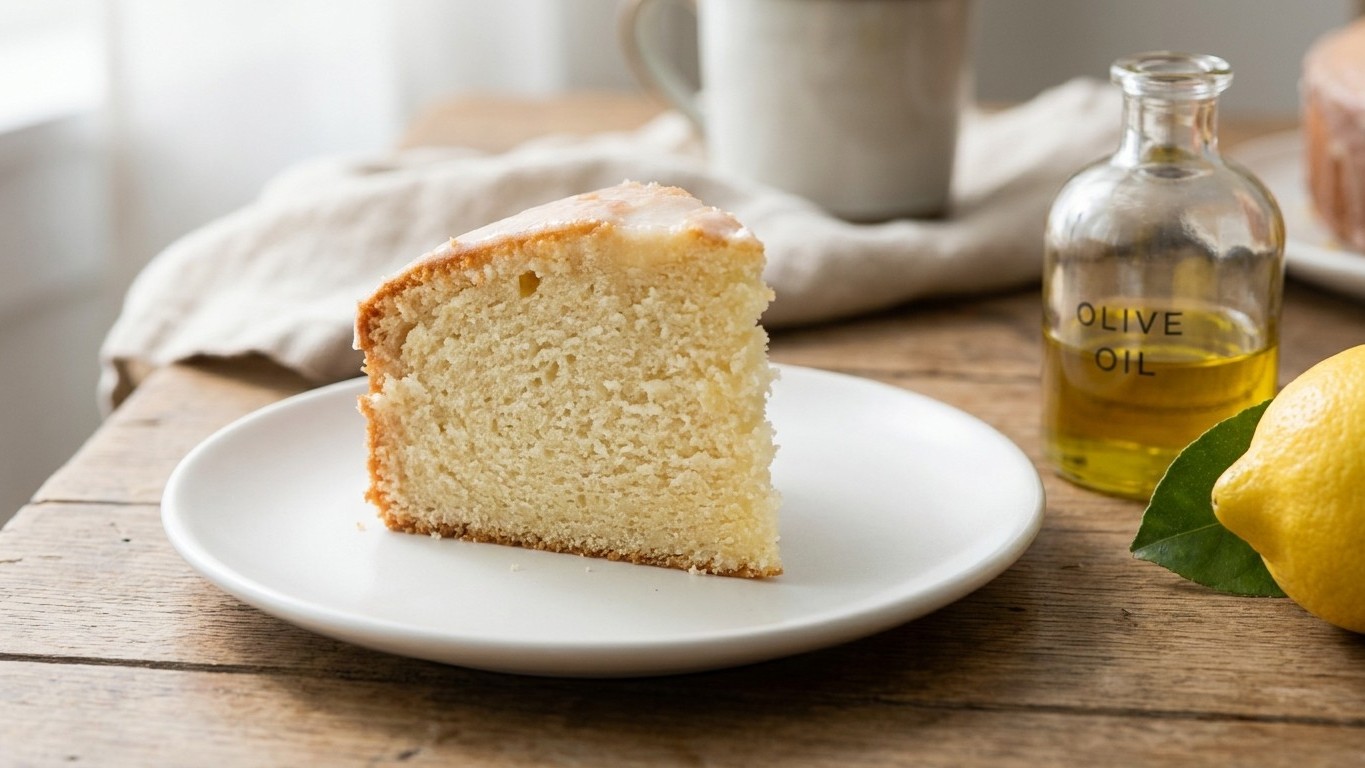
Three days on the counter, wrapped in a kitchen towel because I couldn’t be bothered digging out plastic wrap, and that lemon cake had gone from “pretty good” to “wait, what happened.” The crumb hadn’t dried out. It had gotten softer, somehow, and the lemon had bloomed into something deeper, almost floral. I hadn’t planned an experiment. I’d swapped butter for olive oil purely because I wanted that fruity, slightly peppery note running under the citrus. What I got was a lesson in food science I didn’t know I needed.
Key takeaways
- One baker’s lazy ingredient substitution accidentally created a superior cake that improved with age
- Olive oil’s liquid state at room temperature prevents the hardening that butter-based cakes experience—but it’s not about moisture, it’s about physics
- Professional bakeries have been quietly adding oil to ‘butter’ cakes for years to keep them moist for days after purchase
The swap wasn’t about health, it was about flavor
Let’s be honest about the motive here, because most articles pretend it’s virtuous. It wasn’t. I wanted the taste, that faint bitterness good olive oil carries, the one that makes lemon desserts in Puglia or Sicily taste less like a candle and more like an actual fruit. Whether a cake tastes strongly of olive oil depends on the kind you use, and pure or regular olive oil is barely discernible in the background, which pairs perfectly with lemon. If you want the oil to actually announce itself, extra virgin is the move, since it’s unrefined and has a bold olive flavor.
The texture shift happened almost immediately, before day three even entered the picture. Fat coats flour particles, preventing them from forming strong gluten networks, which results in a tender crumb and a melt-in-your-mouth texture. Butter does this too, technically, but it does it less efficiently because part of butter’s weight is water and milk solids, not pure fat. Oil is a hundred percent fat, full stop, and that difference matters more than most home bakers realize.
What actually happens to the crumb after day one
Here’s where it gets genuinely interesting, and where most kitchen folklore gets the explanation wrong. The instinct is to assume oil somehow “keeps moisture in” like a sealant. That’s not quite it. According to America’s Test Kitchen, the starches in both oil-based and butter-based cakes retrograde over time, staling and hardening into a crystalline structure that traps water within the crystals, but oil, being liquid at room temperature, acts to retard that retrogradation, causing even a days-old cake to seem moist even though it’s technically not.
So the cake I pulled apart on day three wasn’t literally wetter than it was on day one. Chemically, staling was already underway. But butter solidifies as it cools, and a cake made with butter, which is solid at room temperature, will seem drier by comparison, purely because of how that fat behaves physically at room temperature. Olive oil stays fluid, coating the starch network in a way that keeps the crumb feeling supple even as the internal chemistry marches toward staleness. It’s a bit of a magic trick, frankly, the cake tricks your mouth into reading “fresh” long after the clock says otherwise.
There’s also a flavor development angle that has nothing to do with moisture at all. Pastry professionals who’ve deliberately tested aged olive oil cakes report the same pattern I stumbled into by accident. King Arthur Baking’s test kitchen wrapped a chocolate olive oil cake and left it on the counter for three days, and with each passing day, the chocolate flavor grew a little deeper, and the olive oil notes came through stronger. Their verdict after tasting it fresh versus three days later: the flavor was even better by day three, no question. Swap chocolate for lemon and the same principle applies. Citrus oils and olive oil’s own compounds seem to need a beat to actually talk to each other in the batter.
Why butter still wins in some corners of the kitchen
None of this means butter is obsolete, and I’d roll my eyes at anyone claiming otherwise. There’s a trade-off, and pretending there isn’t would be dishonest. Butter contributes flavor and promotes browning in ways that oil doesn’t. That golden, slightly caramelized crust on a classic pound cake? Oil-based cakes rarely achieve that same crackle and color, because the milk solids in butter are what brown so beautifully in the oven. If you’re after a crisp, defined crust or that unmistakable buttery richness in something like a pound cake or shortbread, oil is the wrong tool.
Cost and convenience tip the scale toward oil too, though that’s a secondary win compared to the texture story. Oil is typically easier to work with than butter since it doesn’t require softening and can simply be poured into the batter, and it’s generally less expensive than butter. No forgetting to take butter out of the fridge two hours before baking, no creaming step, no risk of overbeating and deflating the batter. You whisk, you pour, you wait.
Storage tells its own story, and it’s the part that convinced me this wasn’t a fluke. Pastry chef Pichet Ong, who’s built a career on inventive desserts in New York and Washington, DC, put it plainly: “Even bakeries add oil to their self-proclaimed butter-based cakes to get them as moist as possible for many days after they’re purchased.” That’s an industry secret hiding in plain sight. The commercial cake staying suspiciously soft five days after purchase almost certainly has oil quietly working in the background, whatever the label says about butter.
My lemon cake, olive oil and all, sat under its towel for three full days and came out better than it went in. Not fresher, technically — the science says the staling clock was ticking the whole time. But better. If you’ve got half a bottle of decent olive oil sitting around and a lemon cake recipe calling for butter, the swap costs you nothing but a little patience, and patience, in this particular case, is the whole point.
Sources : hojireal.com | saveur.com