
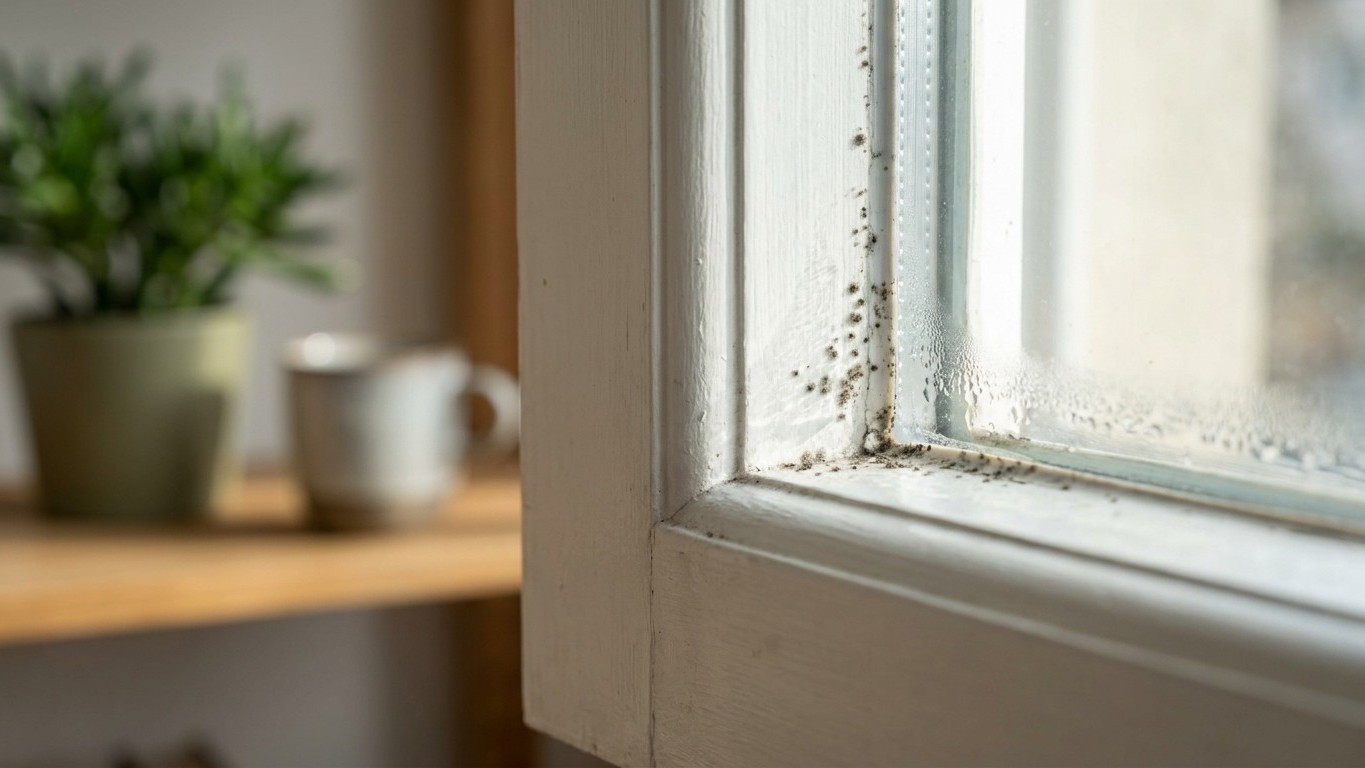
Every household has that one ritual: a damp cloth, a spray of vinegar or bleach, and twenty minutes spent scrubbing the black dots that creep along the window reveal. It feels productive. It looks clean for about three weeks. Then the specks come back, a little darker, a little more stubborn, right where the frame meets the glass. What almost nobody connects to that recurring stain is the laundry cycle running two rooms away, quietly exhaling the very moisture that feeds it.
Key takeaways
- Window mold colonies thrive on condensation, but nobody traces them back to the source—the laundry drying indoors nearby
- One wash load dried on a rack releases 2 litres of water; multiply that by weekly loads and your indoor humidity soars to near-tropical levels
- Mold spores germinate in 24-48 hours once humidity exceeds 60%—and drying laundry in a small room can spike it to 96%
The Window Frame Is the Symptom, Not the Source
Those black or grey dots clustering in the corners of a window reveal are colonies of mold, typically the kind that thrives on condensation rather than standing water. They appear because warm, humid indoor air meets a cold surface, the glass or the aluminum/PVC frame, and drops its moisture right there. Condensation on the inside of a windowpane is a sign that indoor humidity should be kept below 60 percent, ideally between 30 and 50 percent relative humidity. Once that threshold is crossed and stays crossed, the clock starts ticking fast: exposure to these conditions allows mold spores already present in your home to germinate and establish colonies within 24 to 48 hours.
Wiping the frame kills what’s visible. It does nothing to the spores hanging in the air, waiting for the next humid spell to settle and start over. The reveal is simply the coldest, most exposed surface in the room, the place where invisible water vapor becomes visible proof.
What a Single Wash Load Actually Releases Into the Room
Here’s the part that rarely makes it onto anyone’s cleaning checklist. A washing machine doesn’t stop being a source of moisture once the spin cycle ends. Inside the appliance itself, humidity stays extreme for hours: after clothes were removed, humidity in the drum measured 80 percent, and without a drying cycle it steadily leveled off around 86 to 87 percent over the following four hours. Open that door in a small, unventilated laundry nook and you’ve just released a small cloud into the room.
The bigger contributor, though, is what happens after the wash: hanging laundry to dry indoors instead of outside or in a vented dryer. A standard wash load dried on a rack releases about 2 litres of water into the indoor air. That doesn’t sound dramatic until you multiply it. For a family doing 5 to 6 loads per week, this amounts to 10 to 12 litres of water released into the home each week, the equivalent of a full bucket. A UK research team from the Mackintosh Environmental Architecture Research Unit tracked this across dozens of households and found something striking: of the 100 households studied, 87% dried indoors during the cold season, and 75% had humidity levels high enough to support dust mite growth.
The spike can be immediate and severe in a modest-sized room. As one sustainability specialist put it, “Drying one load of laundry in a small room of around 3m x 3m could bring the humidity up to around 96 per cent.” That’s higher than most tropical climates. And unlike outdoor air, that vapor has nowhere obvious to go. It drifts, cools against the nearest cold surface, usually a window, and turns into the film of condensation that mold spores need to take hold.
Breaking the Condensation-Mold Loop
None of this means giving up laundry days, obviously. It means redirecting where that water vapor ends up. A few adjustments make a real difference without any renovation involved.
- Run a second spin cycle before hanging clothes; wringing out more water mechanically means less has to evaporate into the room afterward.
- Dry laundry in one ventilated space with the door closed and a window cracked, or an extractor fan running, rather than spreading damp items through the whole house.
- Leave the washer door and detergent drawer open between loads so the drum and gasket actually dry out instead of holding onto that 80-plus percent internal humidity.
- Favor a vented or condenser tumble dryer for heavier loads (towels, sheets) during colder months, since that moisture gets expelled outside rather than into the living space.
Hanging washing in a single room with the internal door closed and a window open, ideally somewhere naturally warm and easily ventilated, keeps the humidity from spreading through the rest of the home. Garages, basements, and other cold, already-damp spaces make the problem worse rather than better, since the air there is already close to saturated before the wet laundry even goes in.
The window reveal will still need the occasional cleaning, mold spores are everywhere and will always find a foothold eventually. But scrubbing it without touching the humidity source is a bit like mopping up a puddle while the tap keeps running. Fix the moisture at the source, on laundry day, at the washer door, near the drying rack, and the black specks stop reappearing every few weeks.
One detail worth keeping in mind for anyone tempted to just crank up a dehumidifier and call it solved: a dehumidifier speeds up how fast laundry dries by pulling ambient moisture out of the air, but it doesn’t reduce the total amount of water that has to leave the fabric in the first place. It just decides where that water ends up, in a tank instead of on your windowsill.
Sources : airoasis.com | dailyhealthpost.com