
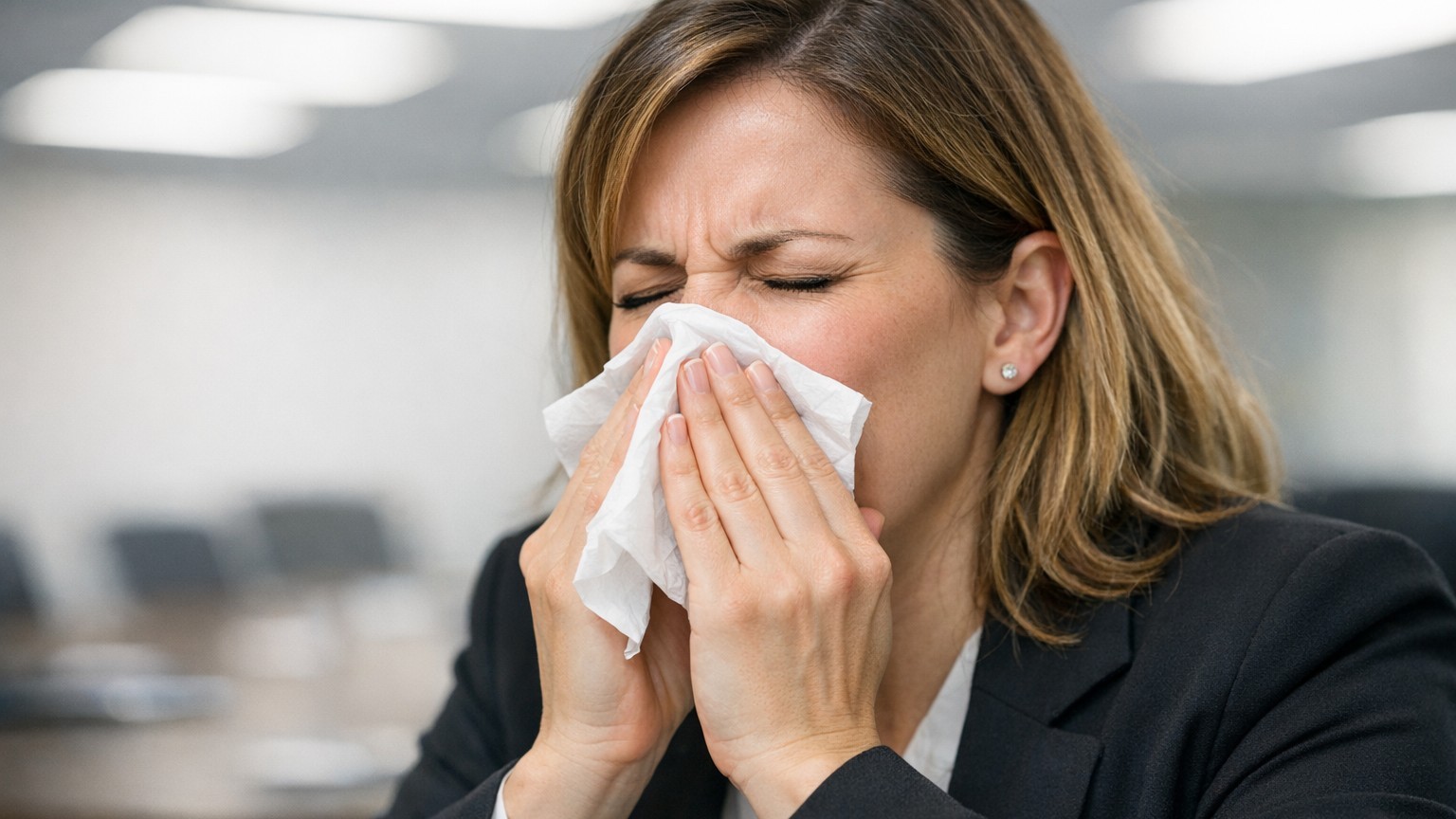
The sneeze was building. A crowded meeting room, the kind with recirculated air and a shared agenda nobody actually printed. The tickle hit, the nose pinched shut, the mouth sealed. Crisis averted, or so it seemed. Most of us have performed this exact maneuver hundreds of times without a second thought, treating a suppressed sneeze as a basic act of social grace. A doctor’s honest answer to what actually happens inside your skull when you do it changes that calculation entirely.
Key takeaways
- A suppressed sneeze can create 5-24 times more internal pressure than a normal sneeze, with nowhere for that force to go
- One documented case involved a man who ruptured his throat trying to hold in a sneeze and ended up hospitalized on IV antibiotics
- The ‘polite’ method of completely sealing your nose and mouth is actually the most dangerous—but there’s a safer alternative
A Pressure Event, Not a Minor Reflex
The sneeze reflex is not subtle. A signal travels through the trigeminal nerve to the brain’s sneeze center, which orchestrates a coordinated muscular response: a deep breath fills the lungs, the epiglottis closes and the vocal cords tighten to trap air, then the chest, throat, and abdominal muscles contract forcefully, building significant pressure within the respiratory system. According to the American Lung Association, the speed of a sneeze can reach in excess of 100 mph and produce more than 100,000 droplets. The figure is contested, some high-speed camera studies have clocked exit velocity closer to 30 to 40 mph at the nostrils — but the internal mechanics are not in dispute.
What matters more than external speed is what happens when that force has nowhere to go. Research published in a computer simulation study found that suppressing a sneeze by holding the nose or mouth leads to a noticeable increase in pressure difference in the respiratory tract, about 5 to 24 times that of a normal sneeze. This significant rise in pressure can justify some of the reported damage due to suppressing a sneeze. That’s not a rounding error. That’s the difference between opening a door and driving a car through it.
What That Trapped Air Actually Does
When you suppress a sneeze by pinching your nose and sealing your lips, you trap a massive amount of air pressure inside your head and upper respiratory tract. Since this energy has nowhere to escape, it gets redirected into various parts of the skull, ears, blood vessels, and sinuses. The cascade of possible consequences runs from the merely unpleasant to the genuinely alarming.
The ears take the first hit. Some of the pressurized air can go into the ears, traveling into the Eustachian tube in each ear that connects to the middle ear and eardrum. This pressure can lead to rupture of the eardrum and hearing loss. Holding in a sneeze can cause a sudden increase in pressure within the middle ear, potentially resulting in ear pain, eardrum rupture, or even hearing loss. The sinuses take the second hit. Suppressing a sneeze can cause the mucus and irritants to be pushed back into your sinuses, potentially leading to sinus pain, congestion and even sinus infections.
Then there is the question of what happens to the eyes and blood vessels. The Valsalva-type pressure increase can burst tiny superficial blood vessels, which is why people sometimes get a bright red patch on the white of the eye (a subconjunctival hemorrhage) or a nosebleed after forceful sneezing or straining. These events usually look dramatic but are benign and resolve over days to weeks; however, patients on blood thinners or with uncontrolled hypertension should treat any unusual bleeding more cautiously.
The most alarming scenario is rarer but documented in peer-reviewed literature. One of the most concerning potential complications is pneumocephalus, a condition where air enters the space around the brain, which can create pressure on the brain tissue and potentially lead to headaches, altered consciousness, or even more serious neurological symptoms. A 2023 NIH case report describes exactly this: a unique case where sneeze suppression led to a rupture of the olfactory bulb. A 72-year-old woman presented to the emergency room complaining of severe headache and rhinorrhea for a few days, denying any trauma or falls. The culprit was a stifled sneeze.
The Case That Made It Into a Medical Journal
The most widely cited proof of concept arrived in 2018. A 34-year-old man described as “previously fit and well” attempted to stop a particularly forceful sneeze by pinching his nose and holding his mouth closed. Not long afterward, he noticed something was wrong. It hurt when he swallowed, his voice changed, and his neck had swollen and was producing an unsettling popping and crackling sensation when he moved it.
By trying to suppress the full force of his sneeze, the man had literally ruptured his throat. The air that the sneeze would have blasted forth instead made its way into his soft tissue as tiny bubbles. The patient was admitted to hospital, tube-fed, and given intravenous antibiotics for seven days. The authors of the BMJ Case Reports study cautioned that “halting sneezing via blocking nostrils and mouth is a dangerous manoeuvre and should be avoided,” noting it may lead to complications including pneumomediastinum (air trapped in the chest between both lungs), perforated eardrum, and even rupture of a cerebral aneurysm.
Dr. Zi Yang Jiang, a head and neck surgeon not involved in the report, called such an incident “exceedingly rare” and said he sees just one or two such cases a year. One or two cases a year, nationally. That’s still real. And the milder versions, earache, sinus pain, burst blood vessels in the eye, are far more common and far less reported.
The Smarter Move in a Quiet Room
Frankly, the conversation about suppressed sneezes gets stuck in an unproductive binary: either let it rip at full volume or block Everything and hope for the best. Both extremes miss the point. Suppressing sneezes isn’t without some dangers, but one sneeze can carry up to 100,000 viruses and bacteria. The etiquette concern is legitimate. The method of suppression is where the problem lives.
Instead of completely suppressing a sneeze by pinching your nose shut, try reducing its intensity. Keeping your mouth open slightly allows pressure to escape while using a tissue to catch the spray, allowing the pressure to release while still keeping the volume and mess to a minimum. A doctor at Banner Health put it plainly: “Covering your mouth and nose loosely will reduce this risk without blocking the release of pressure from the nasal airway.”
The counter-intuitive truth here is that polite sneezing and safe sneezing are not opposites. The nose-and-mouth seal, the move that looks the most considerate, is the one doctors specifically warn against. Sneezing serves an important purpose, clearing irritants and potentially infectious particles from your respiratory system, and regularly suppressing this natural reflex might leave those particles in your nasal passages where they can cause more irritation or even infection. The body built this reflex over millions of years of evolution. The social contract that makes us muffle it is, by comparison, a very recent invention, and a mismatch your Eustachian tubes are quietly paying for.
Sources : medicaldesignandoutsourcing.com | healthspectra.com