
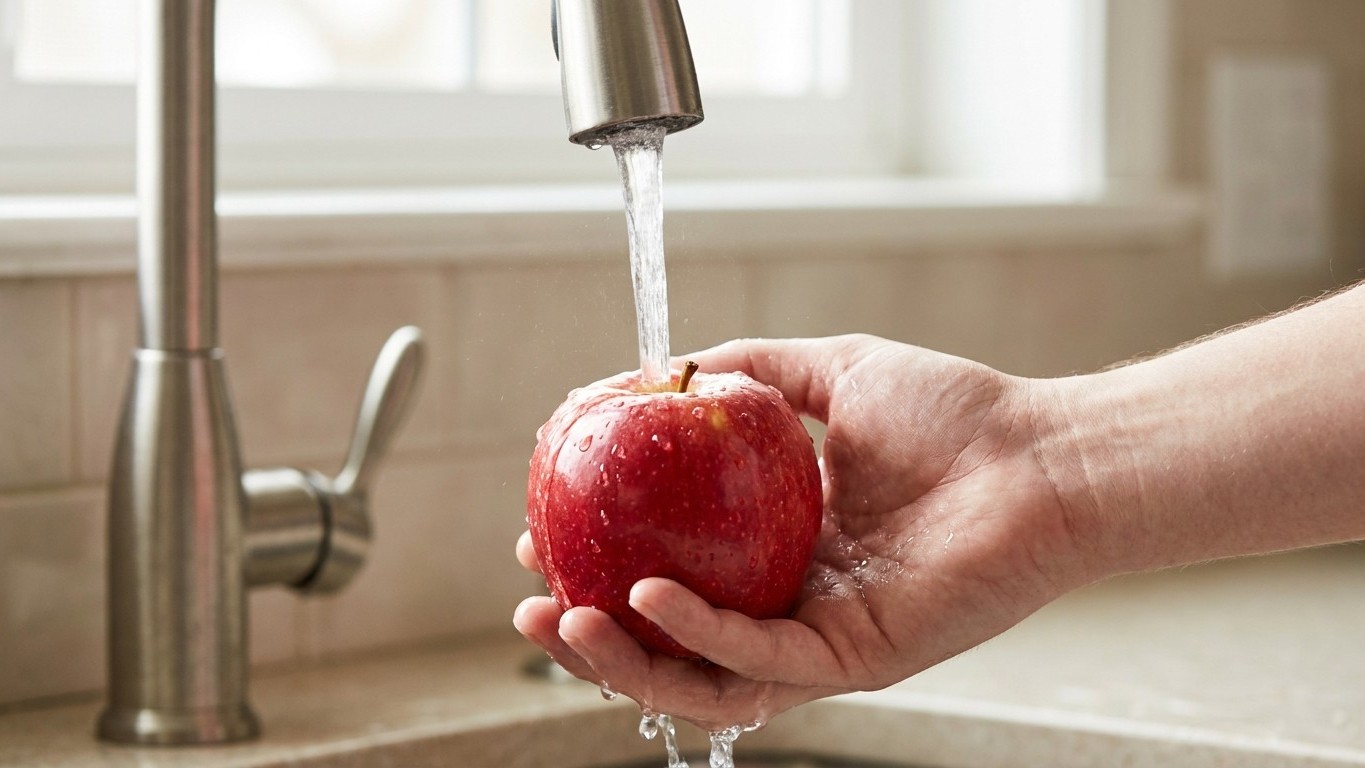
The apple looks clean. You’ve held it under the tap, turned it in your hands, watched the water run clear. Clean enough. The fruit bowl gets a towel-dry and the apple disappears into a lunchbox. This is the ritual, performed without a second thought, in tens of millions of American kitchens every morning. The problem is what the water leaves behind.
A 2024 study published in ACS Nano Letters used high-sensitivity imaging technology to look inside fruit surfaces after washing, and what it found upends a belief most of us have held since childhood. Researchers sprayed the fungicides thiram and carbendazim onto apples, air-dried the fruits, then washed them to mimic everyday practices. Using their membrane imaging system, they detected pesticides on the apples even at low concentrations, and were able to resolve contamination not just on the skin, but through the peel and into the outermost layer of pulp. The result. Bluffant. Washing alone could be insufficient to prevent pesticide ingestion, and peeling would be required to remove potential contamination in the skin and outer pulp.
Key takeaways
- A 2024 study used advanced imaging to reveal pesticides still coating fruit after washing—even deep inside the peel
- Tap water alone removes almost nothing from many fruits; one study found just 2-25% reduction depending on the pesticide
- Systemic pesticides travel through the plant like water through a sponge, making them impossible to wash away
Why Water Alone Falls Short
Here’s the counter-intuitive part that food chemists have known for years but that never quite filtered down to consumer level: the effectiveness of rinsing has almost nothing to do with water solubility. Tap water has a limited effect on the removal of pesticide residues, because many pesticides are hydrophobic. Their chemical structure makes them repel the very thing we’re trying to use to wash them away, a bit like trying to clean a greasy pan with cold water and no soap.
Washing, peeling, and cooking can lower pesticide residues on fruits and vegetables, though their effectiveness depends strongly on the chemical properties of the compound. Hydrophilic pesticides are more easily reduced by washing, whereas systemic or lipophilic pesticides tend to persist in plant tissues. The distinction matters enormously. Systemic pesticides are usually hydrophilic, which allows them to permeate into plant tissues and translocate through the peel of fruits and vegetables. In vascular plants, they can shift across phloem or xylem transporting tissues, they travel through the plant the way water travels through a sponge. No amount of rinsing reaches them.
Pesticides can stick to soft skins, and the wax coating used on some produce can trap pesticide residues. Some pesticides are systemic, taken up by the plant’s root system and distributed into the fruit or vegetable flesh — so they simply cannot be washed off. Strawberries, with their dimpled, porous surface and no protective peel, are a particular case. When strawberries are washed in water, some of the pesticide residue on the cap may be removed and can potentially transfer to the fruit surface. The relatively low water solubility, systemic activity, and stability of some compounds make them difficult to remove through simple washing or rinsing.
The numbers from real-world studies tell a sobering story. When kumquat was washed with tap water for 5 minutes, the average reduction of 10 pesticides was only 25%. A separate study of oranges found reductions ranging from just 2% to 84% depending on the pesticide, meaning certain compounds are virtually immune to tap water. The maximum and minimum reduction ratio for pesticides in orange was 84% and 2%, respectively. A quick rinse, may be doing almost nothing for some of the most stubborn chemicals on your produce.
The Baking Soda Upgrade
The good news is that the science also points toward something better, and it’s already in your pantry. Surface pesticide residues are most effectively removed by sodium bicarbonate (baking soda) solution when compared to either tap water or Clorox bleach. The reason is chemistry, not magic: most pesticides aren’t stable at an alkaline pH, so soaking them in a baking soda solution can break down their compounds, and together with a rinse under tap water, can help to wash them away.
The catch is time. Submerging apples in a baking soda solution for two minutes removed more pesticides than a two-minute soak in bleach or two minutes under running tap water. But it took 12 to 15 minutes in the baking soda solution to completely remove the pesticides used in the study. Not exactly a weekday-morning habit, which is probably why most people still default to the 10-second rinse.
A 2025 study from the University of Massachusetts added more nuance, testing household ingredients against commercial produce-wash products. Soaking in 2% corn starch followed by soaking in 5% baking soda was the most effective homemade strategy, removing over 94% of thiabendazole. The practical formula for home use: add 1 teaspoon of baking soda to every 2 cups of cold water, submerge your fruit, and let it soak for 12 to 15 minutes, the time helps the baking soda do its job. Follow with a rinse under cold running water and a gentle scrub for firmer fruit. The labor-to-benefit ratio is actually quite reasonable for the weekend; less so for the Tuesday school run.
The Hard Truth About Systemic Pesticides
A baking soda soak handles surface residues reasonably well. But it runs into a wall with systemic compounds. Thiabendazole, a systemic pesticide, penetrated 4-fold deeper into the apple peel than did phosmet, a non-systemic pesticide, leading to more residues inside the apple that could not be washed away using even the baking soda solution. Peeling helps, but at a cost. Peeling apples helps to remove pesticides that have penetrated the fruit; however, it also reduces nutritional content. The fiber, the polyphenols, the antioxidants — all concentrated in the skin you just removed.
While the peel can act as a barrier that slows pesticide absorption, some pesticides can penetrate deep into the fruit or vegetable. Some can even move across thick-skinned fruit such as citrus and bananas. Which means the comforting logic of “I only eat the inside” doesn’t hold up as neatly as we’d like.
The longer pesticides sit on fruits and vegetables, the deeper they’re absorbed, and the harder they become to remove, which makes the timing of washing genuinely relevant. Washing right before eating, rather than at the start of the week when you unpack groceries, may actually matter. And one variable that the research almost never discusses: the mechanical action of rubbing. The majority of pesticide residue appears to reside on the surface of produce, where it is removed by the mechanical action of rinsing — meaning the physical scrubbing motion may do more work than the water chemistry itself.
A Practical Reset for Your Kitchen Routine
No household washing method eliminates pesticide exposure entirely. That’s the honest summary of a decade of food safety research. “The effect of washing is not going to be consistent across all pesticides and probably not across all fruit and vegetable items,” as one food safety researcher put it. But reduction is still meaningful, and some choices have more impact than others.
For firm fruit, apples, pears, peaches, a baking soda soak is your best practical tool at home. For soft berries, which can absorb soaking liquid and deteriorate fast, a thorough rinse under cold running water with gentle rubbing remains the advised method. Pesticide removal generally improves with increased washing time. Pyrethroid pesticides are the easiest to remove, whereas chlorpyrifos proved the most resistant to washing.
The produce that carries the highest pesticide load year after year, strawberries, spinach, kale, grapes, peaches, cherries, apples — are among those most consistently flagged in annual residue analyses. For these, the case for buying organic is more straightforward than for, say, an avocado or a pineapple, whose thick rinds provide natural protection. A 2012 study estimated that increasing fruit and vegetable consumption could prevent 20,000 cancer cases annually, while 10 cases of cancer per year could be attributed to consumption of pesticides from the additional produce. The math, still strongly favors eating the fruit. What’s worth questioning is whether the water running over the apple for four seconds is doing half the job we imagine it is.
Sources : naturalnews.com | pubs.acs.org