
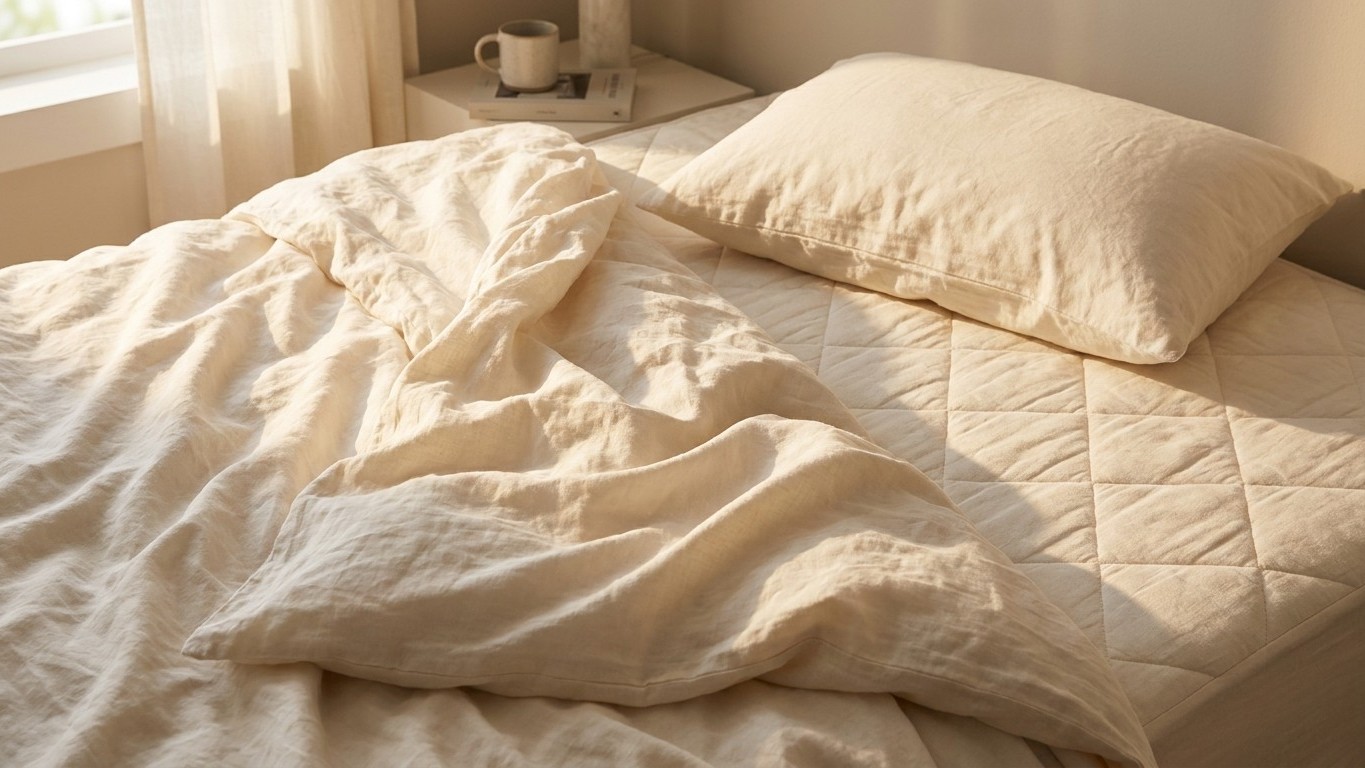
Every night, you spend roughly a third of your life lying on it. You’ve probably had it for years, maybe a decade. You barely think about it. And yet, when sleep researchers and physicians are asked what single object in a bedroom most directly determines sleep quality, they don’t point to the white noise machine, the blackout curtains, or even the phone charging on the nightstand. They point to the mattress, consistently, across studies, across disciplines, across patient profiles.
The phone gets all the attention, and frankly, it deserves some of it. But the obsession with screens has created a kind of blind spot, one that lets millions of Americans lie awake on a degraded sleep surface night after night while fixating on their blue-light exposure. The mattress is the silent variable. The one nobody audits.
Key takeaways
- 93% of people know mattresses matter for sleep, yet most sleep on degraded surfaces years past their lifespan
- One peer-reviewed study documented a 24% sleep quality improvement within one week of mattress replacement
- Your mattress is a thermal environment—overheating at night reduces deep sleep more than most people realize
The Number That Should Make You Check Your Mattress Right Now
Despite the fact that 93% of people indicate a mattress plays a pivotal role in achieving high-quality sleep, there is a scarcity of research investigating the influence of mattresses on sleep quality, pain, and mood. That gap between awareness and action is striking. We know the mattress matters. We just don’t act on it.
The timeline issue is real. On average, mattresses should be replaced every 7 to 10 years. As mattresses age, they lose their ability to provide proper support, potentially leading to poor spinal alignment during sleep, which can result in morning stiffness and chronic back issues. Here’s the uncomfortable part: most Americans are sleeping on mattresses well past that threshold and attributing the consequences, back pain, restless nights, morning fatigue, to stress, aging, or lifestyle. The mattress rarely enters the conversation.
An older mattress that’s well past its recommended lifespan can negatively impact sleep quality. Reduced support and an uneven surface can lead to discomfort and pain, causing a lot of shifting throughout the night. That shifting matters more than most people realize. Each repositioning is a micro-arousal, a brief interruption in sleep architecture that chips away at the restorative phases your brain and body depend on.
One published study put this to the test with impressive clarity. Participants’ sleep quality significantly improved with the replacement of their old sleeping surface (mean age: 9.5 years). The improvement in sleep quality was realized within the first week and sustained. Also, improved over the remainder of the post-testing period by 24.2%. Similarly, stress symptoms were significantly reduced after 4 weeks of sleeping on the new bedding. A 24% improvement in sleep quality, not from a new medication, not from a mindfulness app, but from a new mattress. The result. Bluffant.
Firmness, Pressure, and the Individuality Problem
Here’s where it gets more nuanced, and where most mattress marketing gets it wrong. Studies on mattress firmness and sleep quality found no significant differences in some cases, implying that individual preferences may play a more critical role in sleep quality and mattress selection. The “one firmness fits all” narrative, usually pushing medium-firm as the universal answer, is an oversimplification.
That said, the research on medium-firm surfaces leans positive for a broad population. Studies have shown that medium-firm mattresses improve sleep quality by 55% and decrease back pain by 48% in patients with chronic low back pain. And a separate intervention study found that sleeping on a pressure-relieving grid mattress led to significantly improved sleep quality, increased daytime activity, reduced daytime fatigue, improved mood, and lowered anxiety and stress.
Some studies have found that a newer mattress will promote better sleep quality and alleviate more back pain than an older model. The best mattress for you, however, likely depends on individual factors like body weight, normal sleep position, and whether you prefer lying on a soft or firm surface. Body weight, sleep position, pre-existing pain patterns, these are the actual variables. A side sleeper with broad shoulders needs something fundamentally different from a back sleeper with a history of lumbar issues. The sooner we stop shopping for mattresses the way we shop for toothpaste (cheapest available, same as last time), the better.
The thermal layer of a mattress also deserves more attention than it gets. Foam or overly soft mattress toppers can retain heat, which compounds one of the most underestimated enemies of good sleep. Overheating at night can reduce deep sleep and increase wakefulness. Your mattress material isn’t just about support, it’s also a thermal environment. Breathable, moisture-wicking materials for bedsheets and sleepwear, such as cotton, bamboo, or silk, can help, but if the mattress itself traps heat, surface textiles will only do so much.
The Full Bedroom Equation
The mattress is the anchor, but sleep researchers are clear that it operates within a broader environmental system. Studies have shown people simply sleep better when their bedroom is optimized for temperature, noise, and light levels, and comfort. Since sleep quality and duration are directly tied to other aspects of human health, a bedroom environment that promotes sleep can also improve how you feel while you’re awake.
Temperature, specifically, is where the science has become increasingly precise. The body’s core temperature naturally drops at night, signaling to the brain that it’s time to sleep. A cool bedroom environment can support this wind-down process. Studies have shown that a bedroom temperature of 60 to 67 degrees Fahrenheit supports more consolidated, uninterrupted sleep. Research confirms the stakes: sleep was most efficient and restful when nighttime ambient temperature ranged between 20 and 25°C, with a clinically relevant 5 to 10% drop in sleep efficiency when the temperature increased from 25°C to 30°C.
Air quality in the bedroom matters too, in ways most people never consider. Findings suggest that currently prescribed minimum ventilation rates for residential environments may provide insufficient ventilation for bedrooms and may thus lead to disturbed sleep. PM2.5 and CO2 accumulation in poorly ventilated bedrooms contribute to increased sleep fragmentation. Cracking a window, even slightly, can have a measurable impact on the depth of your sleep. An underrated, almost embarrassingly simple fix.
Since our brain creates associations with different environments, consistently keeping our bedrooms dark, quiet, cool, and comfortable trains the mind to shift into “rest mode” when we enter the bedroom. The mattress is not just a piece of furniture, it’s the physical foundation of that conditioned response. Everything else in the bedroom ecosystem builds on top of it.
What to Actually Do About It
The first step is the one most people skip: assessing the current state of your mattress honestly. You can tell a mattress is too old based on its current condition. Consider replacing yours if it has visible signs of deterioration, such as noticeable sagging, body impressions, and lumps, or if its springs squeak loudly with the slightest movement. Those are not cosmetic issues. They are Structural failures with direct physiological consequences.
An old mattress can disrupt your sleep, leading to fatigue, irritability, and difficulty concentrating during the day. Chronic sleep deprivation weakens your immune system, making you more susceptible to illnesses. Beyond the obvious fatigue, an older mattress is more likely to harbor dust mites, leading to lung and throat irritation, a compounding health factor that rarely gets factored into the cost-benefit analysis of keeping an aging mattress.
When choosing a replacement, a great mattress should help keep your spine aligned throughout the night. Depending on your sleep preferences, you may enjoy the close body contour of memory foam, the gentle support of latex, or the springy feel of a mattress with coils. Hybrid constructions have grown popular precisely because they combine the pressure relief of foam with the breathability and support of coil systems.
One detail worth noting, especially for anyone over 40: by that age, your body tolerates less pressure, which means you might need a new mattress after five to seven years rather than the standard eight to ten. The age of the sleeper and the age of the mattress are both variables in the equation, and they interact.
Stanford sleep physician Dr. Cheri D. Mah frames the ideal bedroom with a deceptively simple image: “The bedroom should be like a cave, dark, cool, and quiet.” The cave analogy works because it strips away the optimization noise, the gadgets and supplements and elaborate routines, and returns to the primal essentials. A surface that supports your body without fighting it. An environment that doesn’t interfere with what your nervous system is already wired to do. The mattress is where that logic begins — and for a significant portion of American adults lying awake right now, it may also be where the solution ends.
Sources : sciencedirect.com | sciencedirect.com