
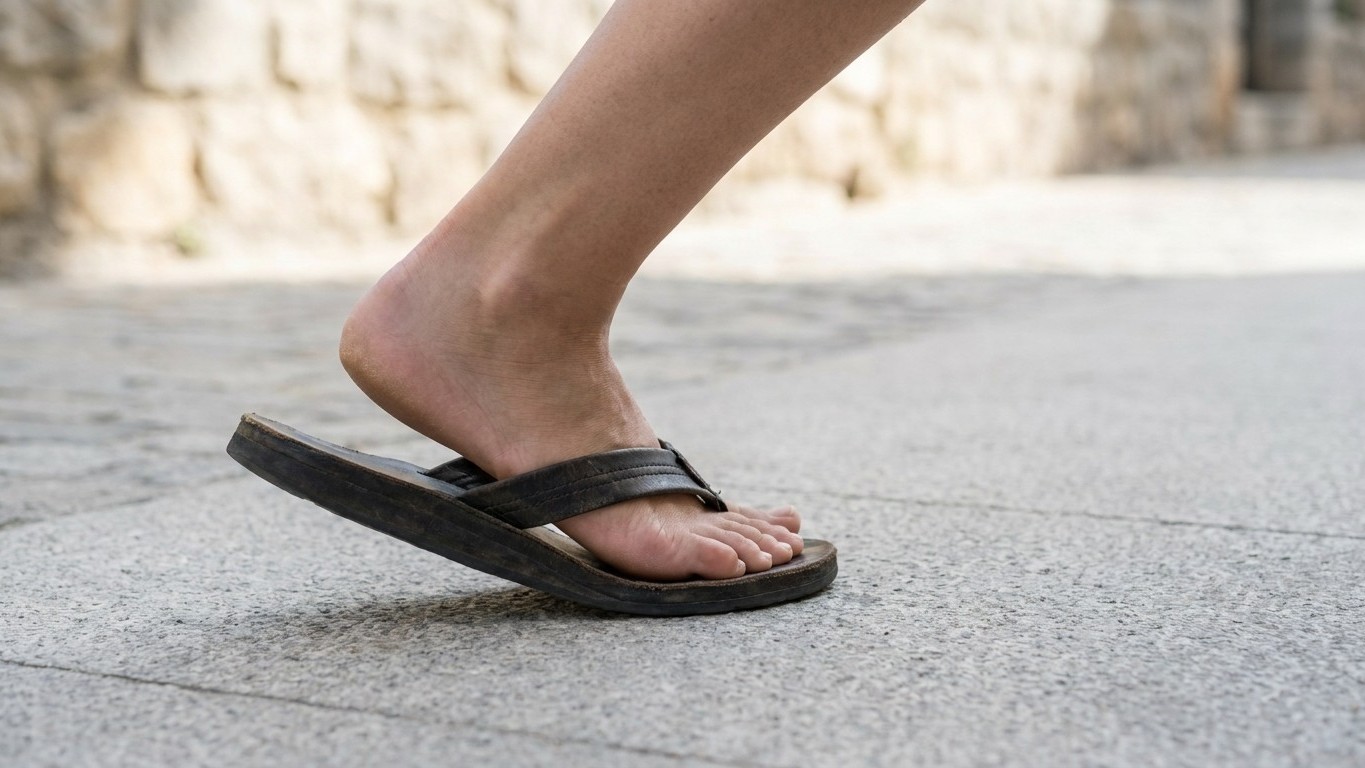
Every summer, the same ritual: the first warm morning of May, out come the flip-flops. They slip on in two seconds, they pair with Everything from cutoffs to sundresses, and they basically define the sensory grammar of the season, the soft slap against the pavement, the ease, the airiness. But while you’re strolling the boardwalk or running errands in your beloved thong sandals, a very small, very persistent act of muscular labor is happening at the front of your foot — and it’s sending damage straight to your heel.
Key takeaways
- Your toes perform a constant micro-gripping action in flip-flops that most people never notice
- This repetitive strain doesn’t hurt at the source—it accumulates silently in your heel’s foundation
- The damage is measurable and widespread: 10% of people will experience plantar fasciitis in their lifetime
The Grip Nobody Talks About
Your toes tend to over-grip when you wear flip-flops, because the thin straps don’t securely hold your shoes in place. This isn’t dramatic or even noticeable, it’s a tiny, reflexive clench that fires with every single step. Your toes curl slightly downward, catching the sole just enough to keep it from flying off. Do that a few thousand times over a beach day, and you’ve subjected the intrinsic muscles and tendons of your foot to a kind of low-grade endurance event they were absolutely not designed for.
This gripping action can strain the muscles and tendons in the feet, leading to overuse injuries. Over time, this unnatural gait can extend problems beyond the feet, affecting the ankles, knees, hips, and even the lower back. The body, as always, compensates. That compensation travels upward through the kinetic chain like a slow fault line.
And here’s the part that surprises most people: the damage doesn’t happen at your toes. This over-gripping, along with a lack of arch support, can lead to inflammation in the plantar fascia ligament along the bottom side of your foot, known as plantar fasciitis, one of the most common and painful results of over-wearing flip-flops.
Why the Heel Takes the Hit
To understand the injury, you need to understand the anatomy. The plantar fascia is anchored at the inner heel bone (medial calcaneal tubercle) and fans forward toward the toes; it supports your arch, stores and releases energy with each step, and helps turn the foot into a stable lever during push-off. It is, in essence, the central tension cable of your entire foot.
When the toes are dorsiflexed in the propulsive phase of gait, the plantar fascia becomes tense, resulting in elevation of the longitudinal arch and shortening of the foot, akin to a cable being wound around the drum of a windlass, with the plantar fascia as the cable and the metatarsal head as the drum. Elegant mechanics. The problem is that constant toe-gripping in flip-flops essentially keeps this “windlass” under perpetual, low-level tension rather than letting it function dynamically as it should.
The pathology of plantar fasciitis has traditionally been understood as secondary to microtrauma, with resulting damage at the calcaneal-fascial interface from repetitive stressing of the arch with weight bearing. Excessive stretching of the plantar fascia can result in microtrauma either along its course or where it inserts onto the medial calcaneal tuberosity. This microtrauma, if repetitive, can result in chronic degeneration of the plantar fascia fibers.
The heel hurts because that’s where all this accumulated stress concentrates, at the origin point, the bony knob of the calcaneus. Individuals with plantar fasciitis experience the most severe pain when they first get out of bed in the morning, making the first few steps of the day an agonizing experience. A condition that started at the front of your foot, with your toes doing their quiet little grip, ends up punishing you every morning under your heel. That’s the disconnect that makes flip-flop-related foot damage so easy to dismiss — until it’s too late.
The Scale of the Problem
This isn’t a niche concern. About 2 million Americans receive treatment for plantar fasciitis yearly, and an estimated 10 percent of people will face this problem during their lifetime. U.S. adult females are 2.5 times more likely to report plantar fasciitis than males, which maps almost perfectly onto who wears flip-flops most often and for the longest stretches.
A recent report on a teenage population attributed 37% of foot complaints and pain to the prolonged usage of flip-flops. The trend starts young. And the gait changes are measurable: wearing flip-flops causes you to take shorter strides compared to sneakers, and they increase peak plantar pressures, putting your feet at risk for plantar fasciitis and other abnormalities. Shorter strides mean more steps for the same distance, which means the overuse cycle compounds faster than you’d expect.
There’s a counter-intuitive twist here worth sitting with. Most people assume that flat footwear is neutral, it’s the high heels that wreck your feet, right? As one orthopedic surgeon at Scripps Clinic puts it: “If you wear flip-flops every day, you are more vulnerable to getting plantar fasciitis because they are too flat. Any heel that is too high is not good for you either. Both can also make you vulnerable to an ankle sprain.” Flat is not the same as safe. Flatness without support is its own category of stress.
The toe-gripping habit also carries a second downstream consequence: if your toes undergo excessive bending to keep your flip-flops on, hammertoe can occur after an extended time. And for those who already have compromised tendons, constant flip-flop wear can lead to an overuse injury like tendonitis, occurring when parts of the foot work overtime to compensate for the lack of support, causing tendons and muscles to become strained and irritated.
Smarter Summer Footwear : Without Giving Up the Sandal
Nobody is asking you to abandon sandals in July. That would be absurd. But there’s a meaningful difference between a classic flat rubber thong and a well-engineered sandal that actually supports the structures of your foot.
The architecture matters. A deep heel cup can help stabilize the foot and distribute pressure more evenly, reducing the risk of heel pain and plantar fasciitis. Opt for flip-flops with wide, supportive straps that distribute pressure across the foot more evenly and reduce the need for toe gripping. That last part is the key: reduce toe gripping, and you break the entire chain of events described above.
The shoe should only bend at the ball of the foot, bending right down the middle means the shoes are too flimsy. Opt instead for durable materials like leather or thick rubber, which offer better structural integrity and far less temptation for your toes to compensate. It’s also best to look for shoes with a back strap or multiple straps to keep your foot snug while taking pressure off your toes.
Research has backed this up practically. A clinical trial demonstrated that the use of a flip-flop with a moulded foot-bed resulted in a statistically significant reduction in pain compared to a group not using a contoured flip-flop. The difference between a $4 foam drugstore flip-flop and a contoured sandal with arch support isn’t about vanity, it’s about whether your plantar fascia is being systematically degraded every time you walk to the farmers’ market.
One last thing worth knowing: more than 61 percent of plantar fasciitis patients reported having pain every day, and almost 54 percent reported that their pain interfered with normal work activities at least moderately. A condition that starts as a small morning twinge under the heel can, left unaddressed, become something that reorganizes your entire day. The toes grip. The fascia strains. The heel suffers. And the whole sequence begins with something as casual and cheerful as slipping on your sandals on a warm morning in May, which is precisely why it’s so easy to ignore until the damage is already done.
Sources : journals.sagepub.com | pubmed.ncbi.nlm.nih.gov