
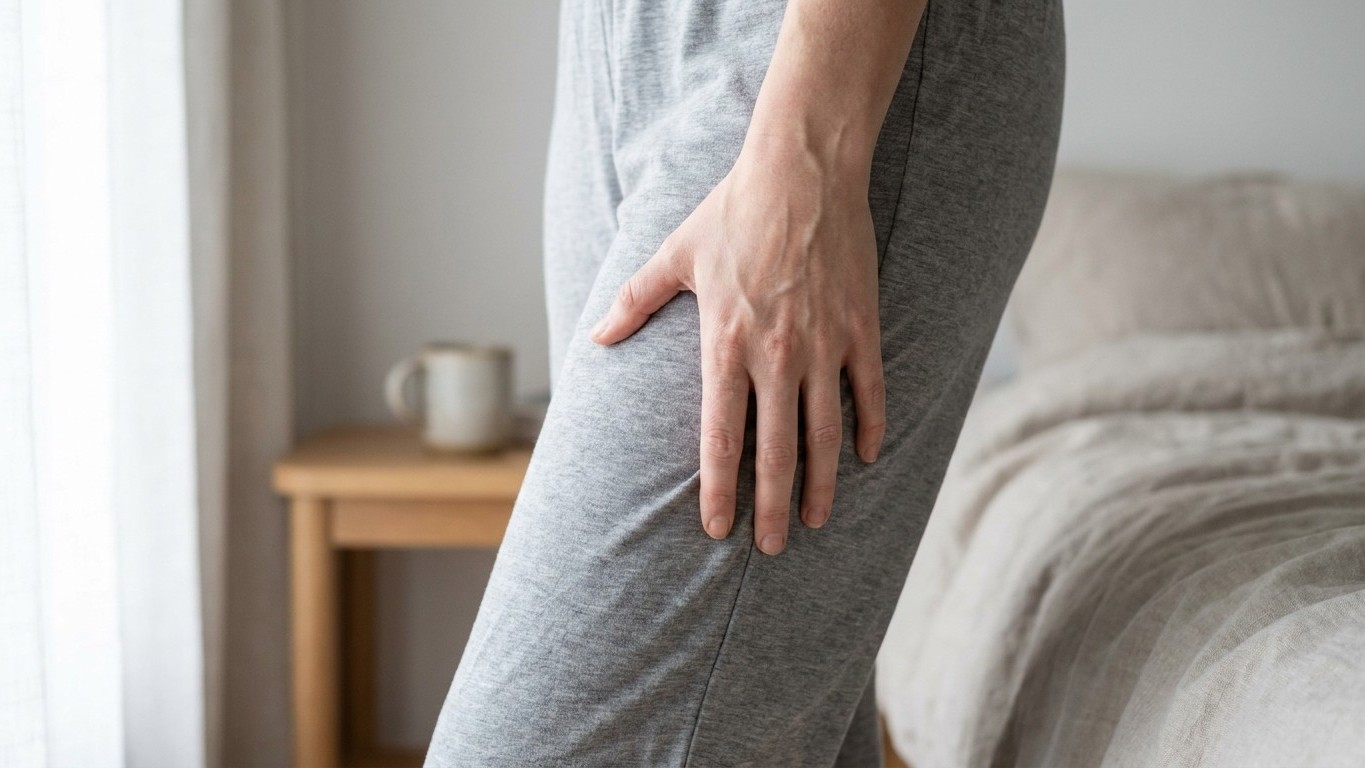
Three days after a single long workday in your tightest pair of skinnies, your outer thigh is still sending faint electric signals into the air. You haven’t hit the gym. You haven’t twisted your knee or slept funny. You just wore jeans. What is happening inside your body is more specific, and more instructive, than you might expect.
Key takeaways
- A single day in restrictive jeans can compress a nerve in your groin that controls sensation in your outer thigh
- The tingling persists for days because nerves don’t instantly reset when pressure is removed—inflammation lingers
- Even soft fabric touching your skin can trigger sharp pain as the irritated nerve overreports every signal
The nerve you’ve probably never heard of (until now)
Meralgia paresthetica, also known as lateral femoral cutaneous nerve entrapment, is a condition characterized by tingling, numbness, and burning pain in the outer thigh. The name sounds clinical and obscure, but neurologists have a more vivid nickname for it: “tingling thigh syndrome.” It has nothing to do with a pulled muscle or a hip flexor flare-up. It’s caused by the compression of the lateral femoral cutaneous nerve, which provides sensation to the skin along the outer thigh starting from the inguinal ligament and extending down toward the knee.
Here’s the anatomy that makes this nerve so vulnerable. In most people, this nerve passes through the groin to the upper thigh without trouble. But in meralgia paresthetica, the lateral femoral cutaneous nerve becomes trapped, often under the inguinal ligament, which runs along your groin from your abdomen to your upper thigh. Now layer a pair of rigid, low-rise skinny jeans over that junction for eight hours at a desk, and the geometry changes fast.
The most well-documented neurological concern associated with overly tight jeans is meralgia paresthetica, sometimes referred to informally as “Skinny Pant Syndrome.” The nerve becomes entrapped or irritated as it exits the pelvis and passes beneath the inguinal ligament, which is often tightened by a restrictive waistband. One important detail worth sitting with: the symptoms are purely sensory, because the lateral femoral cutaneous nerve has no motor function. Your leg still works. Your nerve is simply protesting, loudly, persistently, and on its own timeline.
Why the tingling doesn’t stop when you take your jeans off
This is the part that surprises most people. You removed the jeans. The pressure is gone. So why does the outer thigh still buzz three days later, sometimes waking you up at 2 a.m. when the sheets barely graze it?
Meralgia paresthetica develops when the lateral femoral cutaneous nerve is exposed to sustained pressure or irritation along its course near the hip and groin. This compression interferes with normal nerve signaling, leading to sensory symptoms in the outer thigh. Nerves don’t simply “reset” the moment the source of compression disappears. The irritation and inflammation linger in the tissue around the nerve even after the physical trigger is removed. The burning or sharp pain is often described as a searing or electric sensation, especially on one side of the body, and a “pins and needles” feeling is a frequent complaint, particularly after standing for long periods or during hip movement.
Hypersensitivity to light touch is another hallmark: even minimal contact, such as fabric brushing against the skin, can trigger exaggerated pain responses. If you’ve found yourself wincing at your pajama pants, that’s exactly what’s happening. The nerve, still inflamed, is overreporting every signal. Frankly, this is one of the more disorienting symptoms, the softest touch hurting more than real pressure, because it runs so counter to how we expect pain to work.
Wearing tight jeans or other constrictive clothing can cause nerve damage, specifically to the lateral femoral cutaneous nerve. While often temporary, repeated pressure can lead to chronic symptoms. That word, repeated, matters. A single long day in uncomfortably tight denim is not a medical emergency. But it is a data point your body is filing away.
How long does it actually take to recover?
The honest answer is: it depends. The prognosis for meralgia paresthetica is usually good. Approximately 85% of people with meralgia paresthetica experience recovery with conservative treatment. For clothing-triggered cases especially, the fastest path to relief is the most obvious one: stop compressing the nerve. Typically, meralgia paresthetica goes away in a few months on its own or with conservative treatment, like wearing loose-fitting clothing or losing weight.
A few months feels like a long time for something that started with your outfit. But it can take some time for thigh pain to go away, and some people will still feel numbness even after treatment. In most cases, though, recovery happens within 4 to 6 weeks. For mild, first-time cases triggered by tight clothing rather than a metabolic condition, the timeline is often shorter, days to a couple of weeks if you genuinely remove the source of pressure and give the nerve space to settle.
If symptoms persist past two or three weeks despite changing your clothes and your habits, it’s time to get help. A physical therapist can help pinpoint mechanical issues and design a personalized plan for relief. Specific meralgia paresthetica stretches are often prescribed to improve range of motion and relieve pressure in the thigh region. In more stubborn cases, a doctor might discuss a nerve block or anti-neuropathic medication. Surgery exists, but it’s the last resort, reserved for cases that haven’t responded to anything conservative after several months.
The jeans are coming back anyway (here’s what to actually do)
Here’s the counter-intuitive part of this story. You might assume that skinny jeans are on their way out of wardrobes permanently, replaced by the barrel legs and wide-cut silhouettes that dominated the past few years. The briefly shunned skinny jean may have a good year in 2026, thanks to consumers’ rising nostalgia for the 2010s. Skinnies are picking up momentum on the catwalks for several seasons. Sales of slim and skinny denim declined by 37% between 2019 and 2023, while loose and relaxed fits grew by 42%. The pendulum is swinging back. Which means the conversation about nerve health and tight denim isn’t going away anytime soon.
The practical answer isn’t “never wear fitted jeans again.” Choosing a mid-rise or high-rise style may be beneficial, as low-rise jeans tend to put focused pressure directly on the lateral femoral cutaneous nerve. Fabric composition matters too: rigid, zero-stretch denim is categorically harder on the nerve than versions blended with elastane, which distribute pressure more evenly and give the inguinal area room to breathe when you sit. Individuals who wear skinny jeans for extended periods, especially while sitting or standing in one position, are at higher risk of developing this condition, which suggests that breaking up long seated stretches with movement is as relevant as the jeans themselves.
One thing worth knowing: high heels increase the chance for the numbing sensation because the shoes tilt the pelvis forward, increasing the pressure on the nerve. Pairing skin-tight denim with stilettos for a full workday isn’t just a comfort question, it’s a mechanical one, with compounding effects on exactly the nerve that’s currently making itself known in your outer thigh. The tingling three days later isn’t your body being dramatic. It’s the most precise feedback mechanism you have.
Sources : shunvogue.com | denversouthchiro.com