
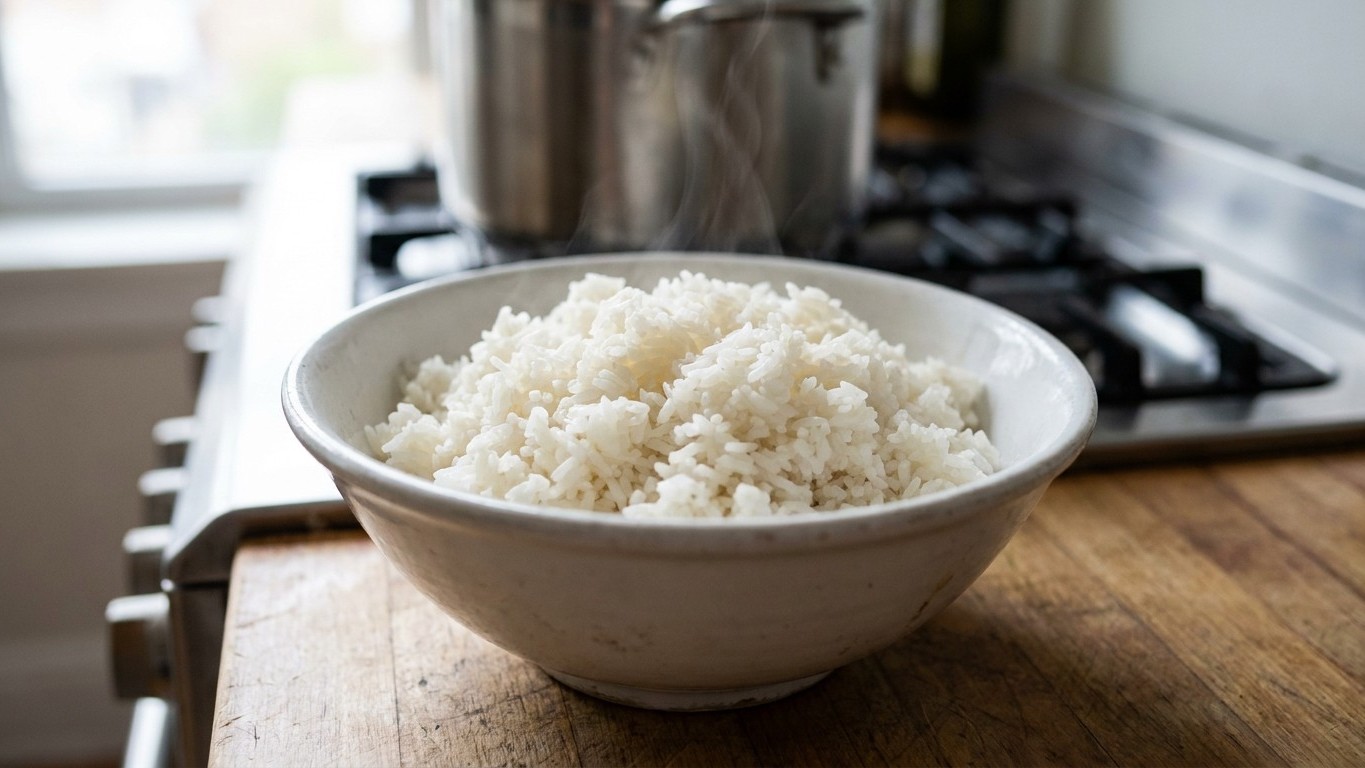
Boiling water at 212°F does not kill Bacillus cereus. Neither does a hard stir-fry in a screaming-hot wok, or three minutes in the microwave the next day. Reheating rice does not kill the bacteria spores, as they can survive cooking. That single fact upends what most people assume about leftovers, and it’s the reason a bowl of rice left on the counter overnight can turn a quick lunch into a night hunched over the toilet.
The confusion is understandable. We’ve been trained to believe heat equals safety, that anything hot enough will “cook out” whatever’s lurking in our food. With most bacteria, that’s true. With this one, it isn’t.
Key takeaways
- Heat-resistant bacteria spores survive cooking and multiply when rice sits out at room temperature
- Reheating rice does nothing to eliminate the toxins already produced—the danger zone is real
- The two-hour rule isn’t arbitrary: at the right temperature, bacterial colonies double every 20 minutes
The bacterium that shrugs off your stove
Fried rice syndrome is food poisoning caused by a bacterium known as Bacillus cereus, a microscopic germ that likes to live on starchy foods like rice and pasta. The bacteria get into rice and other grains as they grow, and what makes them particularly problematic is that they can form protective shells called spores that help them survive harsh environments like high temperatures and dryness. Cooking kills the active bacteria. It does nothing to the spores.
Left alone in the fridge, those spores stay dormant and harmless. But when rice is cooked, the heat kills most bacteria, but the spores of B. cereus survive, and if the cooked rice is left at room temperature, these spores can germinate and multiply, producing heat-stable toxins that are resistant to reheating. That’s the trap. The danger isn’t the rice sitting out for an hour while you finish dinner. It’s the rice sitting out, forgotten, on a counter that never quite gets below 70°F.
Ben Chapman, a food safety specialist at North Carolina State University, puts it plainly: letting grains sit at room temperature for several hours is what usually leads to Bacillus cereus food poisoning, allowing the bacteria to grow and create heat-stable toxins that can’t be cooked out when the rice is reheated. Reheat it all you want afterward. The toxin is already there, and it’s not going anywhere.
Why two hours, specifically
The number isn’t arbitrary, and it isn’t a suggestion pulled from a lifestyle blog. According to the USDA’s Food Safety and Inspection Services, after cooking rice, other grains, and pasta, you should refrigerate them within 2 hours, and that time frame drops to 1 hour if the grains have been out at 90°F, for instance while dining outside on a hot day. This corresponds to what food safety professionals call the danger zone, the range between 40°F and 140°F where bacteria can grow and multiply.
The growth curve inside that zone is aggressive. In the right conditions, a colony of B. cereus can double in size every 20 minutes at around 86°F, producing enough toxins to make you sick. Do the math on a warm kitchen counter over a summer afternoon and you understand why the window is so tight. A pot of rice cooling gently by the stove from noon until dinnertime isn’t “resting,” it’s incubating.
The industrial-grade version of the same warning comes from an outbreak investigated decades ago. If cooked rice is subsequently held at room temperature, vegetative forms multiply, and heat-stable toxin is produced that can survive brief heating, such as stir frying. That report, tied to a fried rice outbreak at a day care facility, remains one of the reference points food safety agencies still cite.
When it actually goes wrong
Most cases resolve on their own, and quickly. Eating a food that contains these toxins may cause nausea and vomiting within an hour or up to five hours later, or intestinal cramping and diarrhea within 8 to 16 hours. Unpleasant, yes. Dangerous, rarely. Illnesses caused by Bacillus cereus are relatively rare compared with those caused by other foodborne bacteria, with about 63,000 people in the U.S. getting sick from it a year, compared with 1.35 million cases of food poisoning and 420 deaths a year from salmonella. Put that next to salmonella’s toll and B. cereus starts to look almost mild.
Almost. The rare exceptions are what turned this into a social media obsession in the first place. A case that resurfaced online involved a college student who reportedly ate spaghetti he cooked, left out of the fridge, and then reheated and ate five days later, and did not survive. Clinical reports have documented severe outcomes too: among the toxins produced by Bacillus cereus, cereulide is the most critical and resistant to heat and acid during cooking, and the emetic type can occasionally cause acute liver failure. A cluster of adults in Europe learned this the hard way after eating fried rice balls made from rice that had been boiled days earlier and improperly refrigerated. One of them tasted the batch with a teaspoon, felt briefly nauseous, recovered, and unknowingly served the same contaminated rice to an entire team that evening. Within thirty minutes, everyone was sick.
These extreme cases remain the exception, not the rule, but they explain why professionals treat the two-hour guideline as non-negotiable rather than a nice-to-have.
The fix has nothing to do with your microwave
Since the reheating step can’t save you, all the leverage sits earlier in the process, at the cooling stage. Once you’re done cooking, don’t let rice sit out on the stove or counter. Spread it out in a shallow dish or tray to cool faster. A deep pot of rice traps its own heat at the center for hours, quietly extending its stay in the danger zone even after it looks cool on top.
Portioning matters just as much. If you batch cook rice for the week, divide it into individual portions and cool each container separately, without stacking them in the fridge, as this can trap heat and take a long time to cool. And once it’s chilled, treat the clock as still running. Cooked rice can keep for up to three or four days in the refrigerator. After that, the smell test isn’t enough, since the toxin doesn’t necessarily announce itself with an odor.
One detail rarely makes it into the viral warnings: this isn’t a rice-specific quirk. Bacillus cereus is also found on other starches like pasta and potatoes, while another spore-forming bacteria called Clostridium perfringens grows on gravy and meats and produces toxins resistant to cooking and reheating too. The lesson from rice applies to that leftover mashed potato bowl sitting on the Thanksgiving counter just as much as it does to last night’s fried rice.
Sources : ncbi.nlm.nih.gov | today.com