
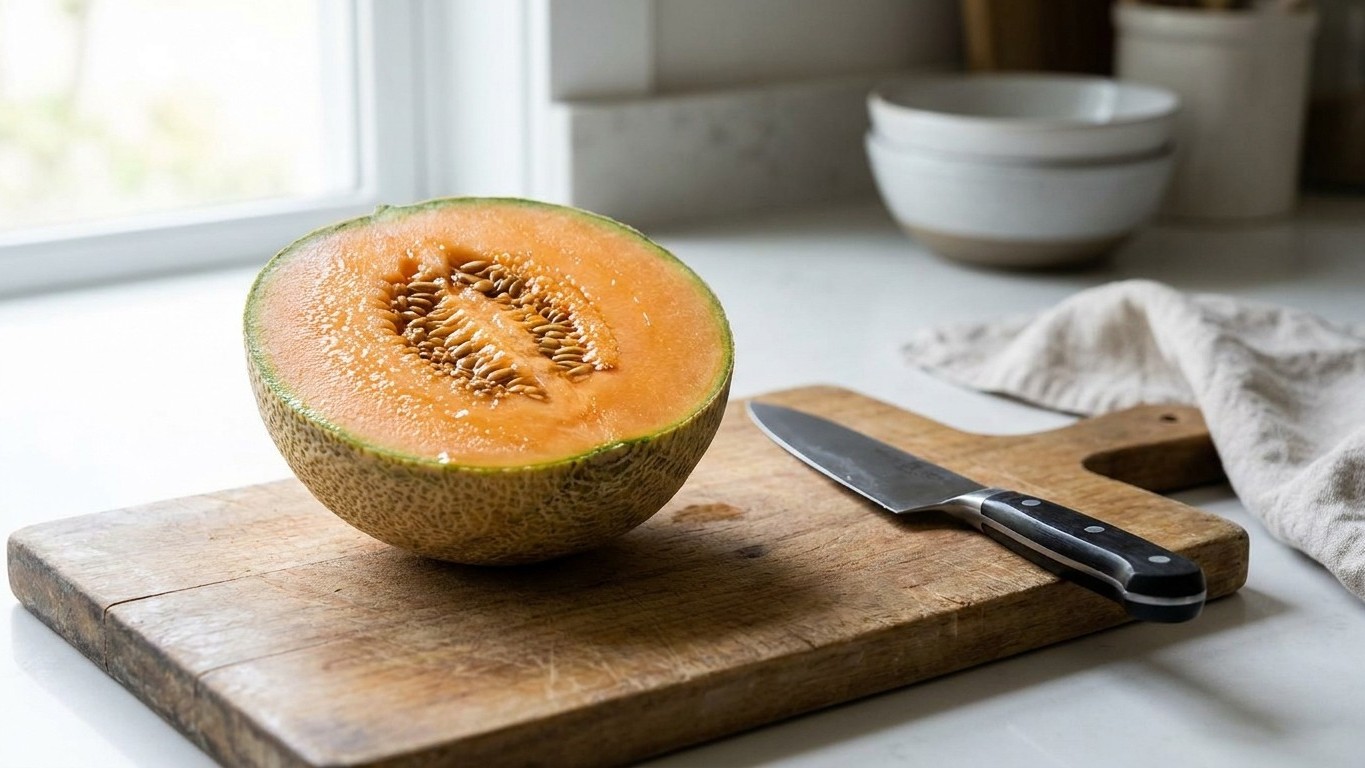
Slice a cantaloupe, set it on the counter while you finish making the fruit salad, and you’ve already opened a window for bacteria to multiply. The fix takes one second: get that cut melon into the refrigerator the moment the knife stops moving. Federal guidelines are blunt about the timeline, refrigerate perishable food within 2 hours, or within 1 hour if it’s been exposed to temperatures above 90°F. For melon, that clock starts the instant the flesh is exposed.
Key takeaways
- The moment a knife hits melon flesh, bacteria from the rind can contaminate what you’ll eat
- Listeria thrives in the cold, making speed—not just temperature—the real defense
- Recent outbreaks prove this isn’t theory: two people died in a 2023 cantaloupe outbreak
Why melon turns into a bacterial breeding ground
Cantaloupe in particular carries a design flaw. Unlike the smooth rind of the watermelon, the cantaloupe rind is textured and netted, with spaces where bacteria such as Salmonella and Listeria can harbor and be difficult to remove. The problem isn’t the rind itself, since nobody eats that part. It’s what happens the second a blade crosses it.
The simple act of cutting the melon can carry bacteria on the knife from the outer rind into the soft inner flesh that we eat, causing the potential for foodborne illness. Add to that the fruit’s chemistry: melon flesh is sweet, low-acid, and roughly 90 percent water — practically a room-service buffet for pathogens once it’s exposed to air and ambient temperature.
And Listeria doesn’t play by the usual rules. Most food safety advice centers on keeping things cold to stop bacterial growth. Listeria monocytogenes, though, thrives under refrigeration, which is exactly why the emphasis for melon isn’t just “keep it cold” but “keep it cold immediately and don’t let contamination take hold in the first place.”
The one-second reflex: chill it before you do anything else
The habit worth building is almost embarrassingly simple. As soon as the melon is cut, portioned, or cubed, it goes straight into a container and into the fridge, no in-between. Not after you’ve wiped the counter. Not after you’ve called the kids to the table. Immediately.
Health authorities frame it as a hard limit, not a suggestion. Cut melon should not be left out of refrigeration at less than 41°F for four or more hours; it should be refrigerated and consumed or discarded within days. Once refrigerated, cut cantaloupe is generally good within 7 days, but only if that first move happens fast.
There’s a second reflex that pairs with it, and it happens before the cutting, not after: washing. The FDA strongly recommends scrubbing the melon’s surface with a clean produce brush under running water to prevent the knife from transferring bacteria to the flesh as you cut. Skip that step and even a spotless refrigerator won’t save you, because the contamination already rode the blade into the part you’re about to eat.
For pre-cut melon bought at the store, the reflex shifts to the shopping cart. If buying pre-cut and packaged fruits or vegetables, choose ones that are refrigerated or kept on ice and keep them refrigerated at home. A clamshell of melon sitting unrefrigerated on a display table is a red flag, not a bargain.
What happens when nobody follows the reflex
This isn’t theoretical caution. It’s the reason cantaloupe has become one of the most closely watched fruits in American food safety, and the history is sobering.
The starkest case remains 2011. Contaminated cantaloupes linked to Jensen Farms of Colorado caused a listeriosis outbreak across 28 states, resulting in 33 deaths and 147 confirmed cases. Investigators later traced the failure to the packing facility rather than the fields, samples taken from the fields and irrigation water were negative, but samples collected inside the packing plant and cantaloupes in cold storage were positive — a reminder that contamination can happen long before the melon ever reaches a home kitchen. What consumers control is what happens after that: washing, cutting hygiene, and immediate chilling remain the last line of defense.
The pattern has repeated since, just at smaller scale. In 2019, 137 people across 10 states were infected with an outbreak strain of Salmonella linked to pre-cut melons, with illnesses starting between March and May, and 38 people hospitalized. In late 2023, a Salmonella outbreak tied to whole and pre-cut cantaloupes sickened people across dozens of states, and 117 people were sickened, 61 hospitalized, and 2 died according to FDA updates at the time. As recently as September 2025, a Minneapolis supplier recalled fresh cut cantaloupe sold under the “Harvest Cuts” and “Fresh & Finest” labels in clamshell containers distributed to grocery locations after routine testing turned up Listeria monocytogenes.
None of that means cantaloupe deserves to disappear from summer fruit bowls. It means the fruit demands a level of respect that, say, an apple doesn’t. Pregnant women, older adults, young children, and anyone immunocompromised face the highest stakes, since a Listeria infection in pregnancy can lead to premature delivery, infection of the newborn, or stillbirth, even when the mother experiences only mild, flu-like symptoms.
Building the habit that actually sticks
The mistake most home cooks make isn’t ignorance, it’s sequencing. Melon gets sliced, then arranged prettily on a board, then left out while the rest of the meal comes together — sometimes for an hour, sometimes for an entire afternoon at a barbecue. That gap is exactly where bacteria that were riding along on the rind get the warm, moist window they need to multiply on the exposed flesh.
Flip the order instead. Cut, container, fridge — then arrange the platter straight from cold storage right before serving, and swap it out for a fresh, chilled batch if it’s been sitting on a table for more than an hour or two, especially outdoors in summer heat. It sounds almost too small an adjustment to matter. But given how many outbreaks trace back to exactly that overlooked stretch of counter time, it might be the single cheapest insurance policy in the entire kitchen.
Sources : fda.gov | archive.cdc.gov