
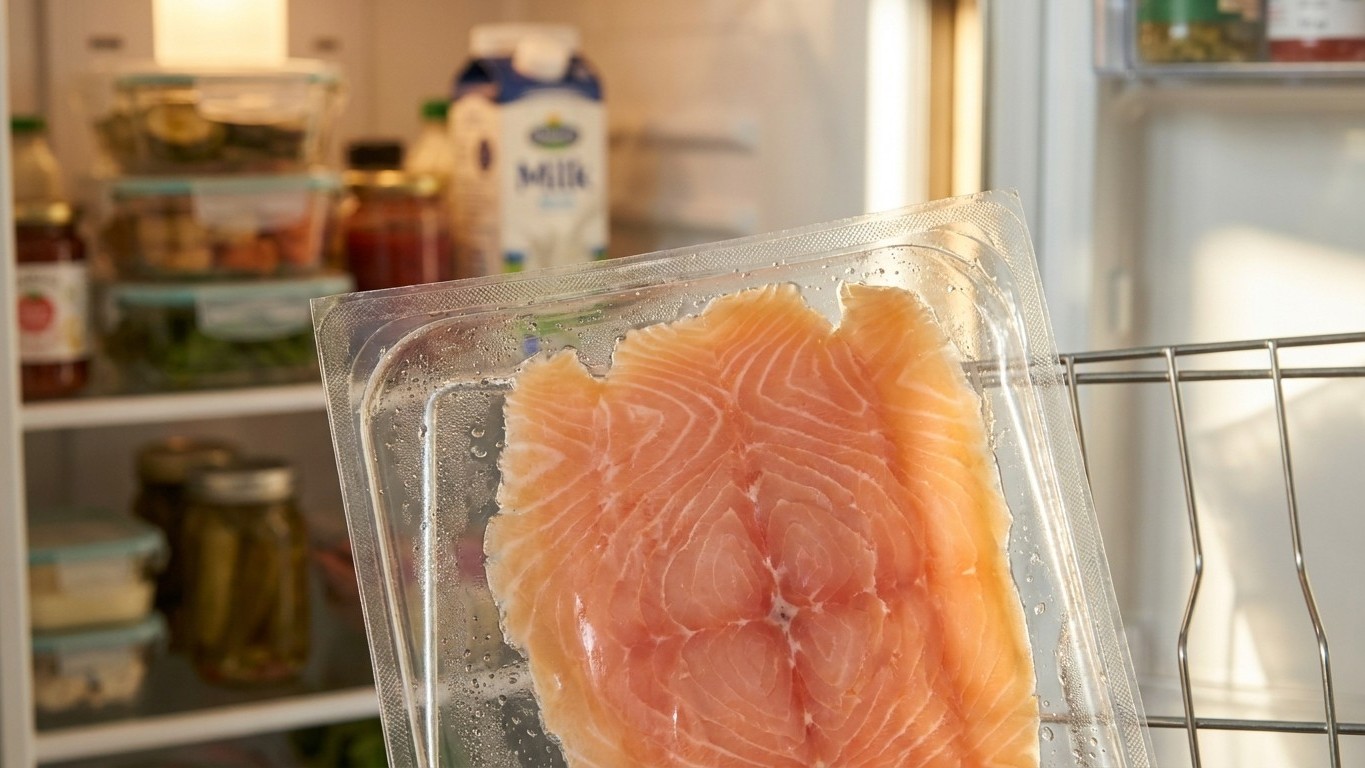
Cold-smoked salmon, the silky, translucent kind draped over bagels or folded into a brunch platter, is not actually cooked. A microbiologist put it to me plainly: that fish is still essentially raw, cured with salt and exposed to smoke at temperatures far too low to kill anything dangerous. The safety gap between hot and cold smoking comes down to temperature.
Hot-smoked salmon is cooked at temperatures high enough to kill pathogens, while cold-smoked salmon is cured with salt and exposed to smoke at low temperatures, typically below 80°F, which gives it the silky, translucent texture people love but leaves it essentially raw. I had always assumed the fridge was doing the heavy lifting, keeping anything nasty in check. The demonstration that changed my mind involved a single bacterium: Listeria monocytogenes. And the uncomfortable truth is that your refrigerator barely slows it down.
Key takeaways
- Cold-smoked salmon is essentially raw, and your fridge temperature likely isn’t cold enough to stop bacterial growth
- Listeria monocytogenes grows at temperatures below 31°F—most home fridges run warmer than the industry safety standard
- One in five people infected with listeriosis dies from it, making this bacterium deadlier than any other foodborne pathogen
A bacterium that shrugs off refrigeration
Most foodborne pathogens need warmth to multiply. Listeria doesn’t play by that rule. It can grow at a minimum temperature of −0.4°C (31.2°F), which is colder than most home freezers even register as “safe.” The CDC states it without ambiguity: refrigeration does not kill Listeria. Freezing doesn’t kill it either, it simply pauses the clock. That distinction Matters More Than people realize, because it means the danger isn’t necessarily what happened at the grocery store. It’s what happens quietly, in your own fridge, over the days you take to finish the package.
A 2023 modeling study pulled 116 records and 465 data points from ComBase to examine how Listeria monocytogenes behaves in cold smoked salmon during refrigerated storage and temperature abuse. The researchers weren’t chasing a theoretical risk. Cold smoked salmon is a high-value ready-to-eat product, but it generally has a short shelf-life even under refrigeration and can support the growth of Listeria monocytogenes. Translation: the very qualities that make lox feel like a treat, its delicate texture, its long fridge life, are the same qualities that give the bacterium room to work.
There’s also something almost sneaky about how it survives. Research out of North Dakota State University found that Listeria grows on refrigerated smoked salmon through different metabolic pathways than in laboratory culture, even when modified to have the same salt content and pH as the salmon. In plain terms, the fish itself seems to give the bacterium an advantage that a petri dish never would. Franchement, that’s the kind of detail that reframes an entire category of “safe” refrigerated food.
Why your fridge isn’t as cold as you think
Here’s the part that genuinely surprised me. We treat 40°F as some kind of magic threshold, the number where bacteria supposedly stop multiplying. They don’t. And most home refrigerators don’t even hit that mark consistently. A UK Food Standards Agency exposure assessment modeled real consumer behavior using data on how fridges actually perform, not how we assume they perform. One modeled consumer had a median performing fridge temperature of 8.1°C, and consumed the product immediately after removing it from refrigeration on the last day of shelf life, while another had a fridge performing in the upper 75th percentile at 8.7°C. That’s 46 to 48°F, comfortably above the danger zone we like to imagine our appliances maintain.
Industry guidance for cold-smoked salmon production is far stricter than the average home fridge setting. Regulators recommend the finished product never exceed 6°C, preferably staying between 2 and 4°C, roughly 35 to 39°F. Most people’s fridge doors, where salmon often ends up wedged next to the mustard, run warmer than that thanks to constant opening and closing. Bottom shelf, back corner, away from the door: it sounds fussy, but it’s the difference between a fridge that behaves like a lab-grade cold room and one that’s basically room temperature with extra steps.
The listeriosis math nobody mentions at the deli counter
Listeriosis itself is rare. But its severity is what separates it from a routine stomach bug. If the pathogen gets into the bloodstream, it can cause listeriosis, a disease that kills one out of every five victims, giving Listeria the highest mortality rate of any foodborne pathogen. That single statistic is the reason food safety agencies treat this bacterium so differently from, say, garden-variety salmonella.
Contamination doesn’t necessarily come from the fish itself. FDA inspections of cold-smoked salmon processing facilities found that while most facilities had a low prevalence of Listeria monocytogenes, two facilities had a higher prevalence, tied to gross insanitary conditions and poor employee practices. It’s a manufacturing and handling issue as much as a storage one, which is exactly why a small, undetectable amount can already be present in a factory-sealed package before it ever reaches your cart.
Pregnant women, adults over 65, and anyone immunocompromised carry the highest risk, and the CDC’s advice for this group is refreshingly unambiguous: choose “shelf-stable” pâté, meat spreads, and smoked fish as safer choices, since shelf-stable foods are treated with heat to kill germs before being sealed in containers that don’t need refrigeration before opening. For everyone else, the practical fix is almost boringly simple: keep it cold, keep the clock short, and don’t treat “best by” as a countdown you can outrun.
What actually changes in how I store it now
I no longer leave the package loitering in the door shelf. It goes to the coldest part of the fridge, ideally the back of a lower shelf, and I’ve started treating the opened-package window as a hard deadline rather than a suggestion. If I’m not finishing it within a few days, it goes into the freezer, wrapped tightly, because pausing bacterial growth is still better than letting days quietly stack up in the danger zone. None of this makes cold-smoked salmon something to fear outright. It just means the fridge was never the fortress I thought it was, and the real safeguard was always the clock, not the compressor.
Sources : sciencedirect.com | food.gov.uk