
Sixty percent. That’s the share of home cooks in a federal study whose kitchen sink still tested positive for bacteria after they rinsed raw poultry under the tap. Fourteen percent still had bacteria there even after they’d gone back and scrubbed it. I didn’t know any of this the day a food safety consultant swabbed my worktop as part of a segment I was covering, ran the sample, and showed me the plate a few days later, dotted with colonies that had traveled well past my sink basin. Fifteen years of “cleaning” my chicken, and I’d been doing the opposite the whole time.
The instinct makes sense on paper. Raw poultry looks slick, sometimes a little pink-tinged, and rinsing it under running water feels like basic hygiene, the same reflex that makes you wash a bell pepper before slicing it. Except chicken isn’t a pepper. The bacteria that make you sick, primarily Salmonella and Campylobacter, aren’t removed by washing. They’re killed by heat during cooking. Water does nothing to them except give them a ride.
Key takeaways
- A food safety test exposed hidden bacterial contamination spreading from a simple kitchen habit practiced for decades
- Water droplets from rinsing raw chicken can travel three feet, contaminating dishes, cutting boards, and ready-to-eat food
- 60% of home cooks still had bacteria in their sinks after rinsing poultry; 26% transferred it directly to salad lettuce
What actually happens when water hits raw chicken
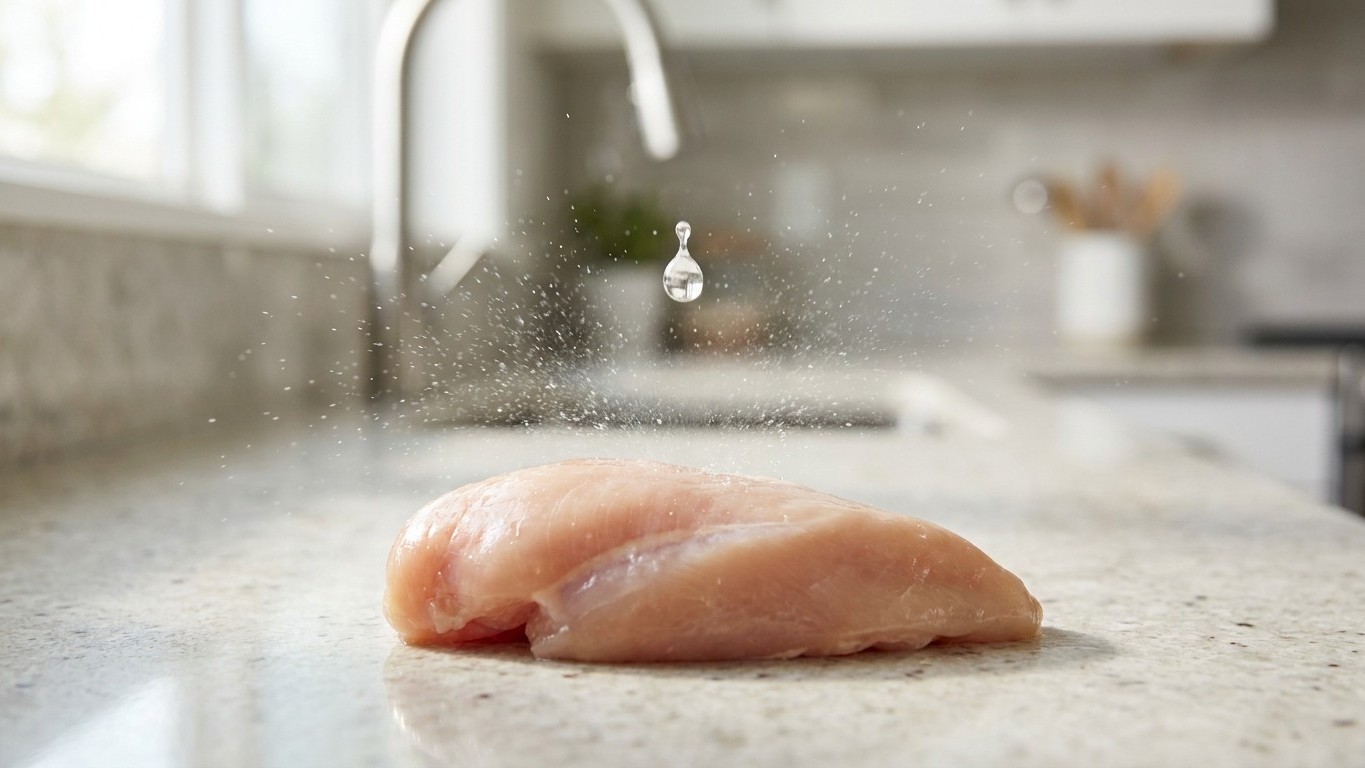
This is the part that changed how I cook, permanently. When water hits raw chicken, it creates tiny droplets that carry bacteria outward from the sink. The Physics of Fluids study measured exactly how far these contaminated droplets travel and found that chicken rinsed at a typical kitchen faucet height of 40 cm produced far more bacterial contamination on surrounding surfaces than chicken rinsed at 15 cm. The higher the tap, the wider the invisible blast radius. And it isn’t a gentle process, either: higher water flow made things worse, and whether the chicken had skin on or off made no difference.
The federal agency that oversees meat and poultry safety put a number on the splash zone. The USDA says bacteria on raw chicken, like salmonella, ride misting water droplets out from the sink in a process known as “aerosolization,” splattering the food-prep area in a 2-3 foot radius. Three feet. That’s your dish rack, your coffee mug drying on the counter, the cutting board you’d set aside for tomorrow’s salad, all sitting in what amounts to an invisible contamination field every time the faucet runs over a chicken breast.
The observational study behind this warning followed real home cooks, not lab technicians in splash suits. Of the participants who washed their raw poultry, 60 percent had bacteria in their sink after washing or rinsing the poultry, and 14 percent still had bacteria in their sinks after they attempted to clean the sink. Twenty-six percent of participants who washed raw poultry transferred bacteria from that raw poultry to their ready to eat salad lettuce. Lettuce. The one item on the counter nobody thinks to associate with raw meat.
The Julia Child problem
Here’s the contradiction nobody warns you about: an entire generation learned to cook watching someone rinse chicken on television. Legendary chef Julia Child was a proponent of washing raw chicken, and often advised viewers of her cooking shows to do the same. That habit got passed down through decades of family kitchens, mine included, long before food safety agencies had the tools to trace exactly where the water went. It wasn’t sloppiness. It was inherited wisdom that simply predated the science.
The agency that finally quantified the risk didn’t mince words about it. “Even when consumers think they are effectively cleaning after washing poultry, this study shows that bacteria can easily spread to other surfaces and foods. The best practice is not to wash poultry,” said Dr. Mindy Brashears, the USDA’s Deputy Under Secretary for Food Safety. The results of the observational study showed how easy bacteria can be spread when surfaces are not effectively cleaned and sanitized. Public health guidance rarely gets phrased that bluntly. When it does, it’s worth listening.
The CDC’s public messaging on this has been just as direct for years. Washing can spread germs from the chicken to other food or utensils in the kitchen. And the illness numbers behind that warning aren’t small. Every year in the United States about 1 million people get sick from eating contaminated poultry. Somewhere in that count are people who thought they were doing Everything right by scrubbing the raw meat first.
So what do you actually do instead
Skip the sink entirely. Raw chicken is ready to cook and doesn’t need to be washed first. Take it straight from the package to the pan, the baking dish, or the cutting board reserved only for raw meat. If there’s excess liquid, a paper towel does the job water can’t: it lifts moisture without launching a single droplet across the room.
What actually matters happens after the chicken is out of your hands. If you choose to wash chicken, do so as safely as possible: run the water gently over the chicken to reduce splashing, immediately clean the sink and area around the sink with hot, soapy water and sanitize them thoroughly, and wash your hands for 20 seconds. Better still, treat every surface the raw meat touched, board, faucet handle, dish towel, as contaminated until proven otherwise, and sanitize before anything else goes near it. Use a separate cutting board for raw chicken, and never place cooked food or fresh produce on a plate, cutting board, or other surface that previously held raw chicken.
None of that replaces the one step that actually neutralizes the danger. Cooking to 165°F is the only step that makes chicken safe. A thermometer, not a rinse, is the tool doing the real work in your kitchen.
I still catch myself, sometimes, reaching for the tap out of pure muscle memory before stopping myself mid-motion. The swab test didn’t just teach me a fact. It rewired a habit that fifteen years of cooking had made feel like common sense. The strange part is how ordinary the fix turned out to be, a paper towel, a dedicated board, a thermometer left in the drawer for far too long, doing more to protect a dinner table than any amount of scrubbing ever did.
Sources : nbcbayarea.com | gulfnews.com