
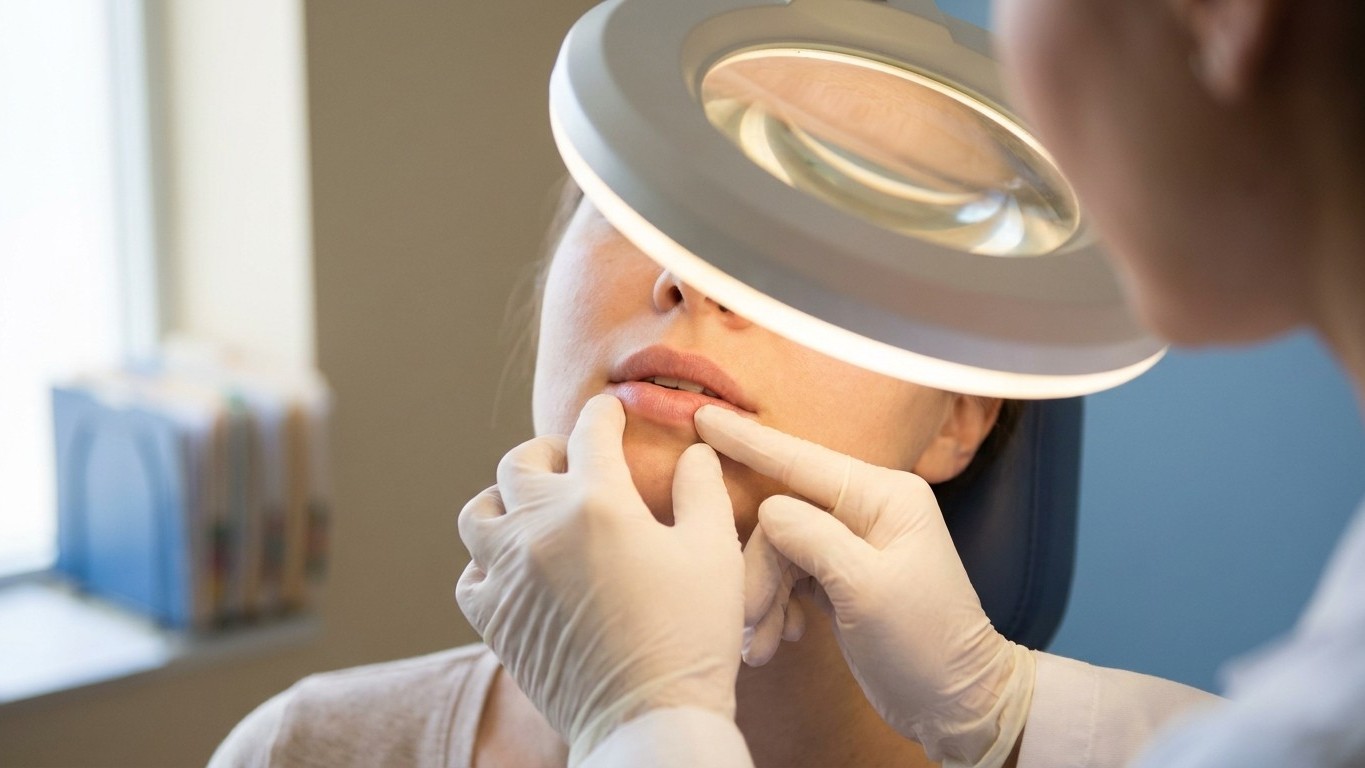
The dermatologist tilted a small lamp toward my chin, pressed two fingers under my lower lip, and pulled it gently outward. I remember the silence in the room more than the words that followed. What she saw there, a rough, whitish patch running along the edge where lip meets skin, wasn’t sunburn peeling away. It was the accumulated bill for every summer morning I’d carefully swiped SPF 50 across my cheeks, forehead, and nose, and completely forgotten my mouth.
That’s the paradox Nobody Tells You about at the pharmacy counter: the part of your face most exposed to direct sunlight, angled skyward, protruding forward, catching every ray, is also the part most people never think to protect.
Key takeaways
- Your lips are uniquely vulnerable: thinner skin, less melanin, no oil glands—and the lower lip catches even more UV rays
- What looks like severe chapping might actually be actinic cheilitis, a precancerous condition that doesn’t heal itself
- One dermatologist’s discovery sparked a reckoning about the sunscreen step nobody talks about at the pharmacy counter
Why lips burn faster than the rest of your face
The skin covering your lips isn’t really skin in the way we think of it. Your lips are more vulnerable to the sun’s rays than other areas of skin, because the skin on your lips is thinner and contains less pigment to protect cells from the sun’s damaging rays. There’s no real buffer, no melanin cushion, no oil glands standing guard. The physical properties of the lips, such as their shape and being a transition area from oral mucosa to skin with thinner epithelium, less sebaceous glands, and less melanin, contribute to less protection and increased exposure to UV radiation.
And the lower lip draws the short straw specifically. It gets more sun exposure because it protrudes from the face, and typically protrudes further than the upper lip, so most actinic keratosis lesions form there. Some dermatologists frame it even more bluntly: actinic cheilitis, an inflammation of the lip brought on by chronic sun exposure, almost always only affects the lower lip as its location causes it to catch a proportionally larger amount of UV radiation than the upper lip. Which is exactly the spot my own dermatologist had lifted with two fingers.
What that white patch actually is, and why it’s not “just chapped lips”
The condition has a name: actinic cheilitis, sometimes called sailor’s lip, because it was first noticed in fishermen and outdoor workers who spent decades squinting into open water. It’s a precancerous condition that causes rough, scaly patches, and chronic sun exposure can also damage the skin barrier around the lips and make your lips look aged and discolored.
Here’s the part that reframes everything: this isn’t cosmetic. Actinic cheilitis is a precancerous condition caused by long-term sun exposure, leading to rough, scaly, discolored patches on your lips, and treatment can prevent cancer. Left alone, it doesn’t just sit there looking dry. This is a pre-cancerous lesion that can progress into squamous cell carcinoma if left untreated. The distinction matters because most of us mentally file lip dryness under “annoying” rather than “warning sign.” While it can look like severely chapped lips, actinic cheilitis is different because it involves pre-cancerous changes in the cells caused by sun damage.
The numbers behind this are more sobering than the average sunscreen ad lets on. In the US, there are more than 3,500 new cases of lip cancer annually, 90% of which are squamous cell carcinoma. A study cited by researchers found something startling about how common the precancerous stage already is: a recent study showed the prevalence of actinic cheilitis in the population over age 45 years old to be 31.3% in northwestern Spain. Nearly one in three. Franchement, that’s not a niche concern reserved for retired fishermen.
Interestingly, gender plays into this too, though not the way I expected. Some sources note that men develop it more often, likely tied to more outdoor work and less habitual use of lip balm or cosmetics, while others point out that women may carry their own elevated risk depending on the study. Men are affected more than women, likely due to their comparatively increased work in the sun and less use of protective lip balm and cosmetics. Either way, the common denominator isn’t gender. It’s habit.
The SPF conversation nobody has at the makeup counter
Here’s the uncomfortable irony: dermatologists have been saying this for years, and it still doesn’t land. While the American Academy of Dermatology recommends a lip balm with at least SPF 30 as part of daily sun protection, lip-specific photoprotection tends to get far less airtime than facial or body sunscreen. Even the research trailing behind consumer habits admits its own limits. One dermatologist candidly noted that the clinical research specifically linking lip SPF products to reduced lip cancer rates is “surprisingly thin.” But thin research doesn’t mean absent risk. That doesn’t mean you can skip applying SPF to your lips; in fact, the lips, tops of the ears and head are among the most common areas where melanoma gets diagnosed.
You might assume that dabbing on some leftover facial sunscreen solves the problem. It doesn’t, at least not ideally. If you’re in a pinch, experts say you can apply face sunscreen to your lips, but it isn’t ideal, since face sunscreens do not have the same consistency and are more challenging to apply to the lips. Lip-specific formulas exist for a reason beyond marketing. Lip SPFs are more hydrating, contain more emollients and are made with ingredients that are safe if ingested, since lip skin is thin and less likely to absorb a thicker product.
What should you actually look for on the label? A few things worth checking every time:
- SPF 30 or higher, broad-spectrum, applied like an actual skincare step, not an afterthought
- Mineral filters such as zinc oxide, which dermatologists favor for sensitive lip skin
- Reapplication after eating, drinking, swimming, or licking your lips, since balm doesn’t survive contact with anything wet
While SPF 15 provides basic protection, dermatologists recommend SPF 30 as the minimum for adequate daily protection, since SPF 30 blocks 97% of UVB rays compared to SPF 15’s 93%. That five-point gap sounds small on paper. On lip tissue with almost no natural defense, it isn’t.
What actually happens once the damage is diagnosed
My own patch wasn’t advanced. The dermatologist called it early, manageable, reversible with the right follow-up. But she was clear that ignoring it wasn’t an option, because this tissue doesn’t heal itself quietly in the background. It typically does not resolve on its own because it involves sun-induced damage to the lip tissue, and it develops slowly over years of sun exposure, typically not going away without intervention.
Treatment options range from watchful monitoring to actual procedures, depending on severity. Advanced options include laser ablation, where a laser removes the outer layers of sun-damaged skin, cryotherapy, where affected patches are frozen off, vermilionectomy, where the outer layer of the lip is surgically removed, and electrocautery. None of that sounded appealing sitting in that exam chair, which is precisely why prevention beats correction every single time. The most effective way to protect your lips from precancerous or cancerous lesions is to shield them from the sun whenever you’re outside, even on cloudy days and in the winter, using a lip balm with SPF 30 or higher applied frequently.
I keep a tinted SPF balm in every bag now, the car, the gym tote, the coat pocket, because the moment it’s not within arm’s reach is the moment I skip it. My dermatologist mentioned something in passing that stuck with me more than any statistic: she sees new lip lesions most often not in summer, but in early autumn, once people have already stopped thinking about sunscreen at all.
Sources : medicalnewstoday.com | wederm.com