
Most of us were taught that a good shower means hot water, a satisfying lather, and thorough scrubbing. The hotter and longer, the cleaner. That logic is deeply embedded in American bathroom culture, and dermatologists have quietly been ignoring it in their own routines for years.
The step they skip most consistently? Washing their entire body with soap. And beyond that, many have abandoned the idea of scrubbing their face under the shower stream at all. These aren’t rogue opinions from fringe practitioners. They represent a growing, research-backed consensus that what we’ve long considered basic hygiene may actually be working against our skin, quietly, daily, and cumulatively.
Key takeaways
- The one shower habit dermatologists eliminated from their routines—and it’s not what you’d expect
- Why hot water and thorough lathering might be your skin’s worst enemy
- The 3-minute window after showering that changes everything (and most people miss it)
The Soap Habit Dermatologists Quietly Dropped
“If you talk to most dermatologists, probably none of them use actual soap, except on their hands,” says Dr. Erin Chen, a dermatologist at Massachusetts General Hospital. That line should stop you mid-lather. The professionals who treat dry skin, eczema flares, and compromised skin barriers for a living have largely ditched the bar sitting on their shower ledge. They just haven’t been broadcasting it at appointments.
The reason comes down to skin chemistry. A study in healthy volunteers showed that washing with soap disrupts the skin barrier, and the more times soap was applied and rinsed while cleaning, the more disruption occurred, leading to dry skin, sensitivity, and increased risk of infection. The same study showed that soap changed the skin’s acidity, because soap has a lower acidity level than the skin, and that mismatch upsets the skin’s pH balance.
The skin is naturally slightly acidic. Using cleansers or other products with harsh ingredients that are too acidic or alkaline can contribute to skin barrier damage. Studies have proven that skin benefits most from products that have a pH of 4.0–5.0. Traditional bar soaps often fall far outside that range.
The fix most dermatologists have personally adopted is deliberately minimal. When using a cleanser, you’re probably doing enough to counter dirt by specifically targeting the smellier areas, armpits, groin, and feet. Dr. Nazarian uses an unscented cleanser in these areas only during her daily showers (in addition to shampoo), noting “you don’t need to cleanse the whole body” because shampoo suds running down do a nice, basic cleaning of bacterial sweat. The rest of the body, she suggests, essentially doesn’t need the intervention.
What Really Happens When You Wash Your Face in the Shower
The face-washing-in-the-shower debate is where dermatologist behavior diverges most sharply from what they recommend, or at least from what they practice privately. The honest issue isn’t the location. What dermatologists take issue with is the water temperature. While a hot, steamy shower might feel great for sore muscles, “hot water can dehydrate the skin, damage the skin’s surface, and even cause skin inflammation, peeling, or itching,” says Dr. Gonzalez.
Heat speeds up transepidermal water loss, the invisible escape of moisture from the skin into the air. After a hot shower, the face leaks hydration faster, which is why you get that tight-then-shiny paradox: the barrier’s disrupted, so the skin both loses water and pumps out more oil to compensate. That midday shine isn’t excess oil. It’s your skin in recovery mode.
There’s a second, less obvious problem: shampoo residue. Shampoo and conditioner can leave residue on your skin that leads to clogged pores. The heavy ingredients in these products, left to sit on skin, can clog pores and result in acne or irritation along the forehead or sides of the face. Many women who struggle with persistent forehead breakouts have never considered the shampoo drifting over their skin as the culprit.
Frankly, the most honest take comes from Dr. Ivy Lee, a board-certified California dermatologist: “Unlike real estate, location doesn’t matter when it comes to washing your face. By cleaning your face in the shower, you can save time.” The location isn’t the villain. The temperature and the technique are. Turn down the heat, use cupped hands instead of letting the shower jet blast your face directly, and cleanse at the end of your shower, after hair products have had time to rinse off, and you’ve largely solved the problem.
The 3-Minute Rule They Don’t Explain Thoroughly Enough
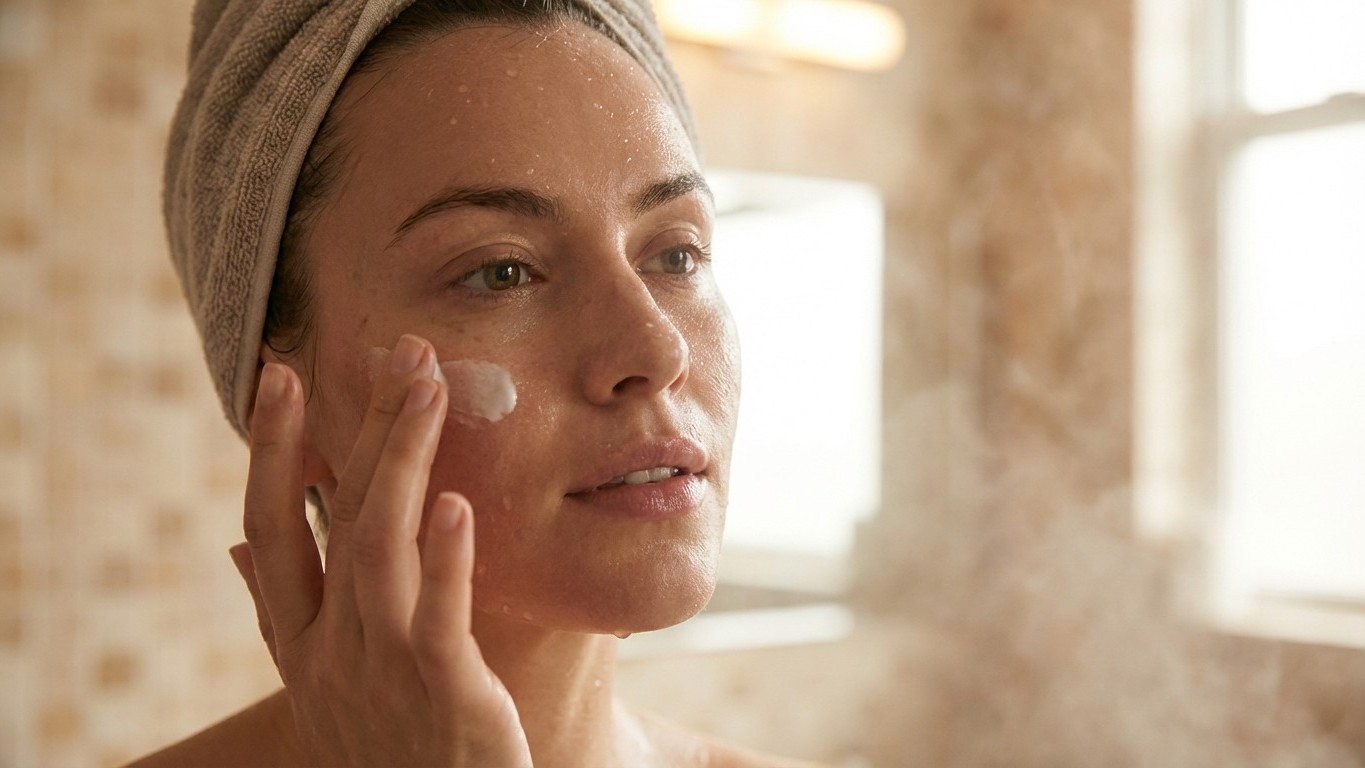
Here’s the step dermatologists do recommend but rarely explain with enough urgency: moisturizing immediately after stepping out. Not “soon.” Not “when you’re dressed.” Immediately.
When you step out of the shower, your skin is plump and slightly damp, that’s the sweet spot. Applying moisturizer right then traps water into your skin before it evaporates. The American Academy of Dermatology recommends applying moisturizer within three minutes of getting out of the shower. Dermatologists call this the “3-minute rule,” because after that, the moisture on your skin starts to evaporate rapidly.
The mechanism matters: moisturizers help replenish the lipids and hydration that skin loses, particularly after cleansing, and create a protective barrier that helps lock moisture in and environmental aggressors out. Most people pat themselves dry, wander to the bedroom, spend ten minutes picking an outfit, and then reach for lotion, at which point they’ve already lost the window. “If people use moisturizer immediately after getting out, they can buy themselves a little more flexibility with how they cleanse, with less skin punishment.” Most people, notes Dr. Chen, “need a little assistance to replace their skin’s lipids after showering.”
The ingredients in that post-shower moisturizer also deserve more attention than they typically get. “A few important product ingredients for healthy skin include ceramides, glycerin, and hyaluronic acid,” says board-certified dermatologist Dr. Simonds. Ceramides help repair and strengthen your skin barrier, while glycerin and hyaluronic acid pull moisture into the skin and help keep it there. These aren’t trendy additions. They’re the structural materials your skin barrier is literally built from.
The Counterintuitive Truth About “Thorough” Cleansing
Over-showering is real and can compromise your skin barrier. Showering more than once a day or taking very long or hot showers can strip the skin of natural oils, leading to dryness, irritation and even eczema flares. That seems obvious in hindsight, but the counterintuitive part is what happens next.
When the skin barrier becomes compromised, skin loses moisture more easily and may respond by producing excess oil to compensate. This rebound effect can contribute to clogged pores and breakouts, even though the skin feels dry. So aggressive cleansing, the kind marketed as “deep” or “purifying,” can actually trigger oiliness in people convinced they need more washing. The skin isn’t producing more oil because it’s dirty. It’s producing more oil because you stripped it.
Taking scalding hot showers is a sure way to damage the skin barrier, says Tamia Harris-Tryon, a physician scientist who studies the skin microbiome at the University of Texas Southwestern Medical Center. “If it’s hot enough to clean your pots and pans of oil, it will clean your body of natural oils,” she says. The analogy lands. Hot water doesn’t discriminate between the grime you want gone and the lipid film your skin needs to function.
Dermatologists recommend simple shower routines using lukewarm water and fragrance-free, hypoallergenic cleansers, followed by moisturizer or oil. Excessive washing, hot water, double-cleansing, and frequent exfoliation can damage the skin barrier and cause dryness or irritation. Soap should be limited to skin folds and private areas. That last sentence is the one that tends to shock patients. Not the whole body. Just the areas that genuinely need it.
The real gap between what dermatologists do and what they tell patients isn’t about professional secrecy. It’s about practicality. Telling a patient to ditch their shower gel routine entirely feels too radical to land well in a seven-minute appointment. But the gap adds up in your skin, over months, over years. Older people may be more vulnerable to the effects of over-cleansing, particularly menopausal women, for whom hormonal changes typically create a drying effect on the skin. The women who need this information most are often getting the most standard advice.
Sources : floramourgardeners.com | today.com