
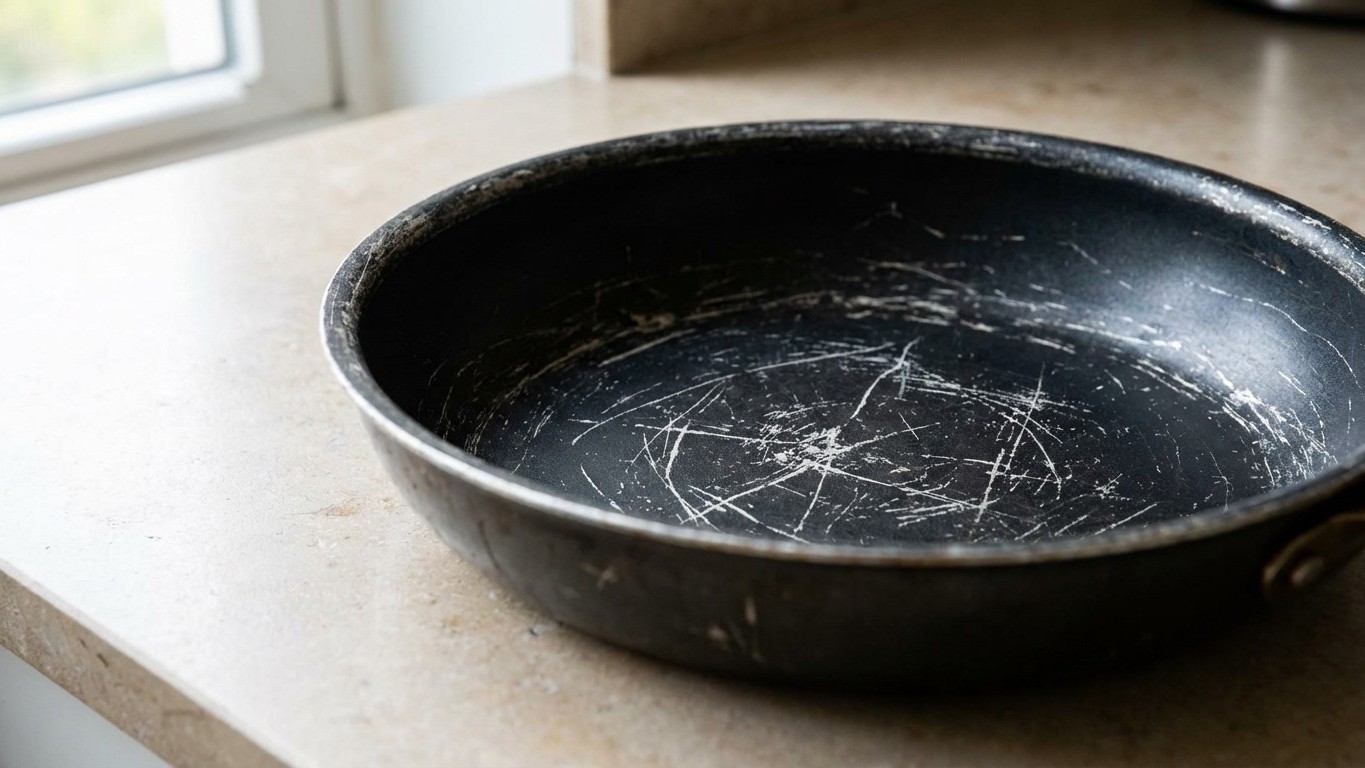
The pan sits in the cabinet, crisscrossed with fine white lines from years of metal spatulas, the occasional fork used in a rush, a dishwasher cycle or two despite the warning on the box. It still works. Eggs still slide, sauce still simmers. So most of us keep using it, and in doing so, we’re seasoning our meals with something that belongs nowhere near a kitchen: microscopic plastic particles, and a class of synthetic chemicals that scientists call “forever chemicals” for a reason that is, frankly, unsettling.
Key takeaways
- A single metal spatula scratch releases thousands of microplastic particles; heavily damaged pans release millions per use
- PFAS chemicals in non-stick coatings don’t break down in your body or the environment—they accumulate over time
- Even ceramic pans marketed as “safe alternatives” showed detectable PFAS levels in recent testing
What Actually Happens When a Pan Gets Scratched
Teflon, the brand name for polytetrafluoroethylene, or PTFE, is a synthetic fluoropolymer designed to withstand high temperatures and resist sticking. But when the surface becomes scratched by metal utensils or abrasive cleaning materials, the protective coating can degrade, releasing both microscopic particles and gaseous compounds. The numbers behind that degradation are where things get genuinely alarming.
Researchers estimated about 9,100 particles of microplastics and nanoplastics could be released from small scratches during cooking, and a whopping 2.3 million particles could be released from significantly damaged areas such as cracks or fractures. Read that again. A single scratch, the kind you make every time you run a metal spatula across the surface — releases thousands of particles per use. A pan that’s genuinely broken or heavily worn? Millions. Per meal.
A dry-mixing with a stainless steel spoon for just 30 seconds could scratch and damage the surface of PTFE-coated pans, with scanning electron microscopy used to visualise the release of micro- and nanoplastic PTFE particles. Thirty seconds. The time it takes to scramble eggs on a Monday morning.
PFAS: The “Forever Chemicals” in Your Skillet
When scratched, Teflon pans can lead to the release of toxic compounds, many of which belong to the notorious class of chemicals known as per- and polyfluoroalkyl substances (PFAS). These synthetic compounds, often referred to as “forever chemicals,” are linked to various health concerns including cancer, hormone disruption, and organ damage. The word “forever” isn’t poetic, it refers to the fact that these molecules don’t break down in the environment or in the human body. They accumulate.
IARC’s 2025 classification of PFOA and PFOS as carcinogenic to humans strengthens the causal argument connecting long-term PFAS exposure to cancer risk. This is not a fringe concern anymore. According to a 2025 study, PFAS identified in U.S. drinking water and cookware might cause up to 6,864 additional cancer cases every year, with the strongest connections observed for tumors of the kidney, testicular, respiratory, endocrine, and digestive system. The counter-intuitive part? Most people scanning nutrition labels and obsessing over organic produce have never once thought about what their cookware is silently contributing to each plate.
Up until 2015, manufacturers made PTFE with perfluorooctanoic acid (PFOA), a type of PFAS found in the blood of 99.7 percent of Americans. There has been extensive research on PFOA exposure, suggesting links to kidney and testicular cancer, thyroid disease, high cholesterol, and ulcerative colitis. Newer pans dropped PFOA from their formulas, but the replacement of PFOA with other forever chemicals by the industry is also problematic, and old pans, particularly those manufactured before 2013, are especially hazardous since they are more likely to contain PFOA.
The Ceramic “Safe Alternative” Problem
Here’s where the received wisdom deserves a hard look. Many people switched to ceramic-coated pans specifically to sidestep PTFE and PFAS concerns. The marketing is convincing, sand-derived, eco-friendly, clean. A 2024 study by the University of California tested 15 ceramic pans. Half showed detectable levels of fluorine, a marker for PFAS, on the surface. Some even released more PFAS than older Teflon pans when scratched. The “healthy” alternative, may carry the same hidden risk once the coating begins to wear.
A 2024 study found that prolonged heating and temperatures higher than 250°C (482°F) affected the internal structures of all cookware tested. Ceramic-coated cookware showed fewer signs of wear, suggesting greater resistance, but Teflon-coated cookware was more likely to degrade and transfer plastic particles into food or air. The practical takeaway: ceramic holds up better under heat, but scratching either type accelerates exposure to whatever is underneath the glossy surface.
What to Do With That Pan Right Now
The science, at this stage, does not call for mass panic. Researchers are still working to quantify exactly how much long-term consumer exposure from cookware contributes to measurable health outcomes. It is unclear how much a person would need to consume to Experience adverse health effects, and current research suggests nonstick cookware is generally safe when used carefully. But “used carefully” is doing a lot of work in that sentence.
It is safest to replace any nonstick cookware when the coating is damaged, particularly if it was made before 2015, according to Whitney Linsenmeyer, PhD, RD, spokesperson for the Academy of Nutrition and Dietetics. Practically, that means a few concrete habits: use rubber or wooden cooking utensils and avoid anything metal; when storing, lay a cloth towel over the surface to prevent scratches from stacked pans. Experts also recommend using nonstick cookware for less than 45 minutes at a time and at temperatures lower than 250°C (482°F).
If replacing is on the table, the options are well-established. Stainless steel and cast iron pans are durable, PFAS-free alternatives that can last for decades with proper care. Cast iron, in particular, has a learning curve, it needs preheating, a little fat, and some patience, but it rewards that effort with a surface that gets better with age rather than more toxic.
Regulation is also slowly catching up to the science. As of January 1, 2025, Minnesota became the first state to ban the sale of nonstick cookware coated with PFAS. Meanwhile, Vermont, Connecticut, Rhode Island and Colorado are moving ahead with bans or restrictions on cookware containing intentionally added PFAS, with enforcement dates ranging from 2026 to 2028. That legislative momentum tells you something: the conversation has quietly shifted from “possible concern” to “established risk worth legislating.” The pan in your cabinet may have made it there before any of those rules applied.
Sources : princeea.com | fox9.com