
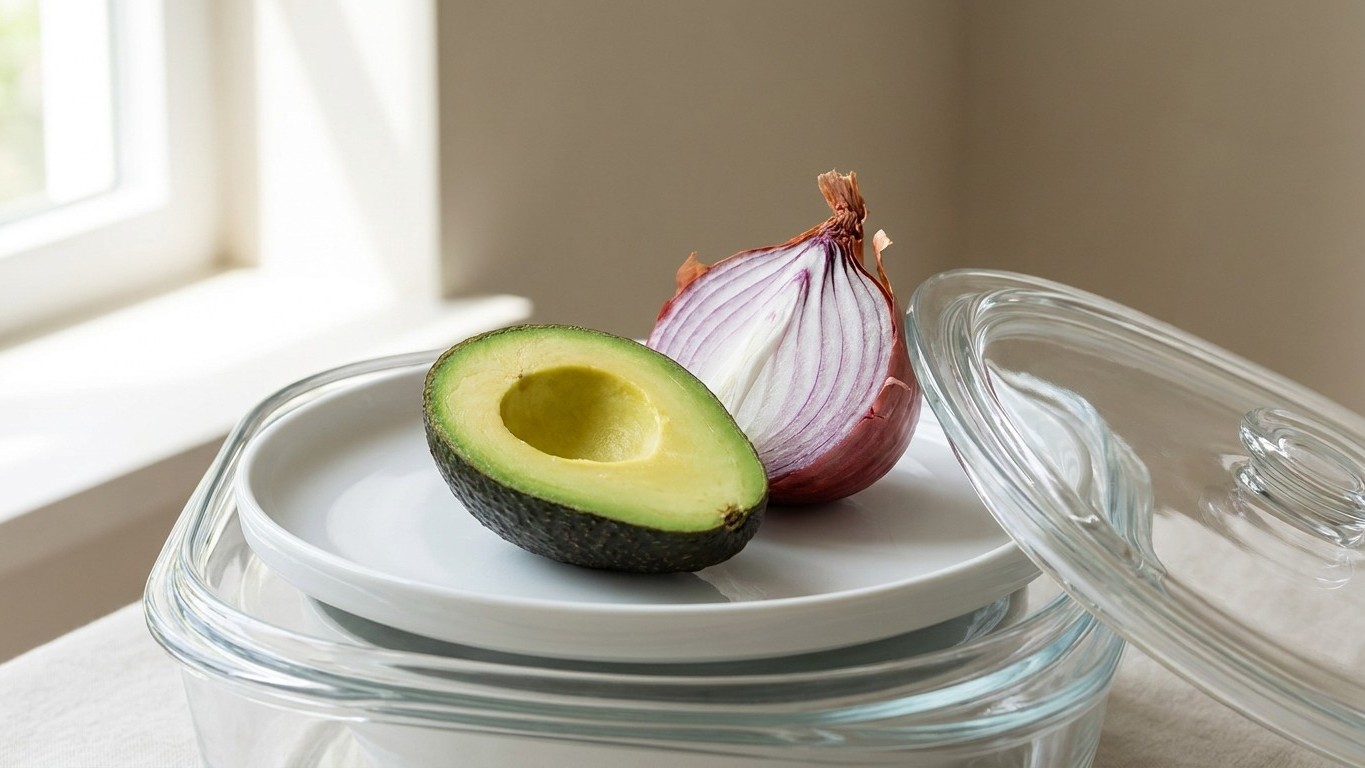
Two days. That’s how long a cut avocado stayed a bright, appetizing green in my fridge after I tucked half a raw onion into the same container, skin barely touching skin. No lemon spritz, no plastic wrap pressed onto the flesh, no pit left in for good luck. Just an onion, a lid, and patience. When I finally sliced into it, the color hadn’t budged. That’s when it clicked why every lemon-juice trick I’d tried before had quietly failed within hours.
The short version: onions and lemons attack the browning problem from two completely different angles, and only one of them plays well with time in a sealed container. Understanding the chemistry behind an avocado’s collapse into brown mush explains why.
Key takeaways
- One kitchen staple outperformed the most popular avocado hack by a shocking margin
- The reason has nothing to do with acidity and everything to do with molecular machinery
- A sealed container and one simple adjustment make all the difference
The Real Reason Avocados Turn Brown
Avocado flesh browns because of a copper-containing enzyme called polyphenol oxidase, or PPO. When you cut open an avocado, you expose the enzyme in the avocado cells to oxygen in the air, and PPO catalyzes the reaction of the avocado’s phenolic compounds with oxygen, producing a pigmented compound called melanin. That brown film isn’t rot. It’s a chemical reaction, not unlike what happens to a sliced apple left on the counter.
What makes avocado especially prone to this is sheer enzyme concentration. Avocados brown especially quickly because they contain a large amount of polyphenol oxidase compared to many other fruits. And the reaction needs very specific conditions to fire: polyphenol oxidase requires three elements to function: oxygen, neutral pH, and substrate phenolic compounds. Remove any one of those three, and the browning stalls.
That’s the whole game. Every kitchen trick out there, from lemon juice to plastic wrap to submerging avocado in water, is really just an attempt to knock out one of those three requirements. Which brings us to why lemon juice and onion don’t actually compete on the same playing field.
Why Onion Wins Where Lemon Falls Short
Lemon juice works by acidity. Nearly 80 years of research on PPO confirms it’s most active between pH 6-7.5 but becomes inactive below pH 3, which explains why acidic treatments work so effectively. The problem is that lemon juice only lowers the pH exactly where it lands, and only for as long as it stays wet and undisturbed. The citric acid in lemon and lime juice lowers the pH on the avocado’s surface, which reduces PPO activity, but it does not stop browning permanently, it only slows the process significantly. Leave that avocado in the fridge for 48 hours, the acid dries, migrates unevenly, or simply isn’t reapplied, and the enzyme wakes back up right where it left off.
Onion works differently, and this is the part that genuinely surprised me. It doesn’t touch pH at all. Researchers believe that since PPO is a copper-containing enzyme, onion’s sulfuric compounds and their derivatives may interact with copper at the enzyme’s active site and hinder its activity. onion doesn’t create a hostile environment around the avocado, it disables the enzyme itself by jamming its molecular machinery. And the effect isn’t folklore: compounds containing a sulfhydryl group may disrupt PPO-induced browning by up to 33%.
There’s also a delivery mechanism at play that lemon juice simply can’t replicate. Onion releases its sulfur compounds as a gas, one that fills the sealed space around the avocado rather than sitting as a thin film on its surface. The same sulfur that makes our eyes water when we cut an onion will keep the avocado or guacamole bright green. That gas bathes every exposed surface continuously, as long as the container stays sealed, instead of drying out after twenty minutes the way citrus juice does.
The Fine Print Nobody Mentions
None of this works if the container leaks air. That’s actually the more common reason lemon juice “fails,” beyond the pH issue: a loose lid lets oxygen creep back in regardless of what’s coating the flesh. A food blogger who tested this side by side found her avocado “still perfectly green” after three days in the fridge, stored in a sealed glass container, adding that “you might taste a tiny tinge of onion” but that it’s “definitely not overpowering and it’s super subtle”. She also noted that lemon juice, while a solid backup, “never lasted a full three days without browning in the fridge”.
There’s a real caveat with onion, though, and it’s the reason mine worked without tasting like a salad topping. The onion should only remain in contact with the skin of the avocado and not the pulp, and the same warning shows up across every source that’s tested this. If your onion piece is actually pressed against exposed avocado flesh, expect flavor bleed. Keep it wedged nearby in the container instead, close enough to fill the air with sulfur compounds, far enough to avoid direct contact.
Refreshing the onion matters too if you’re stretching this beyond a couple of days. If you plan to let an avocado half sit in the fridge for several days, you can cut a thin sliver off the onion wedge every day, since the fresh cut will release more sulfur and help further preserve the avocado. A tired, dried-out onion piece stops releasing much of anything.
Worth saying plainly: brown avocado was never dangerous to begin with. Brown avocado flesh caused by oxidation is safe to eat, and you can remove that thin surface layer and eat the green flesh underneath. The onion trick isn’t about food safety. It’s about not wanting to scrape off a sad brown crust every time you want guacamole on a Tuesday. And if you’re the type who preps avocado for a full week of meal prep, know that even science’s most obsessive testers, the crew at America’s Test Kitchen, found that only vacuum sealing kept avocados a pristine green for a full five days among the eleven methods they tried. The onion in a sealed jar is the compromise between “actually works” and “doesn’t require kitchen equipment you don’t own.”
Sources : goodmorningamerica.com | livescience.com