
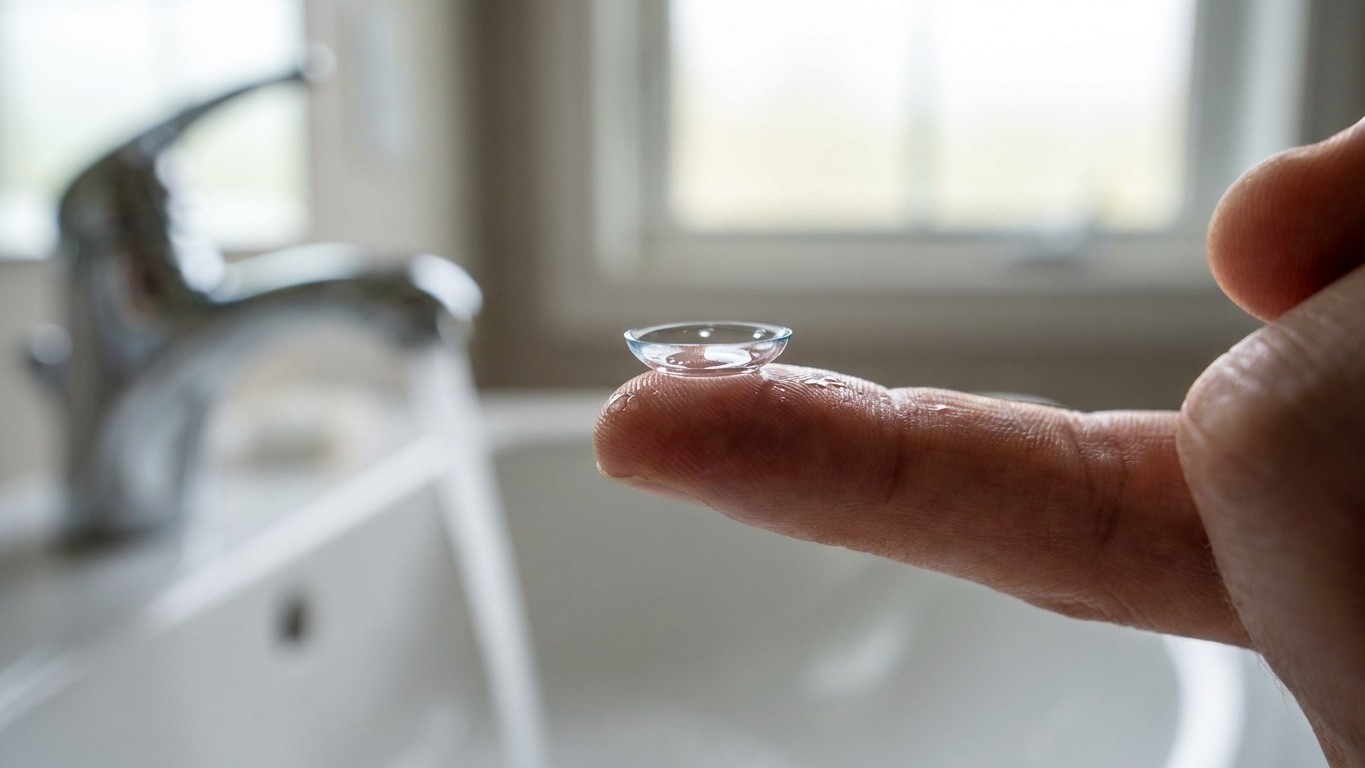
Acanthamoeba. The name sounds like something out of a biology textbook you’d never willingly open. But this microscopic, single-celled organism lives in your bathroom right now, most likely present in the water running from your faucet, and it has one very specific vulnerability it exploits: the micro-environment created by a contact lens sitting on your eye.
Acanthamoeba is a microscopic, free-living ameba that can cause rare but severe infections of the eye, skin, and central nervous system. Most of the time, it’s harmless. You drink tap water containing it, you shower in it, you splash your face with it, and nothing happens. The problem begins the moment a contact lens enters the picture.
Key takeaways
- A microscopic organism in tap water poses almost no threat—until you put a contact lens on your eye
- Your contact lens acts as a biological delivery vehicle, holding the organism against your cornea for hours
- Chlorine in municipal water can’t kill this organism; it survives by forming a dormant cyst that can last 20 years
The Contact Lens as a Biological Trap
One of the most visually devastating forms of microbial keratitis is Acanthamoeba keratitis (AK), and nearly 85% of Acanthamoeba cases occur in contact lens wearers. A primary risk factor for developing AK is exposing contact lenses to water. The reason is Structural, not coincidental. The manufacturing material of the lens affects its ability as a mechanical host, allowing attachment and transfer of Acanthamoeba trophozoites or cysts onto the corneal surface. A soft lens, absorbing water and conforming to the eye, essentially acts as a delivery vehicle, holding the organism in prolonged contact with the one tissue it needs to breach.
Acanthamoeba keratitis occurs when the ameba infects the cornea. It likely invades the eye through a physical opening, such as a minor abrasion, in the corneal epithelium, the outermost layer of the cornea. That abrasion doesn’t need to be dramatic. The daily mechanical friction of lens wear is enough to create micro-disruptions in the surface, invisible entry points that the organism can exploit within hours.
Here’s where conventional wisdom fails most contact lens wearers: they assume that as long as their tap water is safe to drink, it’s safe to use with their lenses. Even household tap water, although treated to be safe for drinking, is not sterile and contains microorganisms that can contaminate lens cases and contact lenses and cause eye infections. Potable does not mean sterile. The chlorination standards used in municipal water treatment are calibrated for your gut, not your cornea.
Why Chlorine Can’t Fully Protect You
This is the counterintuitive part that most people, including many healthcare providers, underestimate. Chlorine applied at low residual concentrations of 2 to 5 ppm in drinking water treatment is ineffective against Acanthamoeba. The organism has a survival mechanism so resilient it borders on extraordinary: when conditions become hostile, it forms a cyst.
Acanthamoeba is a free-living protozoan existing in two distinct forms: the dormant cystic form and the motile trophozoite form. The cystic form, characterized by reduced metabolic activity, exhibits resistance against extreme conditions such as temperature variations, dry weather, pH fluctuations, and antiamoebic drugs. In cyst form, Acanthamoeba can survive up to 20 years (maybe more) at room temperature. Twenty years. In a lens case you rinse out every evening.
In an analysis of the drinking water storage towers of Paris, approximately 20 to 25 Acanthamoebae were detected per liter. The organism isn’t rare in the water supply; it’s just usually harmless, until a contact lens creates the right conditions for infection. Acanthamoeba is found in chlorinated swimming pools, hot tubs, domestic tap water, and even in bottled water. There is, in practice, almost no water source you can fully trust with your lenses in place.
The Diagnosis Problem: When Doctors Miss It
Getting infected is only the beginning of the ordeal. The real nightmare of Acanthamoeba keratitis is how easily it hides. In early stages of the disease, about 75 to 90% of all patients are misdiagnosed. Acanthamoeba keratitis is often incorrectly diagnosed as bacterial or viral keratitis. This can cause poor treatment and pain management. Many cases have been misdiagnosed as herpes simplex keratitis, which is treated with steroids. This treatment can hide Acanthamoeba keratitis symptoms, and once stopped, the infection can become worse.
The average interval from symptom onset to diagnosis is 1.2 months. That’s more than a month of the organism deepening its invasion into corneal tissue. The sooner the disease is diagnosed, the better the outcome. If diagnosis is delayed, the amoebae have already penetrated deeply into the corneal stroma and successful therapy becomes exceedingly difficult. By the time the correct diagnosis is made, treatment may require hourly eye drops around the clock for months. The duration of therapy may last 6 to 12 months or longer. In the most severe cases, patients may need to undergo a corneal transplant, where all or part of the cornea is removed and then replaced with healthy donor tissue.
Over 23,000 people are estimated to be diagnosed with AK globally each year. In the United States, research indicates there could be up to 1,500 cases per year. These numbers are likely undercounts, given the systematic misdiagnosis problem.
What You Can Actually Do
The CDC, the EPA, and ophthalmology bodies have aligned on guidance that is simple in principle and harder to follow in practice. Contact lens wearers should remove contact lenses before showering, using a hot tub, or swimming, and should clean, rub, and rinse lenses every time they take them out. The rubbing step matters more than many wearers realize, it mechanically dislodges organisms that disinfecting solutions alone may not kill.
Storage cases deserve more attention than they typically get. Avoiding tap water exposure when wearing contact lenses is important. Such water exposure potentially contaminates the lens and storage case and places the patient at risk for serious infection. The case should be rinsed with fresh solution only, never tap water, left open to air-dry after each use, and replaced regularly. A contact lens case that sits perpetually damp in a bathroom is one of the most favorable environments imaginable for the organism.
Daily disposable lenses reduce (but don’t eliminate) the risk. Acanthamoeba keratitis risks are increased more than threefold in daily wear reusable lens users versus daily disposable lens use. But risks for daily disposable lens users can be minimized by adherence to safe use guidelines: no reuse, no overnight wear, and no contamination by water. The lens being disposable only matters if you don’t reuse it and don’t shower with it in.
One behavioral pattern that research has consistently flagged, and that almost no one talks about at the optometrist’s office: showering with lenses in. Showering while wearing lenses was reported by 86% of soft contact lens wearers in one study, and most of them perceived no meaningful risk in doing so. That’s the gap between what the data shows and what people know, and that gap, for an unlucky few each year, costs them part of their vision.
Sources : pubmed.ncbi.nlm.nih.gov | pubmed.ncbi.nlm.nih.gov