
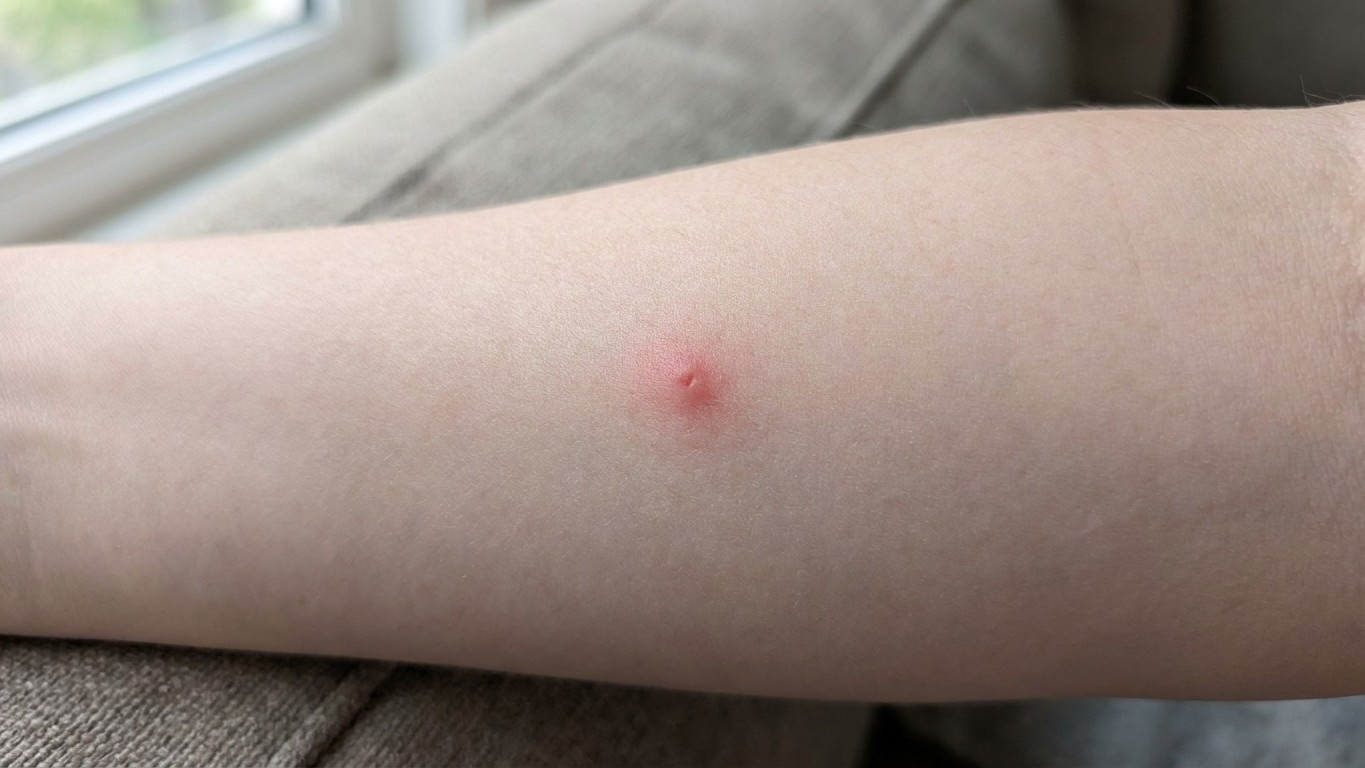
Three bites. Three very different problems. The summer after a picnic in the park, a hike through tall grass, or even an evening on the back porch can leave you staring at your skin wondering what just happened. The bump on your ankle, the cluster behind your knee, the red spot on your forearm, they all itch, they all look vaguely red, and without a roadmap, they’re practically indistinguishable at first glance. But here’s what most people don’t realize: wait six hours, check the location, count the bumps, and your skin will tell you exactly which creature came calling.
Key takeaways
- One creature bites during broad daylight while others hunt at dusk—timing matters
- The bite that barely itches could be the one requiring immediate medical attention
- Your clothing lines tell an unmistakable story about which pest found you
The Tiger Mosquito: Fast, Daytime, and Angrier Than You’d Expect
The common mosquito is a creature of dusk. The tiger mosquito (Aedes albopictus) plays by entirely different rules. Female Asian tiger mosquitoes typically bite during the daytime, which explains why you keep getting welts on your forearms during a perfectly sunny afternoon in the garden. Asian tiger mosquitoes are easy to identify by their black bodies and bold white stripes on their legs and back. They now live in at least 26 states, including most of the southeastern U.S., Texas, California, and Hawaii.
The bite itself has a distinct personality. Tiger mosquito bites appear as small, raised, red bumps, usually 2–5 mm in diameter, sometimes with a pale center surrounded by a red halo. Because Asian tiger mosquitoes often feed repeatedly in one session, you may notice clusters of bumps rather than isolated ones, and the area can swell within minutes to an hour. That speed is the real tell. The first characteristic of the bite of the tiger mosquito is an itchy feeling that arrives very quickly, intensifying for several minutes after the bite, followed by a blister-like button 5 millimeters to 2 centimeters in diameter, with a red halo that may widen depending on personal reactions.
Compare that to a standard mosquito bite: mosquito bites appear as a slightly swollen and red area that may itch and be irritating, with symptoms usually developing quickly after being bitten and getting progressively worse over 8–12 hours. The tiger mosquito, on the other hand, hits faster and harder. Tiger and Asian tiger mosquitoes are known for more aggressive biting and stronger reactions. Their bites are often more painful, itchier, and longer-lasting than regular mosquito bites, with swelling that can last 5 to 10 days. One additional warning: Asian Tiger Mosquito bites can also pose significant health risks as they have the ability to transmit diseases such as dengue fever, Zika virus, and chikungunya.
The Tick: The Bite You Almost Never Feel
Ticks are the counterintuitive ones. You would assume that something embedding its head into your skin would announce itself loudly. It doesn’t. Many people don’t remember or know that they’ve been bitten by a tick, because the tick is tiny, and its bite is usually painless. Unlike insects that take a nibble and fly off before you know it, ticks hang around, they hop on, latch on, and stick around until they’re full.
The visual clue comes later, and it’s different from anything the mosquito or harvest mite leaves behind. A small bump or redness at the site of a tick bite that occurs immediately and resembles a mosquito bite is common, but this irritation generally goes away in 1–2 days and is not a sign of Lyme disease. The red flag is what comes next. The most common early sign of Lyme disease is an expanding skin rash called “erythema migrans.” It begins as a reddened area near the tick bite, and as the rash increases in size, it often clears in the middle and develops a red ring around the outside, giving it a “bull’s-eye” appearance — though it does not always look like a bull’s-eye, but it does expand in size.
According to the CDC, the rash begins 3 to 30 days after the tick bites you. One counter-intuitive but critical detail: unlike many insect bites, a tick rash is usually not painful or significantly itchy, though it may feel warm to the touch. That’s exactly the reverse of what your instincts tell you, the dangerous bite is the one that barely itches. One important thing to keep in mind is that the tick usually needs to be attached to the body for more than 24 hours to be able to transmit Lyme disease. Check yourself thoroughly after every outdoor outing.
The Harvest Mite: The Invisible Culprit With the Most Infuriating Itch
Harvest mites, known in the U.S. as chiggers, are the most underestimated of the three. Chiggers (also called harvest mites or red bugs) are tiny red mites that bite. Chigger larvae measure just 0.15 to 0.3 millimeters, roughly the size of the period at the end of a sentence. You will almost certainly never see one on your skin. What you will feel, hours later, is something that dermatologists and entomologists consistently describe in terms reserved for genuine suffering.
The mechanics are unsettling. The chigger larva releases a liquid chemical into your skin to kill skin cells, and the dead skin cells form a tiny straw (stylostome) for the chigger to drink your skin tissue. The itch intensity is extremely intense, often described as worse than mosquito or flea bites, and the itch is caused by Your Immune System reacting to the dissolved stylostome, not the mite itself.
Location and pattern are the definitive clues here. The most reliable distinguishing factor is location on the body: chigger bites concentrate where clothing meets skin, a pattern unique to chiggers. If your bites cluster around your waistband, sock lines, or underwear elastic after time spent outdoors, chiggers are the most likely culprit. The timing also follows a distinct script: you typically discover a chigger problem only after the itching starts, usually 1 to 3 hours after exposure. Red bumps become fully developed within 24–48 hours, and intense itching lasts 2–4 days, with welts persisting 1–2 weeks.
The good news, and there is good news, is that chiggers only inject digestive enzymes and do not transmit diseases in the U.S., and their larvae can often be washed off with soap and water. Shower immediately after coming in from grassy or wooded areas. It genuinely helps.
Your Six-Hour Field Guide to the Three Bites
Six hours after contact, your skin holds most of the answers. A single puffy bump on an exposed arm or leg that appeared within minutes, itches intensely, and sits alone on otherwise clear skin? That’s a mosquito, tiger variety if the swelling is unusually pronounced and you were outside mid-morning or mid-afternoon. A cluster of tiny, deeply itchy red dots lined up neatly along your waistband or sock line, getting worse by the hour? Harvest mite, every time. A single, potentially painless spot that you noticed only because you felt something attached — or because a mild rash is slowly expanding outward days later? That’s your cue to think tick and act accordingly.
The three prevention principles remain the same across all three: apply insect repellent containing at least 20% DEET to exposed skin and clothing; wear long-sleeved shirts, long pants, and closed-toe shoes when outdoors; and opt for lighter-colored clothing, which makes it easier to spot ticks and other pests. Do a head-to-toe tick check after hiking, gardening, or yard work, and shower within two hours to wash off unattached ticks and chiggers. What changes the outcome entirely, particularly with ticks, is how quickly you respond. Seek medical attention if you observe any symptoms and have recently had a tick bite, live in an area known for Lyme disease, or have recently traveled to an area where Lyme disease occurs. The bite that barely registers on the pain scale is sometimes the one worth taking most seriously.
Sources : my.clevelandclinic.org | kidscare.blog