
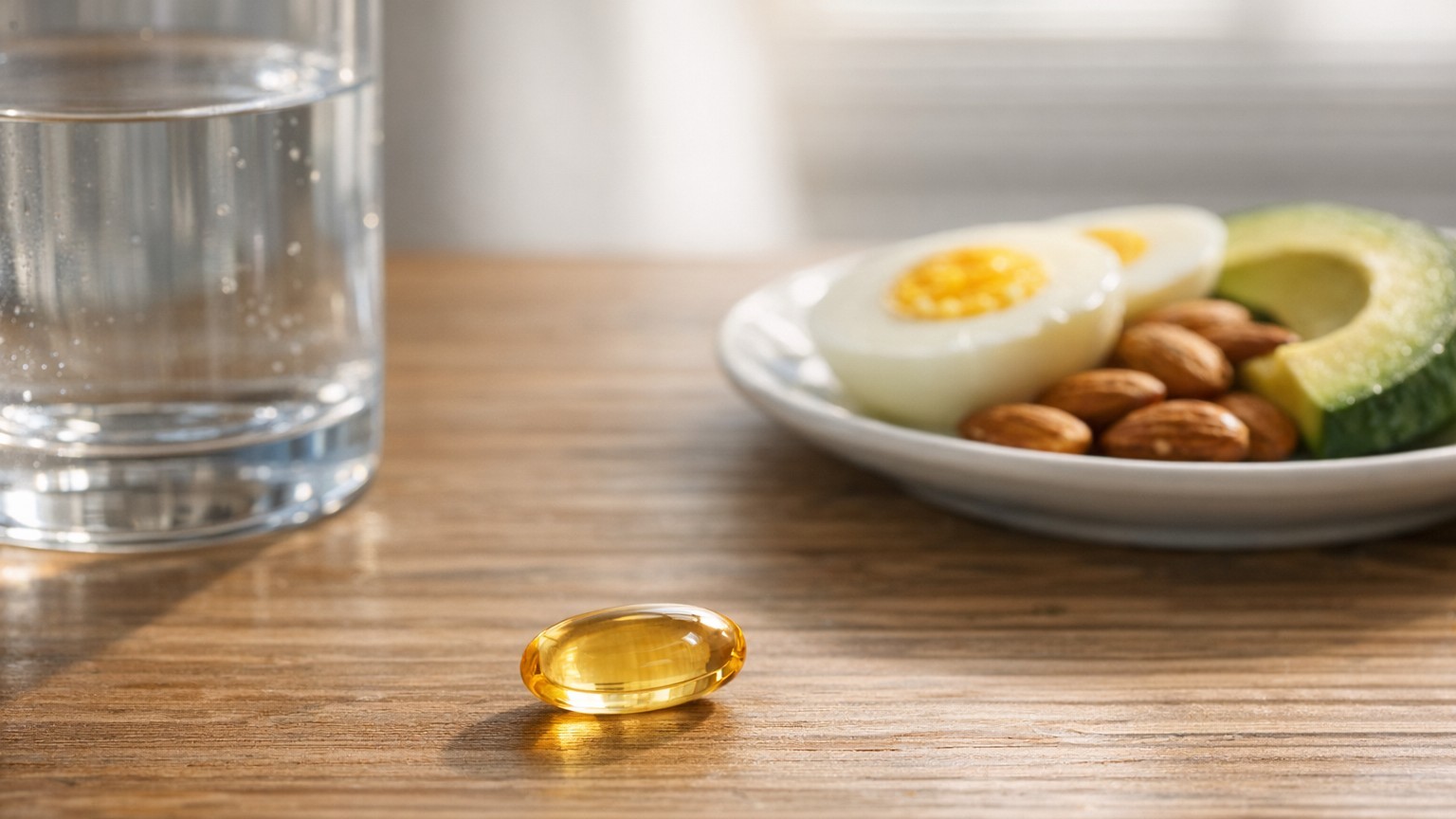
Every morning, for years, the routine was flawless: pill on the tongue, glass of water, done. Virtuous. Efficient. Completely pointless, or nearly so. The conversation with a pharmacist that changed Everything wasn’t dramatic. She simply asked: “What do you eat when you take it?” The answer, “nothing yet,” stopped the conversation cold. That question holds the entire explanation for why millions of Americans take vitamin D supplements faithfully and remain deficient anyway.
Key takeaways
- A pharmacist’s one question exposed why your vitamin D routine has been quietly failing for years
- The missing piece isn’t the pill—it’s what you’re NOT eating when you take it
- One simple change increased vitamin D blood levels by 57% in just two to three months
A fat-soluble vitamin in a fat-free moment
Vitamin D is a fat-soluble vitamin, meaning it does not dissolve in water and is absorbed best in the bloodstream when paired with high-fat foods. Taking it with a plain glass of water, on an empty stomach, is roughly the equivalent of trying to dissolve olive oil in sparkling water. The chemistry simply doesn’t cooperate.
The numbers here are hard to ignore. The peak absorption of vitamin D-3 from a supplement is an average of 32% higher when the supplement is taken with a meal containing a commonly consumed amount of fat compared to a fat-free meal. That’s a third of your dose, quietly lost, every single morning. Over months and years, the gap between what you swallow and what your body actually uses becomes enormous.
Here’s what makes this counterintuitive: the type of fat matters less than you’d think. The presence of fat in a meal with which a vitamin D-3 supplement is taken significantly enhances absorption, but the ratio of monounsaturated to polyunsaturated fat in that meal does not influence absorption. You don’t need to engineer a precise Mediterranean plate. A handful of almonds, half an avocado, a couple of eggs, any of these work. Even small amounts of low- or whole-fat milk or yogurt will do the trick, as will eating food cooked with oil.
Why so many people stay deficient despite doing “everything right”
Subclinical vitamin D deficiency remains prevalent worldwide, affecting up to 1 billion people in both developed and developing countries. In the U.S. specifically, vitamin D insufficiency and deficiency are highly prevalent, impacting an estimated 25% and 41% of U.S. adults, respectively. A significant portion of those people are taking supplements. The pill is not the problem. The context around the pill is.
Fat absorption is only part of the story. There’s another layer that most supplement users have never heard of, and it involves magnesium, a mineral roughly half the American population doesn’t get enough of from diet alone. Magnesium is a critical cofactor for enzymes involved in vitamin D metabolism, including 25-hydroxylase and 1α-hydroxylase, which convert vitamin D to its active form. Magnesium deficiency may impair vitamin D activation, thereby reducing its effectiveness.
Translation: you can take the right dose, with the right meal, and still not get the full benefit if your magnesium levels are low. Research found that magnesium raised vitamin D in people who were deficient while dialing it down in those with overly high levels, suggesting a powerful regulating effect. A 2025 meta-analysis confirmed the synergy: co-supplementing magnesium and vitamin D led to higher blood levels of both nutrients and reduced markers of inflammation in overweight and obese adults.
Then there’s the form of the supplement itself. If you’re looking for a vitamin D supplement, the most absorbable form is vitamin D3. Vitamin D2 has a harder time binding to the main protein that allows vitamin D to be transported in plasma, and it is degraded more rapidly by the body. Many generic or budget supplements still use D2. Worth checking the label.
The timing question is more layered than it seems
The best time to take vitamin D is in the morning or at midday with a fat-containing meal. Morning works well for a practical reason beyond absorption: you absorb vitamin D more easily when you take it with a full meal, and as breakfast is so often the largest and most important meal of the day, the morning is a prime time.
Evening supplementation is more complicated. Vitamin D and melatonin have opposite rhythms, the skin synthesizes vitamin D through exposure to sunlight, whereas the pineal gland primarily produces melatonin at night. Some research suggests a potential conflict between evening dosing and sleep quality, though scientific research to determine whether taking vitamin D in the evening can affect sleep is still lacking clear evidence. The safest, most consistent approach remains pairing it with whichever meal in the day contains the most fat.
One clinical observation, reported in the Journal of Bone and Mineral Research, deserves attention: serum 25(OH)D levels increased by an average of 57% over a two-to-three month period in clinic patients after they were instructed to take their usual doses of vitamin D with the largest meal of the day, as opposed to receiving no advice on when to take their supplements. Same pill. Same dose. Just a different moment at the table. The result was a transformation in blood levels.
What to actually change starting tomorrow
The practical fix is almost embarrassingly simple. Move your vitamin D from the bathroom counter to the breakfast or lunch table. Take it alongside eggs, nuts, olive oil, full-fat yogurt, or whatever fat-containing food is already part of your meal. No need to redesign your diet, just stop taking it with water alone.
If your levels haven’t budged despite months of supplementation, consider two additional checks. First, ask your doctor to test your magnesium levels alongside your 25-hydroxyvitamin D. Second, confirm your supplement is D3 (cholecalciferol), not D2. Looking for vitamin D3 supplements that also contain K2 can enhance absorption even further : K2 helps direct calcium to bones rather than arteries, making the whole system work more cohesively.
There’s also a less discussed factor worth knowing: a body mass index greater than 30 is associated with lower vitamin D levels, because fat cells keep vitamin D isolated so that it’s not released, which often requires taking larger doses to reach and maintain normal levels. This is one reason why two people taking the same supplement at the same dose can have very different blood results, and why personalizing your approach with actual bloodwork matters more than following a one-size-fits-all recommendation.
The pharmacist’s question was deceptively simple. But behind it sat a decade of nutrition science that never made it onto the supplement bottle, and that gap between the label and the biology is exactly where good intentions quietly disappear.
Sources : frontiersin.org | pmc.ncbi.nlm.nih.gov