
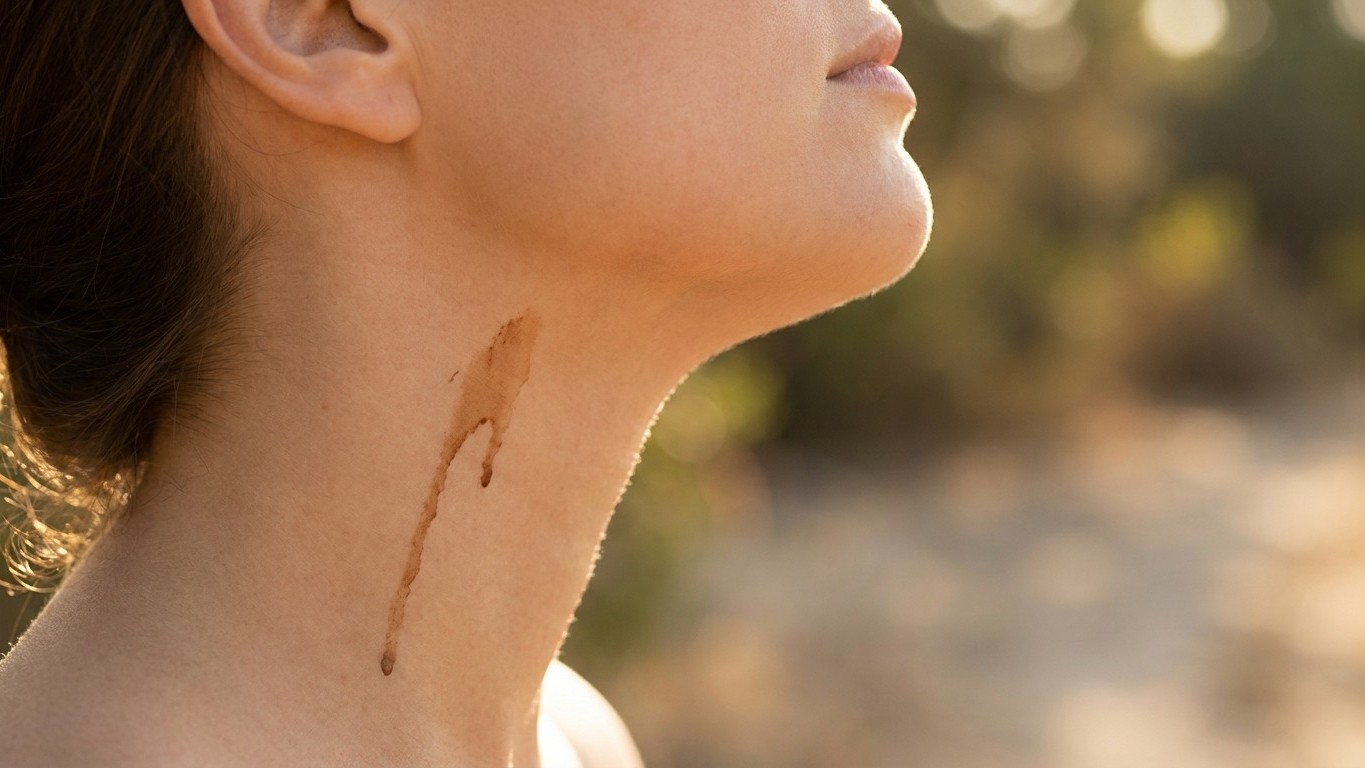
That subtle brown smudge along the side of your neck, the one you kept chalking up to sun exposure or an uneven self-tanner — might actually have a name, a mechanism, and a very specific culprit: your perfume bottle. Not the scent itself, exactly, but the combination of what’s inside it and the morning sunlight you walked into right after spritzing.
Dermatologists have been seeing this pattern for decades, yet it remains one of the most underdiagnosed forms of skin damage in women’s daily routines. The neck gets spritzed, the door gets opened, and the UV rays do the rest.
Key takeaways
- A century-old dermatological condition has a surprisingly modern cause hiding in your fragrance bottle
- The neck’s combination of warmth, moisture, and sun exposure makes it the perfect storm for perfume-induced damage
- Even ‘natural’ perfumes containing bergamot and citrus oils can trigger the same permanent pigmentation as synthetic versions
The Science Has a Name, and It’s Been Around Since 1925
Berloque dermatitis is a phototoxic reaction induced by exposure to long-wave UVA radiation in the presence of bergapten, a furanocoumarin found in bergamot oil. The word “berloque” itself comes from French, meaning trinket or charm, coined by Rosenthal in 1925 to describe pendant-like streaks of pigmentation on the neck, face, arms, or trunk. The streaks literally follow the path of the perfume droplet as it runs down the skin. A trinket-shaped stain. Almost poetic, if it weren’t so permanent.
Bergapten is the photoactive component of bergamot oil, which comes from the rind of the bergamot lime and has long been a popular ingredient in perfumes and fragrances. But bergamot isn’t the only offender. Certain ingredients such as bergamot essential oil, lemon essential oil, and grapefruit essential oil contain bergapten and furocoumarins, substances that cause photosensitivity. Check the notes of your favorite fragrance. Citrus top notes are among the most beloved in perfumery. They’re also among the most reactive.
The mechanics are straightforward, once you Understand them. Fragrances, even those naturally derived from essential oils, create an inflammation response in our skin. The chemical concoction of fragrant ingredients interrupts the skin’s barrier, which sets off a cascade of inflammatory markers. That inflammation, even when invisible to the eye, acts as a trigger. Inflammation within the skin becomes like a green light to melanocytes, the pigment-producing cells, stimulating a cascade of signals that kick-start the overproduction of melanin, and when combined with UV exposure, the impact of a fragrance on skin is multiplied.
Why the Neck Is Ground Zero
Most commonly, fragrance-induced pigment damage appears on the sides of the neck where perfume is most frequently sprayed. That’s no coincidence. The neck is warm, often moistened by sweat, and perpetually exposed to sun, three conditions that, according to dermatologists, intensify the reaction. Moist skin can trigger or intensify this phototoxic reaction.
The damage compounds quietly. Once a pigment cell is overstimulated, melanocytes go into overdrive and the damage to the function of that cell can be permanent, leaving that cell to misbehave and create too much pigment when the surrounding cells don’t need it. Once a pigment cell knows how to misbehave, it will do it at every opportunity. That’s the part no one tells you at the fragrance counter.
There’s also the alcohol angle, which compounds the problem separately. The alcohol in perfume that is directly applied to the skin dries it out and can impact the skin’s barrier, especially around the neck and behind the ears. In many cases, it can cause an inflammatory response of the skin, which leads to redness and itching. Two distinct mechanisms, photosensitizing compounds and alcohol-driven barrier disruption — working in tandem, every single morning.
A condition called Poikiloderma of Civatte takes things further. Characterized by irregular hyperpigmented plaques with unevenly distributed telangiectases and mild atrophy on the sides of the neck, it is the result of chronic actinic damage, and some authors believe it to be a phototoxic reaction associated with the application of fragrance in this area. The redness, the mottling, the texture change you notice in your forties? It can start accumulating in your thirties, silently, with every morning spritz.
The Counter-Intuitive Truth About “Natural” Fragrances
Here’s where the story gets more complicated than most beauty articles let on. Switching to a “natural” or botanical perfume does not automatically protect your skin. The photosensitizing furocoumarins are themselves naturally occurring compounds, found abundantly in citrus peels and plant extracts. Naturally made perfumes can reduce the risk of irritation and photosensitivity because they usually do not contain harmful synthetic chemicals, but it is important to ensure these natural products do not contain any allergens or photosensitizing agents.
The presumption that “natural equals safe” collapses entirely here. A bergamot-forward eau de parfum sourced from organic Italian bergamot is just as capable of triggering berloque dermatitis as its synthetic counterpart, more so, since the bergapten concentration in raw botanical extracts can be higher. Perfumes made with musk also have high levels of alcohol and bergamot oil, which tend to cause reactions similar to sunburn in décolletage areas. Either way, these substances disrupt our skin barrier, leading to inflammation.
The good news, actual good news, not just reassurance, is that regulations have tightened. In the United States, the use of bergapten-free fragrance formulations has rendered berloque dermatitis exceedingly rare. The US Hazardous Substances Act issued regulations stating that in products containing oil of bergamot, the concentration of the oil must not exceed 2%, or 62 ppm bergapten. The condition is rarer than it was fifty years ago, but the broader issue of perfume-induced hyperpigmentation, through inflammation and barrier disruption, even without bergapten — remains very much present.
What to Do Instead (and How to Treat What’s Already There)
The fix is simpler than you’d expect, and it requires almost no sacrifice of scent. Use a good sunscreen, without perfume and alcohol, and spray perfume onto clothing or in your hair instead of directly on the neck. Fabric doesn’t react to UV the way skin does. Your scent will still project. The neck stays unmarked.
Avoid rubbing the perfume into your skin, as this can trigger irritation and inflammation, and rubbing perfume into your skin can also disrupt the fragrance molecule and alter your perfume’s scent. Two reasons to stop doing it, then.
For marks already present, the approach requires patience rather than aggressive intervention. Skincare ingredients such as glycolic acid, niacinamide, vitamin C, and licorice root can help lighten surface pigmentation. Creams containing ingredients such as kojic acid, alpha arbutin, and niacinamide can also help lighten areas of hyperpigmentation. For more stubborn cases, treatment may include topical tretinoin, a form of retinoic acid that encourages skin cell turnover. Laser therapies may also help reduce the incidence of hyperpigmentation.
After stopping the use of products containing well-known allergens such as perfume, not only do the itching and burning sensations subside, there is also an improvement in the condition itself. The skin has a capacity to recover that most people underestimate. But it recovers much faster when you stop repeating the offense daily.
One thing dermatologists rarely say loudly enough: the neck is not a passive canvas. It’s one of the first areas to show cumulative skin aging, and it receives a fraction of the sunscreen attention that the face does. Adding a daily photosensitizing agent to that already-vulnerable surface, then walking outside, is a combination the skin will eventually document. Sometimes in pendant-shaped streaks. Exactly as described a century ago.
Sources : vietnam.vn | ec.europa.eu