
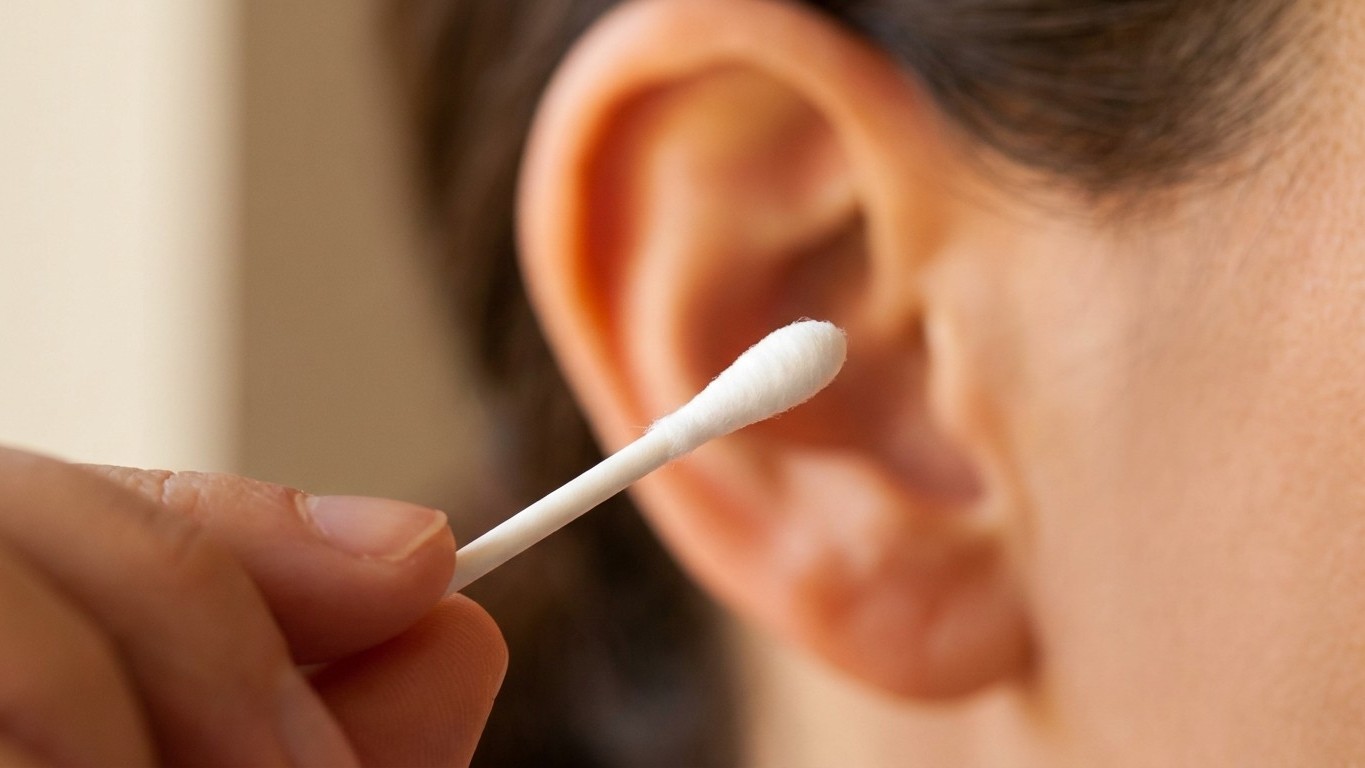
Every morning, for three decades, the ritual never changed: step out of the shower, reach into the medicine cabinet, and clean the ears with a cotton swab. Clean, efficient, satisfying. The kind of habit that feels so obviously correct it never gets questioned. Until the day a doctor peers inside and what appears on the otoscope is not a clean, healthy ear canal, it’s a dense plug of dark, compacted wax pressed directly against the eardrum. A wall. Built, grain by grain, by the very tool meant to prevent it.
That moment rewrites 30 years of certainty in about four seconds.
Key takeaways
- A 30-year cotton swab habit created a wall of impacted wax against the eardrum, causing progressive hearing loss that felt like normal aging
- What feels like cleaning is actually compression—cotton swabs push wax deeper while triggering the ear to produce even more wax in compensation
- After professional removal, 83% of patients reported dramatic hearing improvement, and doctors revealed the serious risks hiding behind this everyday habit
The Cotton Swab Trap: You’re Not Cleaning, You’re Packing
Here’s the counter-intuitive part, and it genuinely surprises most people: due to its shape, a cotton swab can’t actually do much to remove earwax. Instead, sticking one into the ear can push hardened earwax farther into the ear canal, potentially damaging the eardrum and causing hearing loss. What feels like extraction is actually compression. You pull a little wax out on the tip, yes, but only some of the wax comes out. The rest gets pushed down the ear canal past where the body naturally releases it. Over time, the earwax pushed into the canal builds up, impacting the eardrum, causing hearing issues, and making the ear more susceptible to infection.
Cedars-Sinai otologist Dr. Yu-Tung Wong has a blunt way of putting it: “Using a cotton swab like a plunger in the ear canal pushes earwax deeper and deeper in. If you push the wax deeper inside, there’s no way for the wax to get swept out of the ear.” And there’s an irony worth sitting with: by frequently removing earwax, you can disrupt the ear’s natural cleaning process. This can lead to the overproduction of earwax as the ear attempts to compensate, resulting in a cycle of buildup and removal that can further increase the risk of impaction and infection.
The more religiously you clean, the more aggressively your ear produces wax to compensate. A self-defeating loop, running quietly for years.
What Impaction Actually Does to Your Hearing
Most people who ask others to repeat themselves assume it’s age, background noise, or simply not paying attention. Earwax impaction affects approximately 12 million Americans annually, with many cases directly linked to cotton swab use, and the hearing impact is more significant than most expect. Muffled or decreased hearing can potentially affect up to 30% of hearing capacity, and patients often also experience a feeling of fullness in the ear, dizziness or vertigo, tinnitus that may persist for weeks, and ear pain or discomfort ranging from mild to severe.
The symptoms creep in so gradually that the brain adapts. Conversations in crowded rooms become exhausting. TV volume climbs. The phone gets pressed harder against the ear. Hearing loss due to impacted wax can be frustrating and stressful and, if untreated, can contribute to social isolation and depression. What reads as a personality shift, someone becoming withdrawn, less engaged at dinner, can sometimes trace back to something a doctor could fix in twenty minutes.
One detail from research that reframes everything: you can have up to 90% of your ear canal blocked and still be able to hear clearly, since you only need a small pinhole for sound to travel through. Meaning you can be in serious trouble and feel only slightly off. That maddening sensation of asking people to repeat themselves? It may have been building, millimeter by millimeter, for years.
What the Doctor Actually Sees, and Does
Your healthcare provider will perform a physical examination, looking into your ears with a special instrument called an otoscope to see if earwax buildup is present. What gets revealed, in cases of chronic cotton swab use, is often striking: a plug of wax that has hardened over time into a dense, sometimes dark mass sitting directly against the eardrum. If there is so much earwax that the provider can’t see into the ear canal, they will diagnose impacted earwax.
ENT specialists have specialized tools, curettes, suction devices, or controlled irrigation, to safely remove stubborn wax. The results can be almost theatrical. The most common symptom among patients with impaction was hearing difficulty, with half also reporting tinnitus or discomfort. Before wax removal, hearing difficulty was the most bothersome symptom, impacting communication, focused listening, and awareness of surroundings. After removal? More than 83% of patients reported their hearing difficulty to be somewhat or much better. People describe it as the world suddenly turning its volume back up.
For those who want to address mild buildup at home, cerumenolytic solutions, substances that dissolve wax, can be used in the ear canal. These include saline solution or hydrogen peroxide-based ear drops. Over-the-counter ear drops can help soften earwax, allowing it to exit the ear more easily. But the golden rule, endorsed by every ENT from Cedars-Sinai to the Mayo Clinic: never try to dig out excessive or hardened earwax with items such as a paper clip, a cotton swab, or a hairpin. You may push the wax farther into your ear and cause serious damage to the lining of your ear canal or eardrum.
What Your Ears Actually Need From You
The ear, left to its own devices, is a remarkably self-sufficient system. Earwax, also known as cerumen, is slightly acidic, which helps fight bacteria and fungus in the ear, and slightly oily, which provides a waterproof barrier for the ear canal skin. You usually don’t need to ever clean wax out of your ears because there’s a natural cleaning system in the ear canal that sweeps earwax out like a conveyor belt. Earwax also traps dirt and grime, and inhibits the growth of bacteria within the ear canal.
The best way to clean your ears is to let them clean themselves. If earwax becomes visible at the opening of the ear canal, simply wipe it away with a damp cloth. That’s the full extent of what healthy ears require from their owner. No swabs. No tools. No daily ritual with something that has “do not insert in ear” printed on the packaging, a warning that appears right on the back of the box, and that almost everyone ignores.
When you repeatedly remove earwax with cotton swabs, your ear may become itchy or develop flaky, irritated skin. The irritation increases your risk of developing an infection in your ear. And in more serious cases, in severe cases, the cotton swab can damage sensitive structures behind the ear canal and cause complete deafness, prolonged vertigo with nausea and vomiting, loss of taste function, and even facial paralysis.
The cotton swab never really cleaned your ears. It just felt that way, which, for a daily habit wired into muscle memory since childhood, turns out to be more than enough reason to keep doing it. The real question is what other “obviously correct” health rituals are quietly working against us in the same slow, imperceptible way.
Sources : cedars-sinai.org | bannerhealth.com