
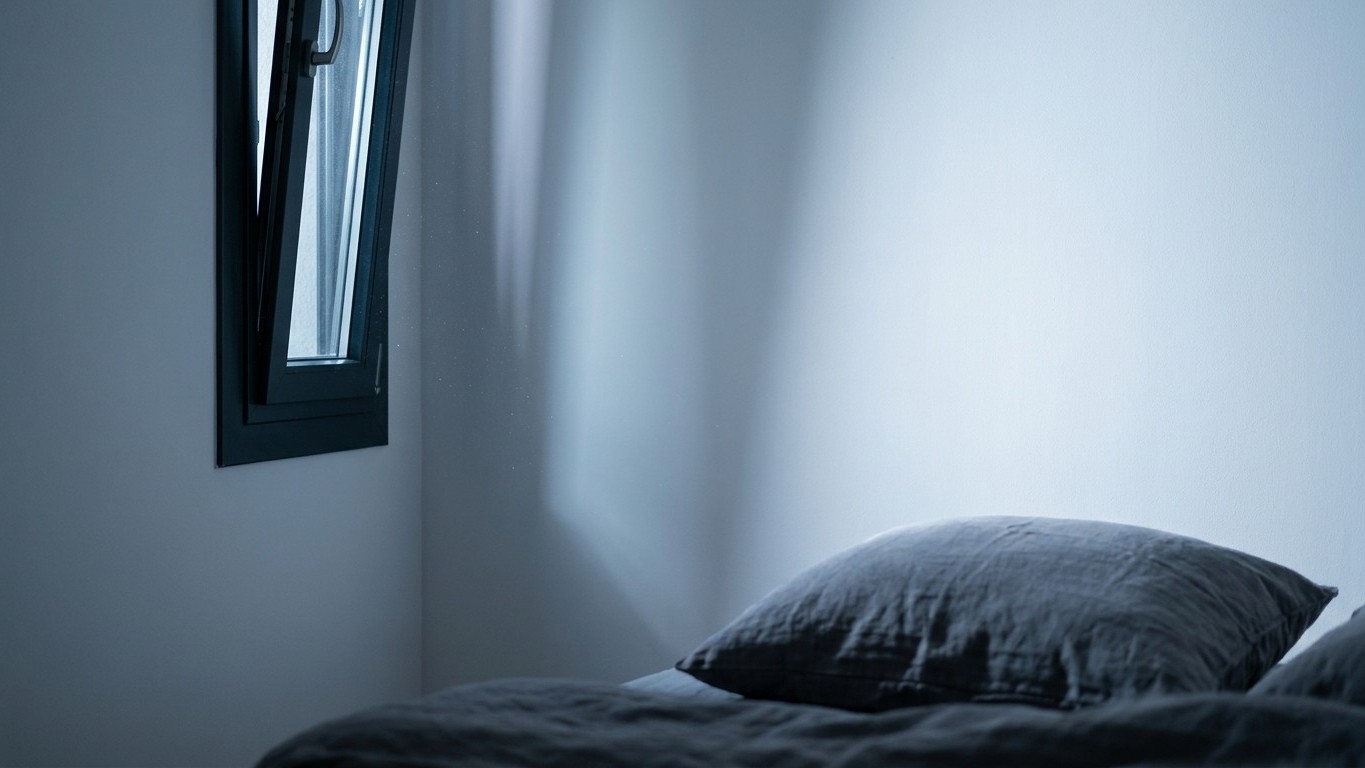
The summer ritual is almost religious: as soon as temperatures climb past bearable, the window swings open. A screen, a thin curtain doing nothing against the night, and the unspoken faith that outdoor air is simply better than what’s been stewing in a closed room all day. For 25 summers, that felt true. It still might be. But tracking what actually crosses that threshold by 3 a.m. on a hot July night complicated things considerably.
Key takeaways
- Pollen doesn’t stop at sunset—it peaks during the hours you have your window open
- At 3 a.m., temperature inversions trap pollution at ground level, contradicting the ‘clean night air’ myth
- Closed windows solve pollution but create a CO₂ problem that measurably disrupts sleep quality
What the night air actually carries in
The first surprise is the pollen. Most people assume pollen is a daytime problem, sunshine, warmth, bees. The common advice says stay inside during the day and take your walks in the evening. The nighttime is widely considered a time of low allergy risk, a belief often reflected in media guidance recommending outdoor activities be saved for the evening hours. But there is evidence to suggest that elevated concentrations of airborne pollen occur well into the night. Grass, tree, and ragweed pollens thrive during warm days and cool nights, and a little wind on a brisk summer evening can send a surge of pollen spores spreading through a house. Open that window at 10 p.m. thinking you’re in the clear, and you’re essentially inviting whatever the afternoon stored up into your bedding.
Many people wake up with symptoms and assume morning air is the worst. What they may be feeling is pollen that settled on surfaces overnight, bedding, carpets, skin, and becomes airborne again when they stir. The culprit isn’t the 6 a.m. air. It’s what floated in at midnight and landed on the pillow.
Then there’s the pollution question, and here’s where the open window complicates things in a way that feels counterintuitive. At night, cool air gets trapped near the ground by warmer air above, creating a lid that traps pollutants. This natural phenomenon means outdoor pollution often peaks during sleeping hours, directly contradicting the common belief that nighttime air is cleaner. The mechanism has a name: temperature inversion. A temperature inversion occurs when a layer of warm air forms above a layer of cooler air, preventing the natural dispersal of pollutants, acting like an invisible lid, keeping pollution at ground level. By 3 a.m. on a still, clear summer night, the air drifting through a ground-floor or second-story window in a suburban neighborhood can carry a quiet cocktail of particulate matter and traffic emissions that had nowhere to go.
In an analysis of 3,110 sites across the world, researchers concluded that particulate matter concentrations are higher both in the morning and at nighttime, peaking between 7:00 to 10:00 AM and 9:00 to 11:00 PM local time. Three in the morning sits neatly in a window of concentrated accumulation.
The closed-window problem is just as real
Here’s the thing nobody wants to hear: shutting the window doesn’t solve it. It just trades one set of invisible problems for another.
Outdoor air sits around 420 ppm of CO₂. A closed bedroom with two adults sleeping can reach 2,000 to 3,000 ppm by morning, not an emergency, but well above the threshold where cognitive function and sleep quality degrade. As the night progresses, CO₂ concentration increases, particularly between 3 a.m. and 4 a.m., and waking up at the same time every night can often be linked to elevated CO₂ levels, as the body responds with increased heart rate and breathing. That mysterious 3 a.m. wake-up that millions of people chalk up to anxiety or stress? It may partly be a ventilation problem.
An overview and analysis of 17 recently published studies found that in most cases, when CO₂ generated by sleeping subjects increased, indicating reduced ventilation, sleep quality was measurably disturbed. Sleep quality was measured by the percentage of deep sleep, sleep efficiency, and sleep onset latency. Research published in Indoor Air confirmed that when bedroom CO₂ levels were lower, participants reported better sleep quality, improved next-day concentration, and stronger cognitive performance.
And then there’s what the mattress is quietly contributing. Because humans spend about one-third of their time asleep in their bedrooms, and are themselves emission sources of volatile organic compounds, characterizing bedroom air composition during sleep matters, and real-time indoor and outdoor measurements have been used to examine VOC concentration enhancements during sleeping hours. Results indicate high emissions of nearly 100 VOCs and other species in the bedroom during sleeping periods, compared to levels in other rooms of the same residence. Body heat, movement, and the warming of synthetic foam materials all contribute. According to research, movement and body heat during sleep cause mattresses, bedding, and pillows to emit air pollutants — and the longer you’re in close contact with these materials, the more volatile organic compounds you’re exposed to.
The honest calculation: open or closed?
Sleeping with windows open can provide benefits by increasing ventilation with outdoor air and reducing CO₂ concentrations, improving air quality and some parameters of sleep quality, but it may also result in discomfort if there are episodic loud noise events or elevated outdoor pollutants. That’s the honest version. No universal winner.
For people in areas with clean outdoor air, minimal allergens, and low noise, open windows may improve sleep quality and overall health. But for urban residents, allergy sufferers, or those in high-density areas, the long-term risks can outweigh the benefits. Location is the variable no sleep study can standardize away.
The smarter move, backed by researchers and sleep physicians, is a hybrid approach. Opening a window for 20 to 30 minutes before bed lets fresh outdoor air dilute the buildup of CO₂ and other indoor pollutants, then closing it before sleep begins. Cracking a window just one to two inches remains the single most effective, free intervention: even a small gap dramatically increases air exchange rate, and a 2021 study found that cracking a bedroom window reduced CO₂ from 2,400 ppm to under 1,000 ppm by 3 a.m. in a typical bedroom.
Natural airflow also cools the bedroom, which is relevant to melatonin release and circadian rhythm balance, cooler temperatures around 60 to 67°F align with optimal sleep environments, making some open-window exposure genuinely helpful in summer months. The goal, then, isn’t to seal yourself in or throw Everything open, but to time the ventilation strategically.
What the tracking exercise ultimately revealed isn’t a reason to abandon the open window, it’s a reason to stop treating it as a passive, thoughtless habit. The air moving through that gap is not neutral. It carries the day’s residue, the neighborhood’s exhaust, the grasses releasing pollen in the evening warmth. Pairing a 30-minute pre-sleep airing with a HEPA air purifier running quietly through the night turns out to be a more sophisticated answer than either “open” or “closed” alone. A well-ventilated room should ideally maintain CO₂ levels below 1,000 ppm — levels above this threshold have been linked to poor sleep quality, headaches, and grogginess upon waking. That number, invisible and odorless, turns out to matter far more than whether the curtain is moving.
Sources : sciencedirect.com | sciencedirect.com