
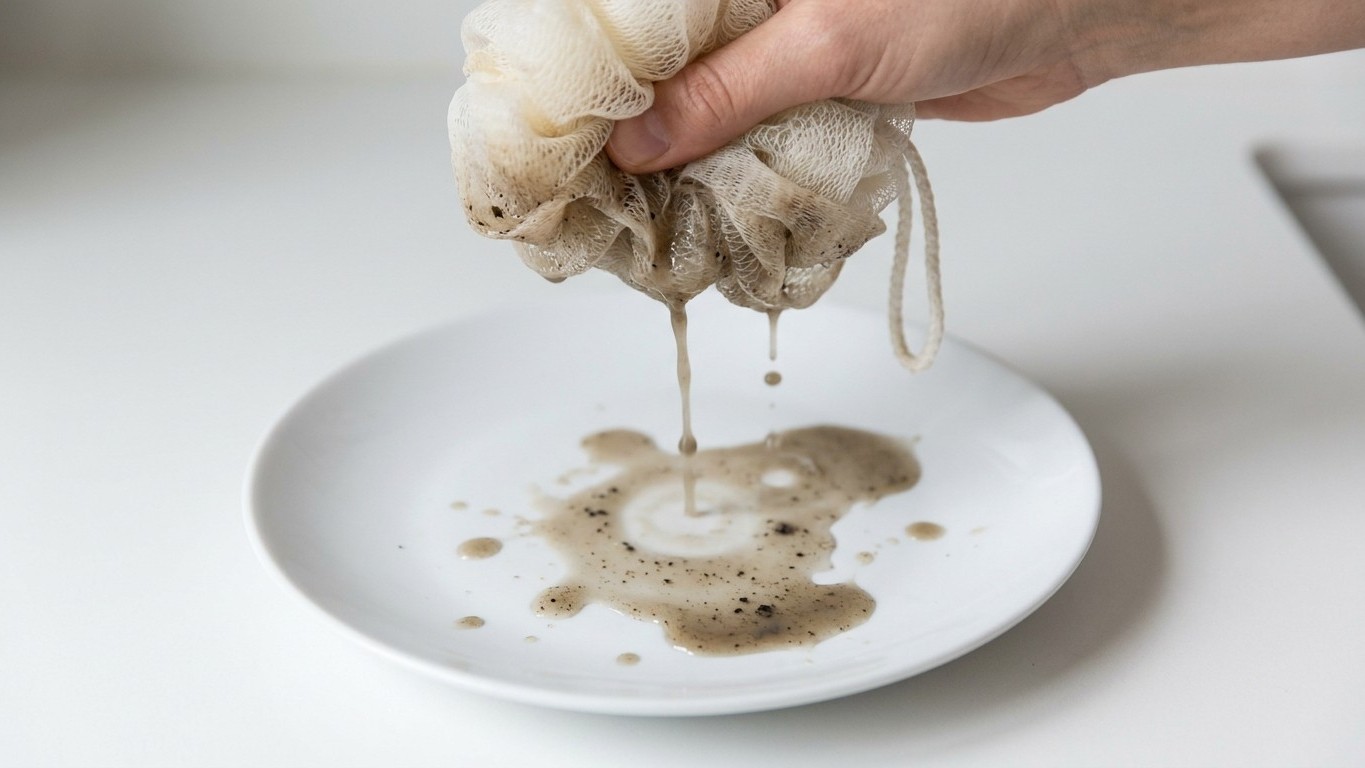
A nurse hands you a white plate. She asks you to squeeze your shower loofah over it. What comes out is not clean water. It’s a murky, brownish trickle of soap scum, dead skin residue, and, almost certainly, a microbial community you never agreed to scrub into your body every morning. That single visual, that plate, is the gut-punch that finally makes the loofah’s dirty secret undeniable. The problem isn’t rare or exotic. It’s hanging in almost every American shower, slowly festering between uses.
Key takeaways
- A simple white plate test exposes the hidden filth living inside your ‘clean’ loofah
- Bacteria like Staphylococcus and Pseudomonas multiply overnight in the warm, damp mesh—forming biofilms that won’t rinse away
- Most people keep the same loofah for months, unknowingly scrubbing dangerous pathogens into their skin daily
Your Loofah Is Not Cleaning You. It’s Re-Contaminating You.
The counterintuitive truth here is stark: the tool you rely on to get clean is likely the dirtiest object in your bathroom. Dermatologists and microbiologists have given it a blunt nickname, a “bacteria hotel.” The tool you use to get clean is likely the dirtiest thing in your bathroom, because its design and material make it virtually impossible to fully clean, trapping dead skin and moisture in a cycle that breeds bacteria faster than you can rinse it away.
The mechanics of why are worth understanding. By their nature, loofah sponges have lots of nooks and crannies, and they’re very porous. When you use one to scrub off dead skin cells, those cells become lodged in those nooks and crannies, and that sets the stage for a bacterial playground, says dermatologist Melissa Piliang, MD, of the Cleveland Clinic. Now add the shower environment itself: warm, perpetually humid, rarely with strong airflow. Showers stay steamy, especially in small bathrooms. A loofah often hangs from the faucet or a hook and stays damp for hours. That wet mesh traps moisture deep inside, where air flow is low. Many bacteria grow fast under those conditions, so each day adds a little more buildup if the sponge never gets a full dry spell.
A study published in the Journal of Clinical Microbiology in 1994 reported that “bacterial overgrowth of loofah sponges and other bath tools takes place overnight.” Overnight. Not over weeks, overnight. That’s the timeline no one mentions when they grab a new pouf off the drugstore peg.
The Specific Bacteria You’re Rubbing On Your Skin
When labs swab used loofahs, they usually find a mixed crowd of microbes. Doctors at the Cleveland Clinic describe traditional loofahs as breeding grounds for bacteria such as E. coli, Pseudomonas, Staphylococcus, and Streptococcus, as well as yeast and mold. These aren’t theoretical pathogens. Contaminated loofahs have even been linked to cases of Pseudomonas folliculitis, a skin infection caused by Pseudomonas aeruginosa that is usually associated with public hot tubs, pools, or spas. Getting the same infection from your own shower is a different kind of bad news.
The staph angle is especially worrying. According to Cleveland Clinic infectious disease specialist Dr. Donald Dumford, “Staph infections are among the most concerning issues when it comes to loofahs. If staph bacteria on your skin transfer to the loofah, they can form what we call a biofilm, or a mucous-like layer that allows the bacteria to persist and multiply.” A biofilm, by the way, is precisely what makes contamination so hard to rinse out. It clings. It protects the bacterial colony underneath it. And your fingers, squeezing the pouf under the showerhead for ten seconds each morning, are not reaching it.
There’s also a fungal dimension most people skip. In addition to bacteria, fungi love the moist and wet environment of loofahs. Mold is one type of fungi that can grow in them. It’s common for people to have allergic reactions when their skin comes in contact with mold spores, redness and itchiness are frequent symptoms. If you’ve ever stepped out of the shower feeling vaguely itchy without a clear reason, your loofah deserves a long, suspicious look.
The plastic mesh design, which most people assume is somehow cleaner or more hygienic than a natural loofah, doesn’t actually help much. The mesh construction creates numerous crevices where bacteria accumulate in ways that resist cleaning. The tight knots and layered construction of mesh poufs trap debris deep within their structure, and standard cleaning methods may sanitize outer surfaces while leaving interior contamination untouched. So the thing looks clean. It is not clean.
How Long Have You Been Using That Thing?
Most people keep a plastic loofah for months. Some keep the same one for a year, replacing it only when it physically disintegrates. This is the hygiene equivalent of using the same kitchen sponge to wash your dishes and your face simultaneously, for a season.
Cleveland Clinic’s Dr. Piliang is direct about replacement timelines: “If you have a natural loofah, you should replace it every three to four weeks. If you have one of the plastic ones, those can last for two months.” Two months, maximum, with proper care. And if you notice any mold growing on your loofah, you should throw it away immediately. Or if it develops a mildewy or musty odor, that’s a sign you should get rid of it.
The white plate test that a nurse might ask you to do is really just a visual way of confronting what’s already happening invisibly. Just because a loofah looks clean doesn’t mean it is. Many bacteria can’t be seen with the eye, so regular cleaning and replacing is key. The squeezed-out residue is only the visible fraction. What remains embedded in the mesh layers never leaves without a structured cleaning protocol, or a trash can.
There’s also the shaving risk, which doesn’t get nearly enough attention. A study published in the Journal of Clinical Microbiology found that bacteria grow exponentially on loofahs overnight. If you use that pouf on freshly shaved skin or a minor nick, you are scrubbing that bacteria directly into an open wound. Legs shaved the night before. A tiny razor nick near the ankle. A loofah teeming with Staphylococcus. The math is unpleasant.
What to Do If You’re Not Ready to Let Go
Frankly, the most hygienic option is to retire the loofah entirely and use your hands or a washcloth. Dermatologist Piliang notes that washcloths are a good alternative, their physical structure makes them less susceptible to anything lodging in them, easier to clean and dry, and you probably tend to wash them in the laundry and replace them more often than you would with a traditional loofah. Silicone scrubbers are the other option gaining ground: according to Cleveland Clinic’s Dr. Dumford, silicone body scrubbers and washcloths can be easier to keep clean than loofahs.
If you’re keeping the loofah, the protocol needs to be tight. After every single use: rinse thoroughly under hot water, squeeze repeatedly until the water runs clear, then hang it outside the shower, not on the showerhead, not in the corner caddy, somewhere with actual airflow. No matter which loofah you’re using, you should clean it at least once a week. To do so, soak it in a diluted bleach solution for five minutes and then rinse thoroughly. Alternatively, a hydrogen peroxide bath, equal parts hydrogen peroxide and water, ten minutes, will disinfect and deodorize.
Avoid using a loofah for a few days after shaving your legs, to prevent bacteria from entering your skin through any cut or nick. Never use it on the face or genital area, as these areas are quite sensitive. And set a hard replacement date. Write it on the calendar when you open a new one. Don’t wait for visible mold, by the time you can see it, the invisible contamination has already been doing its work for weeks.
One more thing worth knowing: every time you use a synthetic plastic loofah, you’re interacting with plastic in a very intimate way. Microplastics are released during use, washed down the drain, and ultimately end up in rivers and oceans, particles virtually impossible to remove from the environment. So that months-old pouf isn’t just a personal hygiene issue. It’s shedding tiny plastic fibers into the water supply with every scrub. The white plate test, it turns out, only shows you half the story.