
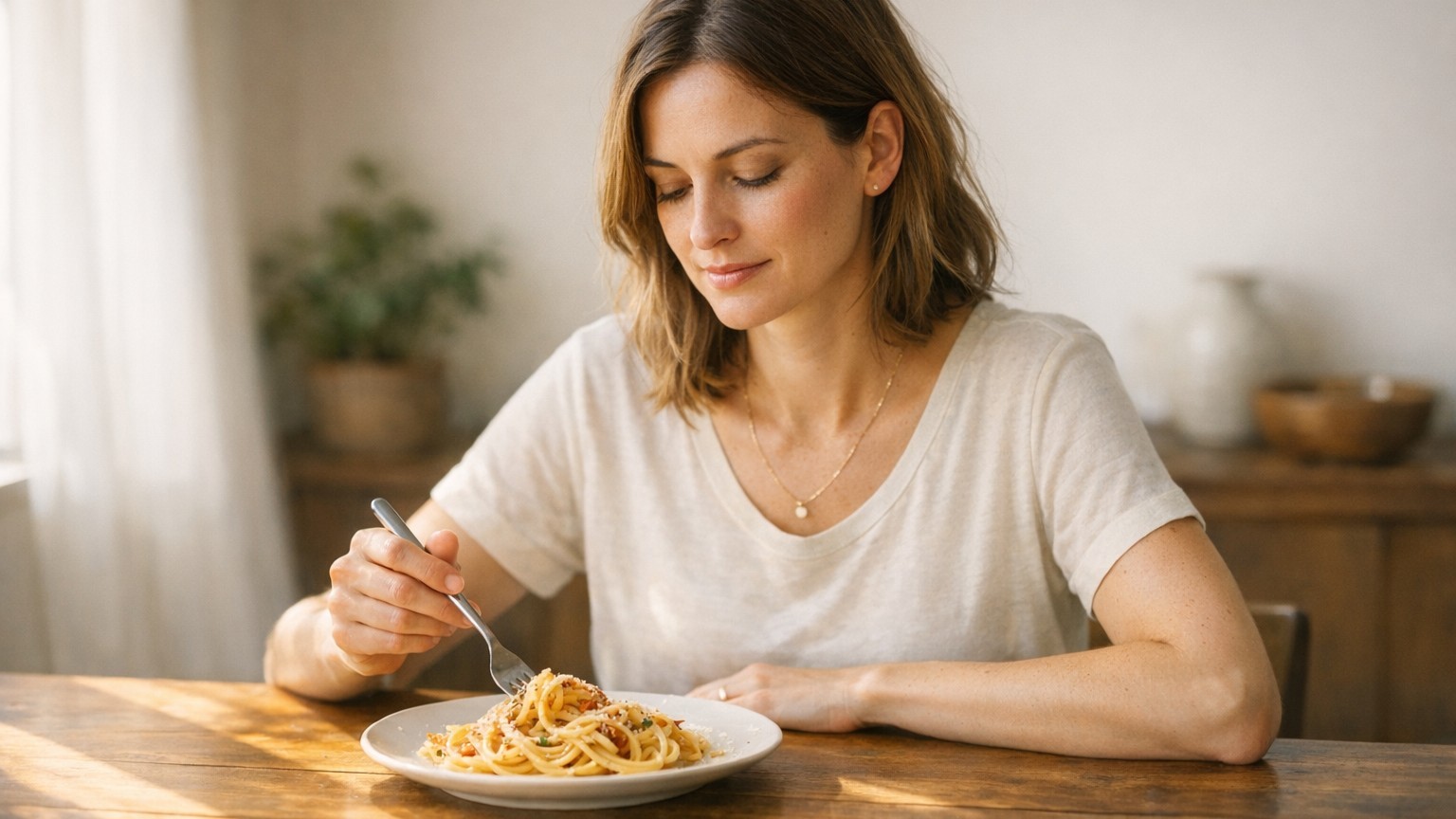
The kitchen counter at 7 p.m. Half a plate of pasta, eaten in four minutes flat, phone scrolling in the other hand. Sound familiar? For years, millions of American women have eaten dinner standing up, a habit born of efficiency, normalized by the chaos of modern schedules. The premise feels logical: why sit down when you’re just going to get back up? The answer, it turns out, lives deep in your gut — and in the specific chain of biological events your body triggers the moment you take a seat.
Key takeaways
- Standing while eating causes blood to pool in your legs, reducing blood flow to your gut and disrupting the entire digestive process
- Your brain needs 20 minutes to register fullness—but standing meals are often finished in minutes, triggering hunger again within the hour
- Sitting down activates your parasympathetic nervous system, the ‘rest and digest’ mode that standing meals actively suppress
What Your Body Is Actually Doing When You Eat Standing
From a physiological standpoint, standing while eating causes blood to “pool” in your legs due to gravity, leading to decreased blood flow to your gut, which is essential for digestion. That’s not a minor inconvenience. Your gut needs that blood to process food efficiently, and when it doesn’t get enough of it, the digestion process may get interrupted, and you may experience some gas and indigestion.
Eating while standing significantly impacts digestion in that it empties the stomach much faster, prompting food to move to the intestine before it is broken into smaller particles. Speed, in this case, is not your friend. Faster digestion can be problematic because it allows less time for nutrients to come into contact with the gut wall, making it more difficult for your body to absorb them. A real consequence, not a theoretical one.
There’s also a gas problem nobody talks about at dinner parties. You eat faster when you eat standing up, and the faster you eat, the more likely you are to swallow air, leading to extra gas in your stomach. Research on carbohydrate digestion found that an upright posture led to more undigested carbohydrates reaching the large intestine compared to a reclined position, meaning some of what you eat may not get fully absorbed in the small intestine, where most nutrient uptake happens. The undigested carbohydrates end up being fermented by gut bacteria, which can produce gas. That bloated, unsettled feeling after a rushed dinner? A direct consequence.
The Satiety Trap, and Why Standing Makes You Hungrier
Here’s the piece that genuinely changes behavior: people who eat standing tend to eat faster, which gives the brain less time to register fullness. It takes roughly 20 minutes for satiety hormones to peak after you start eating, and rushed standing meals often wrap up well before that window closes. You finish the plate, feel fine, and forty-five minutes later you’re rummaging through the pantry for something sweet. That’s not a willpower failure. That’s biology catching up.
Sitting down naturally slows the pace of a meal. You’re more likely to chew thoroughly and take pauses between bites, allowing satiety hormones like leptin to kick in and tell you you’re full before you’ve overeaten. “Rapid eating can override the satiety hormones such as cholecystokinin (CCK) and peptide YY, leading to overeating and bloating.” Two hormones most people have never heard of, quietly running the show.
Eating standing up can also lead to weight gain because you may feel hungry sooner after standing to eat. The cruel irony of the time-saving meal: it costs you more calories later in the evening. Sitting down to eat allows you to take time to enjoy your food and eat more slowly. Food stays in your stomach longer, helping you feel full after finishing your meal.
The Nervous System Angle Nobody Mentions
There’s a layer to this that goes beyond mechanics. Eating while seated and unrushed allows the parasympathetic nervous system to shift into its “rest and digest” mode, improving gastric motility, nutrient breakdown, and the perception of hunger and fullness cues. The opposite state, sympathetic arousal, the stress response, actively works against digestion. Eating at your desk or while doing something else likely raises cortisol, your stress hormone. Cortisol suppresses your production of saliva, enzymes, and stomach acid, so large pieces of undigested food can sit in your stomach and ferment, contributing to acid reflux, bloating, and gas.
Designating mealtimes as a seated pause forces a break in your day. This act of stopping is a form of mindfulness that can lower cortisol levels. A quiet, grounding act dressed up as a simple dinner. The counter-intuitive truth here is that sitting down isn’t passive, it’s actively protective.
A study found that participants who maintained an upright but relaxed posture experienced more efficient digestion and fewer digestive discomforts compared to those who slouched. Note: upright and seated, not upright and standing. The distinction matters.
The One Honest Asterisk
To be fair, standing doesn’t have zero value at mealtime, the picture is more nuanced than a simple verdict. Standing while eating seems to be helpful in patients experiencing symptoms of heartburn or reflux. There is increased pressure in the stomach in these patients, responsible for some discomforting symptoms, and standing while eating may help reduce this pressure. So if acid reflux is your primary issue, the calculus shifts.
A study on intermittent standing found that people who stood during and after meals had a 27% lower overall blood sugar response compared to those who sat. The effect was strongest after breakfast, where standing reduced the post-meal glucose spike by 33 to 40%. A number worth knowing, especially for anyone managing blood sugar. But in everyday eating, nutrient absorption itself occurs later in the digestive tract and isn’t meaningfully altered by whether someone is standing or sitting, the real difference, experts consistently argue, lies in behavior, not posture alone.
Where posture may have its most indirect effect is through eating behavior. Standing meals are often eaten more quickly and with less awareness, which can make it harder to notice hunger and fullness cues. Over time, this may influence portion control for some people. The posture isn’t the villain. The rush is.
What research from 2025 adds to this conversation is telling: a cross-sectional study found that individuals with higher mindful eating scores demonstrated better adherence to national dietary guidelines, stronger Mediterranean diet scores, and significantly lower consumption of ultra-processed foods. Sitting down, it seems, is a gateway behavior, one small ritual that anchors an entire relationship with food. The table, in the end, might be the most underrated piece of wellness equipment in your home.
Sources : droracle.ai | journals.physiology.org