
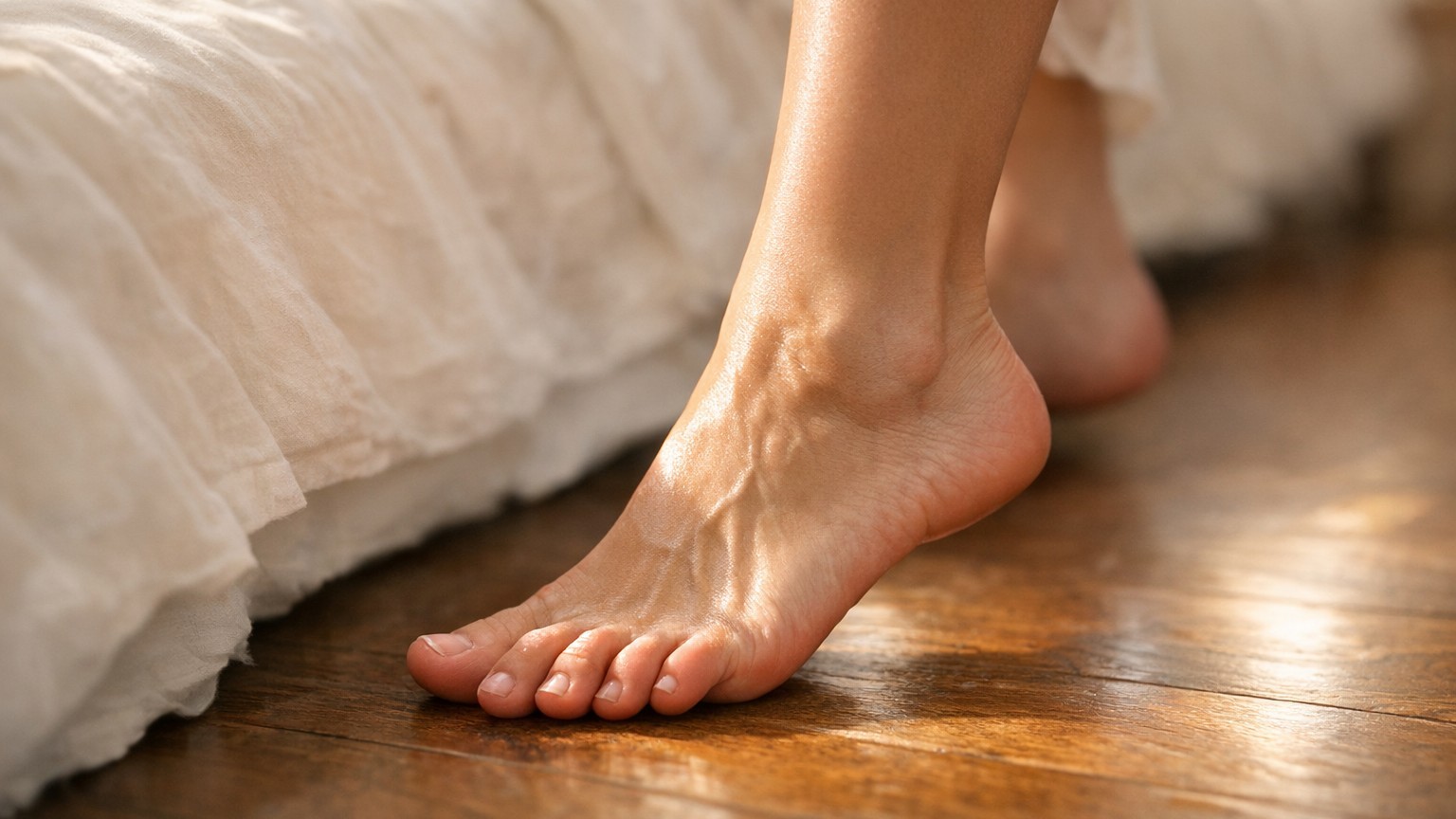
That first step out of bed. The one where your heel hits the floor and sends a sharp, stabbing jolt up your leg before you’ve even had coffee. If this has been your summer ritual, you are far from alone, and the culprit is almost certainly the flat piece of foam you’ve been sliding your feet into every single morning since Memorial Day.
The U.S. flip-flop market was worth an estimated $4.71 billion in 2025, and the shoe that made it there is practically unchanged from its beachside origins. Flip-flops have been around since ancient Egypt, but not much has changed about their structure. Most are made from inexpensive materials that wear down easily, and their flat, flimsy soles provide almost no arch support. The convenience is real. The damage, though, accumulates quietly, until one morning your body refuses to let you ignore it.
Key takeaways
- One specific moment during your morning routine is when plantar fasciitis pain hits hardest—and it has nothing to do with how much you walk
- Flip-flops trigger a three-part biomechanical trap that affects not just your heels, but your ankles, knees, and posture
- A simple pre-bed routine can prevent 90% of heel pain recovery within months—but one common footwear mistake will undo all progress
What’s Actually Happening Under Your Foot
Connecting the heel bone to the toes, the plantar fascia ligament helps you balance your foot as you walk, taking a lot of stress in the process. When it becomes painful and inflamed, the heel condition known as plantar fasciitis may be present. That sharp morning pain isn’t random bad luck. It’s biomechanics catching up with poor footwear choices.
Here’s the counter-intuitive part: the pain is actually worst the moment you stand up, not after a long walk. Plantar fasciitis most commonly occurs with the first few steps in the morning or after sitting for a long time. Morning pain is from the sudden tension of the plantar fascia as it gets stretched after shortening overnight. So your feet were quietly tightening all night, and the floor demands they snap back to action instantly.
If stepping out of bed feels like being stabbed in the heel, you could be suffering from plantar fasciitis, a condition that accounts for about 80% to 85% of all heel pain. Which means most of that summer heel misery has a name, a cause, and, good news, a fix.
The Flip-Flop Trap: Three Reasons Your Feet Are Staging a Revolt
Flip-flops offer little to no arch support, heel cushioning, or shock absorption, making them one of the most common culprits behind foot pain, especially in the heel. But the structural failure goes deeper than just “no cushioning.” Three separate mechanisms work against you simultaneously.
First, the flatness. Without proper support, your feet are forced to strike the ground flat, instead of rolling from heel to toe. Over time, this unnatural motion can irritate the plantar fascia. Second, the gait shift. Flip-flops change your walking mechanics. To keep them on, many people unconsciously shorten their strides or grip with their toes, resulting in an unstable gait. This misalignment can extend stress up through the heels, knees, and even into the lower back. Third, the overuse cascade. The muscles in your feet and toes begin to work overtime to keep those flimsy flip-flops from falling off. Those overused foot muscles can eventually lead to painful plantar fasciitis.
“If you wear flip-flops every day, you are more vulnerable to getting plantar fasciitis because they are too flat. Any heel that is too high is not good for you either. Both can also make you vulnerable to an ankle sprain,” said Dr. Cameron Barr, an orthopedic surgeon at Scripps Clinic Torrey Pines. The scale of collateral damage surprises most people. In the United Kingdom, where a more socialized form of health care makes it easier to track these causes, the National Health Service estimates that $62 million is spent annually treating 200,000 flip-flop related injuries. Consider that the next time a $4 pair seems like a bargain.
The injury risk isn’t limited to the foot alone, either. “When your feet have to work hard to keep flip-flops on, you can set yourself up for overuse injuries,” said Dr. Austin Matthews of Banner Health. “Prolonged wear can also affect your gait and posture, which can lead to stress to the foot. Also, the ankle and rest of the body.” Long-term wearers can also develop toe deformities. The continual toe gripping can exacerbate hammertoe and other deformities where the toe curls downward at an unnatural angle and eventually becomes rigid in that position. Not exactly a trend worth chasing.
How to Actually Quiet That Morning Pain
Rest and ice help acutely, but they don’t solve the underlying tension. The most effective approach, according to orthopedic specialists, combines targeted stretching with a hard reset on your footwear habits.
Stretching can help prevent plantar fasciitis and is one of the most effective treatment approaches. When the calf muscles and the Achilles tendon are tight, they pull excessively on the heel with every step, increasing strain on the plantar fascia. Over time, this tension contributes to microtears and painful inflammation. The morning stretch sequence matters most. If you can’t stretch three times a day, at least make sure you stretch in the morning, the muscles tighten overnight and benefit from being worked on soon after you wake up.
A simple move to do before your feet even touch the floor: loop a towel or band around your toes and gently pull for 20 to 30 seconds. This mini routine warms up tight fascia and helps stave off that morning jolt of pain. For the fascia itself, a stretch that directly targets the inflamed tissue is most effective first thing in the morning or after long periods of rest: sit and cross one foot over the opposite knee, then gently pull your toes back toward your shin until you feel a stretch in the arch.
At night, consider a splint. The splint holds your foot at a 90-degree angle while you sleep, keeping the plantar fascia gently stretched. If sleeping with the splint feels uncomfortable, wearing it for a few hours while resting with your foot elevated can help. “It works for many people because your foot gets tight overnight and by holding the plantar fascia in a flexed position, you are essentially stretching it while you sleep.”
About 90 percent of people greatly improve within 2 to 3 months of initial treatment. The process isn’t glamorous, it’s consistent stretching, smarter shoes, and patience. But going back to daily flip-flop wear before full recovery is a mistake. Flip-flops, high heels, and flat shoes like ballet flats offer little to no support for your arches. Wearing unsupportive footwear places additional strain on your plantar fascia, delaying recovery.
Smarter Summer Footwear : Without Abandoning the Season
Giving up open-toed shoes entirely is not the prescription. The prescription is choosing better ones. “Aim to wear a supportive type of shoe about 80 percent of the time,” says Dr. Jessica Milliman, a podiatrist at University Hospitals. “The other 20 percent of the time, you can be in a more flexible type of shoe, if desired.” That ratio is the key, not abstinence, but proportion.
The best footwear for preventing heel pain is supportive, well-cushioned, and suited to your activity level, look for shoes with strong arch support, a slightly raised heel, firm heel counters, and plenty of shock absorption. For those days when only a sandal will do, look for styles that have the APMA (American Podiatric Medical Association) seal of approval and feature built-in arch support, a cushioned insole, and even a back strap for greater stability.
Many brands now offer sandal-style shoes with orthopedic features that still feel light and breezy but won’t sacrifice your foot health. The category has expanded enough that “supportive sandal” no longer means clunky orthopedic footwear in beige foam. The aesthetic has caught up with the science. And if custom orthotics are on the table, orthotic insoles can provide significant relief, they are designed to fit your unique arch shape and offer customized support to reduce strain.
One final detail worth knowing: flip-flops “are really meant to be a ‘sometimes’ shoe that you wear to protect your feet from touching the ground, not something you wear all day long,” says podiatrist Ernesto Hernandez of Sharp Rees-Stealy Medical Group. They do serve a real purpose, flip-flops play a stellar role in preventing fungal, bacterial, and viral foot infections such as athlete’s foot, toenail fungus, and warts in places like pool decks and gym locker rooms. That’s their zone of genius. The problem is we promoted them to a full-time role they were never designed to fill — and our heels, in their very first morning steps, are the ones paying for it.
Sources : orthoinfo.aaos.org | scripps.org